aımnova
DashboardMy LearningCrash CoursesStudy Plan

Aimnova site navigation

Stay in the loop

Get the latest study resources and updates

New features, study tips and exam insights — straight to your inbox.

IB Diploma

  • IB Past Papers
  • IB Study Notes
  • IB Question Bank
  • IB Mock Exams
  • IB Revision

IB Subjects

  • IB Math AA
  • IB Math AI
  • IB Economics
  • IB Business Management
  • IB Physics
  • IB Biology
  • View all IB subjects→

IB Past Papers

  • IB Math AA HL Past Papers
  • IB Math AA SL Past Papers
  • IB Math AI HL Past Papers
  • IB Math AI SL Past Papers
  • IB Economics HL Past Papers
  • IB Economics SL Past Papers
  • IB ESS Past Papers
  • View all past papers→

Study Resources

  • Study Notes
  • Question Bank
  • Mock Exams
  • Crash Courses
  • Flashcards
  • Revision Guide
  • Exam Skills
  • Command Terms
  • Grade Calculator
  • Exam Timetable 2026

Aimnova

  • Features
  • Pricing
  • For Teachers
  • For Schools
  • For Parents
  • About Us
  • Blog
  • Contact
aımnova

IB study, practice and feedback built around the real exam.

TermsPrivacyCookies·© 2026 Aimnova. All rights reserved.06bfe1b

Aimnova is not affiliated with or endorsed by the International Baccalaureate Organization (IB).

NotesBiologyTopic 2.7Adaptations of arteries for the transport of blood away from the heart
Back to Biology Topics
2.7.33 min read

Adaptations of arteries for the transport of blood away from the heart

IB Biology · Unit 2

Your first topic is free to keep

Know exactly what to write for full marks

Practice with exam questions and get AI feedback that shows you the perfect answer — what examiners want to see.

Start Free

Contents

  1. 1Walls that withstand and keep up high pressure
  2. 2Why artery pressure swings less than the heart's
  3. 3Exam-style question (step by step)
The big idea: Arteries carry blood away from the heart at high pressure. Muscle and elastic tissue in the wall let it withstand that pressure and keep it high between beats.

The points to remember

  • A thick wall withstands the high pressure; collagen in the outer layer stops it bursting.
  • Elastic fibres stretch with each surge, then recoil, pushing blood on: pressure stays high and flow is smoother.
  • Smooth muscle withstands the pressure and can narrow or widen the artery to control blood flow.
  • A narrow lumen keeps the pressure high; a smooth endothelium cuts friction.
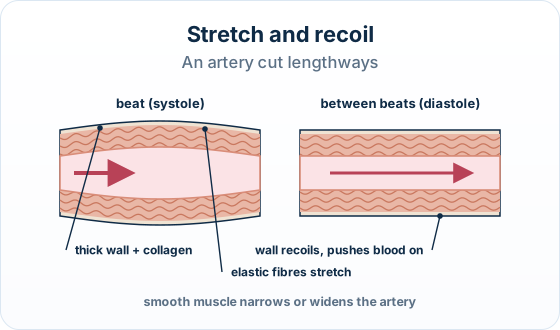
An artery cut lengthways, drawn twice: during a beat the wall bulges as elastic fibres stretch; between beats the wall recoils and pushes the blood onwards
Stretch during the beat, recoil between beats.
Remember it as: Stretch with the beat, recoil between beats.

Real example: the aorta. The aorta takes the full surge from the left ventricle. Its wall is rich in elastic fibres, so blood keeps flowing to the body between beats instead of stopping.

Free preview

This is the free notes preview

You're reading the free notes. Aimnova Pro unlocks the full study experience — and you can try it with your first topic free to keep:

  • FlashcardsLock in vocabulary and key terms with spaced repetition.
  • Practice questionsAnswer exam-style questions and get instant AI marking.
  • Mock exams & past-paper vaultSit full mocks and see exactly how examiners award marks.
  • Personalised study planA daily plan built around your exam date and weak areas.
Start Studying Free Full access to Aimnova Pro · cancel anytime
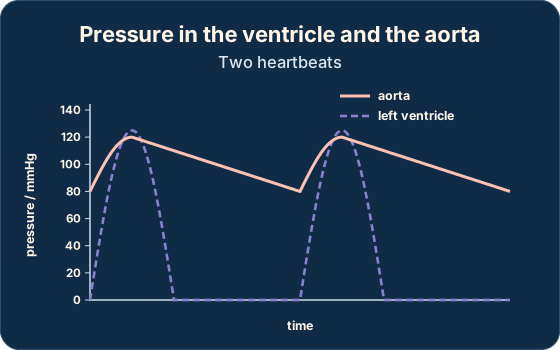
Reading the pressures: In the left ventricle pressure swings from about 0 to 125 mmHg. In the aorta it only swings between about 80 and 120 mmHg.
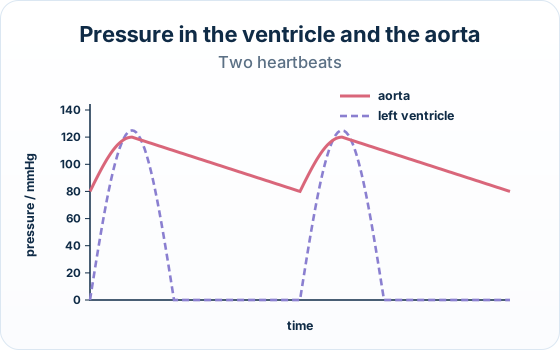
A graph of pressure against time over two heartbeats: the left ventricle swings from 0 to 125 mmHg, while the aorta stays between 80 and 120 mmHgA graph of pressure against time over two heartbeats: the left ventricle swings from 0 to 125 mmHg, while the aorta stays between 80 and 120 mmHg
The ventricle's pressure falls to zero between beats; the aorta's never does.

The points to remember

  • During a beat the aorta's elastic wall stretches, so the peak pressure rises a little less.
  • Between beats the wall recoils, so the pressure falls only to about 80 mmHg, not to 0.
  • This recoil keeps blood moving all the time, not just in spurts.
Trap: The smaller swing is not caused by valves or by a thin wall. It is the stretch and recoil of the elastic wall.

Never wonder what to study next

Get a personalized daily plan based on your exam date, progress, and weak areas. We'll tell you exactly what to review each day.

Try Free Study PlanYour first topic is free to keep • No credit card required
How it is asked: Expect a pressure table or graph for the ventricle and the aorta, or 'outline two adaptations of arteries'. Always give the structure and what it does.
IB-style questionExplain[2 marks]

The pressure in the left ventricle falls to 0 mmHg between beats, but the pressure in the aorta only falls to 80 mmHg. Explain this difference.

Model answer plan

See the answer broken into clear points, with guidance on how each point earns marks.

Claim your free topic

Try an IB Exam Question — Free AI Feedback

Test yourself on Adaptations of arteries for the transport of blood away from the heart. Write your answer and get instant AI feedback — just like a real IB examiner.

The femoral artery carries blood from the aorta to the muscles of the leg.

two adaptations of arteries for the transport of blood.
[2 marks]

Related Biology Topics

Continue learning with these related topics from the same unit:

2.1.1Chemical properties of carbon that allow diverse compounds2.1.2Production of macromolecules by condensation reactions2.1.3Digestion of polymers into monomers by hydrolysis reactions2.1.4Form and function of monosaccharides
View all Biology topics
Improve your exam techniqueCommand terms, paper structure, and mark-scheme tips for Biology
Previous2.7.2Structure of arteries and veinsNextMeasurement of pulse rates2.7.4

6 exam-style questions ready for you

Students who practice on Aimnova improve their scores by 15% on average. Get instant feedback that shows exactly how to improve your answers.

Practice Now — FreeView All Biology Topics