aımnova
DashboardMy LearningCrash CoursesStudy Plan

Aimnova site navigation

Stay in the loop

Get the latest study resources and updates

New features, study tips and exam insights — straight to your inbox.

IB Diploma

  • IB Past Papers
  • IB Study Notes
  • IB Question Bank
  • IB Mock Exams
  • IB Revision

IB Subjects

  • IB Math AA
  • IB Math AI
  • IB Economics
  • IB Business Management
  • IB Physics
  • IB Biology
  • View all IB subjects→

IB Past Papers

  • IB Math AA HL Past Papers
  • IB Math AA SL Past Papers
  • IB Math AI HL Past Papers
  • IB Math AI SL Past Papers
  • IB Economics HL Past Papers
  • IB Economics SL Past Papers
  • IB ESS Past Papers
  • View all past papers→

Study Resources

  • Study Notes
  • Question Bank
  • Mock Exams
  • Crash Courses
  • Flashcards
  • Revision Guide
  • Exam Skills
  • Command Terms
  • Grade Calculator
  • Exam Timetable 2026

Aimnova

  • Features
  • Pricing
  • For Teachers
  • For Schools
  • For Parents
  • About Us
  • Blog
  • Contact
aımnova

IB study, practice and feedback built around the real exam.

TermsPrivacyCookies·© 2026 Aimnova. All rights reserved.c90f7ab

Aimnova is not affiliated with or endorsed by the International Baccalaureate Organization (IB).

NotesBiologyTopic 2.6Transpiration as a consequence of gas exchange in a leaf
Back to Biology Topics
2.6.94 min read

Transpiration as a consequence of gas exchange in a leaf

IB Biology · Unit 2

Exam preparation

Practice the questions examiners actually ask

Our question bank mirrors real IB exam papers. Practice under timed conditions and track your progress across topics.

Start Practicing

Contents

  1. 1Why leaves lose water
  2. 2What changes the rate of transpiration
  3. 3Exam-style question (step by step)
The big idea: Transpiration is the loss of water vapour from a plant's leaves. It happens because the stomata must be open for gas exchange.

The points to remember

  • Stomata open so carbon dioxide can diffuse in for photosynthesis.
  • The walls of the mesophyll cells are moist; water evaporates from them into the air spaces.
  • The air spaces fill with water vapour, so it diffuses out through the open stomata to drier air.
  • Water lost is replaced by water brought in the xylem.
  • Transpiration is the cost of gas exchange: a leaf cannot take in carbon dioxide without losing water.
Remember it as: Open for carbon dioxide, so open for water too.
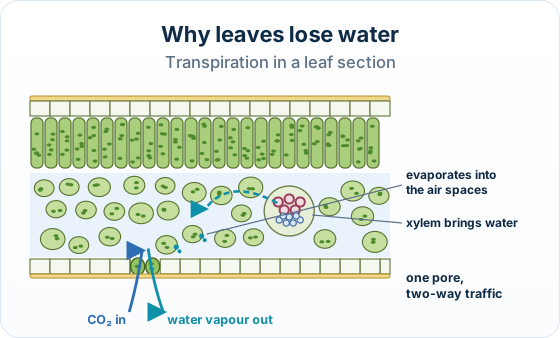
A leaf section: carbon dioxide diffuses in through an open stoma, xylem brings water, water evaporates from the spongy mesophyll walls into the air spaces and water vapour diffuses out through the same stoma
One open pore: carbon dioxide in, water vapour out.
Two traps: Transpiration is evaporation then diffusion of water vapour, not liquid water dripping out.

It is not a process the plant chooses for its own sake: it is a side effect of open stomata.

Free preview

This is the free notes preview

You're reading the free notes. Aimnova Pro unlocks the full study experience — and you can try it with your first topic free to keep:

  • FlashcardsLock in vocabulary and key terms with spaced repetition.
  • Practice questionsAnswer exam-style questions and get instant AI marking.
  • Mock exams & past-paper vaultSit full mocks and see exactly how examiners award marks.
  • Personalised study planA daily plan built around your exam date and weak areas.
Start Studying Free Full access to Aimnova Pro · cancel anytime
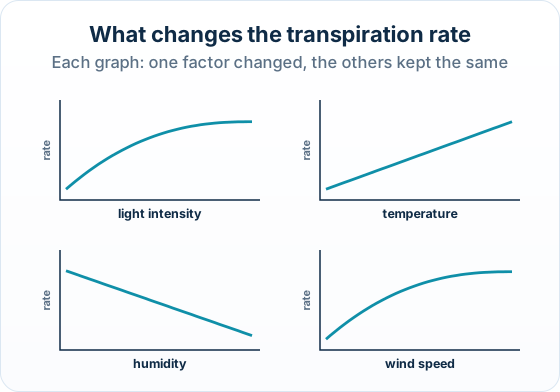
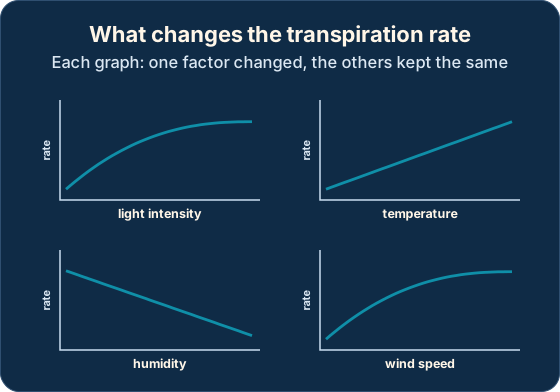
The big idea: Anything that opens the stomata wider, speeds evaporation or makes the air outside drier increases the rate of transpiration.
FactorEffect on the rateWhy
Light intensity upIncreasesStomata open wider in the light
Temperature upIncreasesFaster evaporation and diffusion
Humidity upDecreasesLess difference in water vapour inside and outside
Wind speed upIncreasesHumid air by the stomata is blown away
Dry soilDecreasesThe plant closes its stomata
Four small graphs of transpiration rate: it rises then levels off with light intensity, rises with temperature, falls with humidity, and rises then levels off with wind speedFour small graphs of transpiration rate: it rises then levels off with light intensity, rises with temperature, falls with humidity, and rises then levels off with wind speed
One factor changed at a time.

The points to remember

  • Humidity is the only one of these that lowers the rate when it goes up.
  • Each graph changes one factor; the others are kept the same.
  • Carbon dioxide concentration is not one of the factors to learn.
Trap: More humid air means less transpiration, not more: the water vapour gradient is smaller.

Real example: cacti. Many cacti open their stomata at night, when the air is cooler and more humid, and keep them closed in the heat of the day. They take in carbon dioxide while losing far less water.

Never wonder what to study next

Get a personalized daily plan based on your exam date, progress, and weak areas. We'll tell you exactly what to review each day.

Try Free Study PlanYour first topic is free to keep • No credit card required
How it is asked: Expect a list of conditions to pick from, a factor to state, or a short outline of how the factors work.
IB-style questionOutline[4 marks]

Outline how environmental factors affect the rate of transpiration in plants.

Model answer plan

See the answer broken into clear points, with guidance on how each point earns marks.

Claim your free topic

IB Exam Questions on Transpiration as a consequence of gas exchange in a leaf

Practice with IB-style questions filtered to Topic 2.6.9. Get instant AI feedback on every answer.

Practice Topic 2.6.9 QuestionsBrowse All Biology Topics

How Transpiration as a consequence of gas exchange in a leaf Appears in IB Exams

Examiners use specific command terms when asking about this topic. Here's what to expect:

  • Define

    Give the precise meaning of key terms related to Transpiration as a consequence of gas exchange in a leaf.

    AO1
  • Describe

    Give a detailed account of processes or features in Transpiration as a consequence of gas exchange in a leaf.

    AO2
  • Explain

    Give reasons WHY — cause and effect within Transpiration as a consequence of gas exchange in a leaf.

    AO3
  • Evaluate

    Weigh strengths AND limitations of approaches in Transpiration as a consequence of gas exchange in a leaf.

    AO3
  • Discuss

    Present arguments FOR and AGAINST with a balanced conclusion.

    AO3

See the full IB Command Terms guide

Related Biology Topics

Continue learning with these related topics from the same unit:

2.1.1Chemical properties of carbon that allow diverse compounds2.1.2Production of macromolecules by condensation reactions2.1.3Digestion of polymers into monomers by hydrolysis reactions2.1.4Form and function of monosaccharides
View all Biology topics
Improve your exam techniqueCommand terms, paper structure, and mark-scheme tips for Biology
Previous2.6.8Distribution of tissues in a leafNextStomatal density2.6.10

9 exam-style questions ready for you

Students who practice on Aimnova improve their scores by 15% on average. Get instant feedback that shows exactly how to improve your answers.

Practice Now — FreeView All Biology Topics