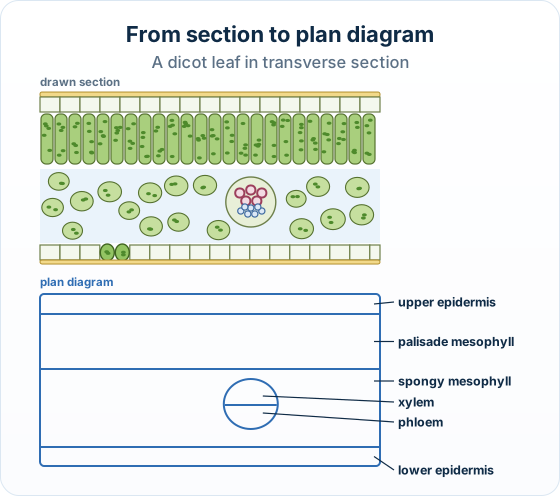
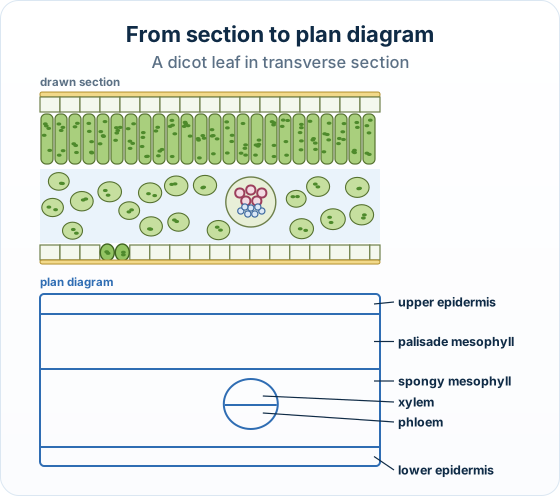
The big idea: A dicot leaf is built in layers, always in the same order from the upper surface to the lower one, with veins running through the middle.
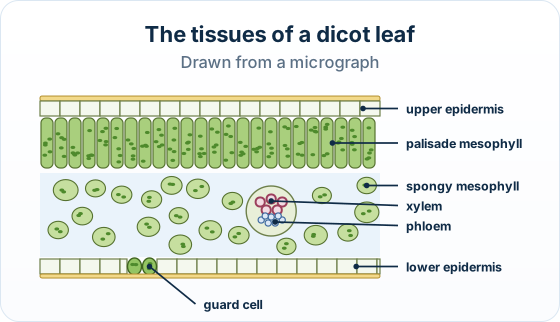
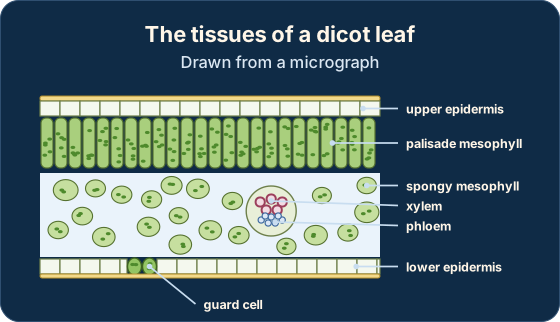
| Tissue | Where | What it does |
|---|---|---|
| Upper epidermis | Top surface, under the waxy cuticle | Protects; transparent, lets light in |
| Palisade mesophyll | Just under the upper epidermis | Most of the photosynthesis |
| Spongy mesophyll | Below the palisade layer | Air spaces for gas exchange |
| Xylem | In each vein, towards the upper side | Brings water into the leaf |
| Phloem | In each vein, towards the lower side | Carries sugars out of the leaf |
| Lower epidermis | Bottom surface, with the guard cells | Holds the stomata |
The points to remember
- The order never changes: upper epidermis, palisade, spongy, lower epidermis.
- Veins (vascular bundles) sit in the mesophyll; the largest is the midrib.
- In a vein, xylem faces the upper surface and phloem the lower one.
Remember it as: Up the leaf: lower epidermis, spongy, palisade, upper epidermis.
Real example: a privet leaf. Privet leaves are a favourite for school slides: thin sections show one neat palisade layer, a loose spongy layer and the midrib's vascular bundle, ideal for a plan diagram.
Free preview
This is the free notes preview
You're reading the free notes. Aimnova Pro unlocks the full study experience — and you can try it with your first topic free to keep:
- FlashcardsLock in vocabulary and key terms with spaced repetition.
- Practice questionsAnswer exam-style questions and get instant AI marking.
- Mock exams & past-paper vaultSit full mocks and see exactly how examiners award marks.
- Personalised study planA daily plan built around your exam date and weak areas.
Start Studying Free Full access to Aimnova Pro · cancel anytime
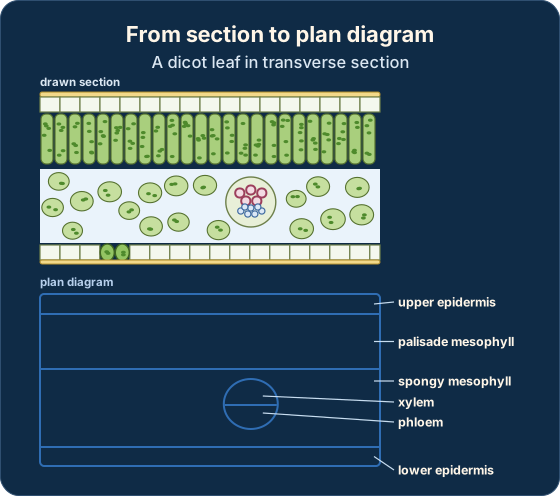
What a plan diagram is: A plan diagram shows where each tissue is, as outlines. It never shows single cells.
The points to remember
- Draw the outline of each tissue with clear, continuous lines.
- Keep the proportions: a thick palisade layer is drawn thick.
- Show upper and lower epidermis, palisade, spongy mesophyll and a vascular bundle (xylem above, phloem below).
- Label with ruled lines that touch the tissue and never cross each other.
- No shading and no cells.
Three traps: Drawing cells turns it into a cell drawing, not a plan.
A thin palisade band drawn as thick as the spongy layer loses the proportion mark.
A label line that stops short of the tissue does not count.
Know your predicted grade
Take timed mock exams and get detailed feedback on every answer. See exactly where you're losing marks.
Try Mock Exams FreeYour first topic is free to keep • No credit card required
How it is asked: Expect a micrograph of a leaf: draw a plan diagram, identify labelled tissues, or give the function of one.
IB-style questionDraw[3 marks]
Draw a plan diagram, with labels, to show the distribution of tissues in a transverse section of a leaf.
Model answer plan
See the answer broken into clear points, with guidance on how each point earns marks.