The big idea: Ventilation is simply breathing — moving air into and out of the lungs. Lungs cannot move on their own; they have no muscle.
Two sets of muscles change the size of the chest (thorax)
- The diaphragm — a sheet of muscle below the lungs
- The intercostal muscles — between the ribs
Volume changes pressure: When these muscles change the chest's volume, they change the air pressure inside — and air flows to even the pressure out.
Ventilation compared. Inhalation (left): the diaphragm contracts and flattens and the external intercostals raise the ribs up and out, so thoracic volume increases, pressure inside falls below atmospheric, and air flows in. Exhalation (right): the muscles relax, the diaphragm domes up and the ribs drop, so volume decreases, pressure rises above atmospheric, and air flows out.
Interactive diagram
Explore the labelled diagram, charts and maps for this topic in full study mode.
- Ventilation
- The movement of air into and out of the lungs (breathing). It keeps a fresh supply of air at the gas-exchange surface.
- Thorax (thoracic cavity)
- The chest — the sealed space containing the lungs, bounded by the ribs and the diaphragm.
- Diaphragm
- A dome-shaped sheet of muscle below the lungs. When it contracts it flattens and moves down, increasing the volume of the thorax.
- Intercostal muscles
- Muscles between the ribs. The external intercostals contract to pull the ribs up and out during inhalation.
- Inhalation (inspiration)
- Breathing in — air moves into the lungs.
- Exhalation (expiration)
- Breathing out — air moves out of the lungs.
Lungs are passive: The lungs themselves do not pull air in — they have no muscle of their own.
It is the diaphragm and the intercostal muscles that do the work, by changing the volume of the chest around the lungs.
The lungs just follow: when the chest gets bigger, the lungs get bigger too.
Free preview
This is the free notes preview
You're reading the free notes. Aimnova Pro unlocks the full study experience — and you can try it with your first topic free to keep:
- FlashcardsLock in vocabulary and key terms with spaced repetition.
- Practice questionsAnswer exam-style questions and get instant AI marking.
- Mock exams & past-paper vaultSit full mocks and see exactly how examiners award marks.
- Personalised study planA daily plan built around your exam date and weak areas.
The whole of breathing comes down to one simple chain of cause and effect:
muscles → volume → pressure → air flow.
If you can follow this chain in order, you can explain both breathing in and breathing out.
Inhalation — making a bigger, lower-pressure chest: To breathe in, the muscles contract and the chest gets bigger.
Breathing in
Muscles contract
The diaphragm contracts, so it flattens and moves down. At the same time the external intercostal muscles contract, pulling the ribs up and out.
Volume increases
Together these make the volume of the thorax increase.
Pressure falls
A bigger space means the air inside is more spread out, so the pressure inside the lungs falls below atmospheric pressure.
Air flows in
Because air always moves from high to low pressure, air flows IN from outside.
Exhalation — making a smaller, higher-pressure chest: At rest, breathing out is the reverse — and it is passive (the muscles simply relax, no contraction needed).
Breathing out
Muscles relax
The diaphragm relaxes and domes up; the intercostals relax so the ribs drop down and in.
Volume decreases
The volume of the thorax decreases.
Pressure rises
Squeezing the same air into a smaller space makes the pressure inside rise above atmospheric pressure.
Air flows out
Air therefore flows OUT until the pressure is even again.
Ventilation compared. Inhalation (left): the diaphragm contracts and flattens and the external intercostals raise the ribs up and out, so thoracic volume increases, pressure inside falls below atmospheric, and air flows in. Exhalation (right): the muscles relax, the diaphragm domes up and the ribs drop, so volume decreases, pressure rises above atmospheric, and air flows out.
Interactive diagram
Explore the labelled diagram, charts and maps for this topic in full study mode.
Inhalation
- Diaphragm contracts → flattens (down)
- Intercostals contract → ribs up & out
- Volume increases
- Pressure falls below atmospheric
- Air flows IN
Exhalation (at rest)
- Diaphragm relaxes → domes up
- Intercostals relax → ribs down & in
- Volume decreases
- Pressure rises above atmospheric
- Air flows OUT
| Link in the chain | What happens during inhalation | The rule behind it |
|---|---|---|
| 1. Muscles contract | Diaphragm and external intercostals contract | Contraction is the active, energy-using step |
| 2. Volume changes | Thoracic volume increases | A bigger sealed space holds the same air more loosely |
| 3. Pressure changes | Pressure in the lungs falls below atmospheric | Larger volume → lower pressure (gas spreads out) |
| 4. Air moves | Air flows in from outside | Gas always moves from high to low pressure |
An easy way to remember: Big chest, low pressure, air in. Make the box bigger and the pressure drops, so air rushes in to fill it.
Small chest, high pressure, air out. Make the box smaller and the pressure rises, so air is pushed out.
Volume and pressure always move in opposite directions.
Reading a breathing trace: Data questions often show pressure inside the lungs plotted over time. Use the chain backwards to read it.
Trace **dips below** the outside (atmospheric) line
- The pressure is low
- The chest is expanding
- The person is inhaling
Trace **rises above** the line
- The pressure is high
- The chest is shrinking
- The person is exhaling
Learn what examiners really want
See exactly what to write to score full marks. Our AI shows you model answers and the key phrases examiners look for.
The big idea: Muscles only pull, so breathing uses antagonistic pairs: one set makes the thorax bigger, the other makes it smaller.
The points to remember
- In: the diaphragm contracts and flattens; the external intercostals contract, pulling the ribs up and out.
- During breathing in, the internal intercostals and abdominal muscles relax.
- Volume of the thorax increases, so pressure falls below atmospheric pressure: air flows in.
- Forced out: the internal intercostals contract (ribs down and in) and the abdominal muscles contract, pushing the diaphragm up.
- Volume decreases, so pressure rises above atmospheric pressure: air flows out.
Two traps: For breathing in, write external intercostals, never internal.
Never write that external and internal intercostals contract at the same time.
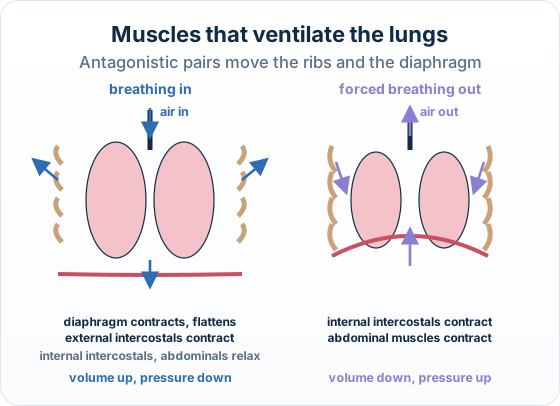
Remember it as: Externals in, internals out; the diaphragm flattens to breathe in.
Real example: blowing up a balloon. To blow up a balloon you need forced exhalation: your internal intercostal muscles pull the ribs down and in, and your abdominal muscles push the diaphragm up, raising the pressure in your lungs.
How this is tested: Ventilation is tested as a 4-mark Paper 2 Explain and as short Paper 1 and Name / State items.
| Question | What they want |
|---|---|
| Paper 2 headline 4-mark Explain: how is the pressure inside the lungs changed during ventilation? | The full chain (muscles → volume → pressure → air flow) for both phases, as separate scoring points |
| Paper 1 1-mark: what causes the thorax to expand during inspiration? | The diaphragm and external intercostals contracting |
| Short Name / State: another muscle group (besides the diaphragm) that contracts to cause inspiration | The external intercostal muscles |
Exam-style question — explain how lung pressure is changed during ventilation
Explain how the pressure inside the lungs is changed during ventilation. [4]
How to score all four marks
- Inhalation — muscles and volume. During inhalation the diaphragm and external intercostal muscles contract, so the diaphragm flattens and the ribs move up and out, increasing the volume of the thorax.
- Inhalation — pressure and air. The larger volume makes the pressure inside the lungs fall below atmospheric pressure, so air flows in down the pressure gradient.
- Exhalation — muscles and volume. During exhalation these muscles relax, the diaphragm domes up and the ribs drop, so the volume of the thorax decreases.
- Exhalation — pressure and air. The smaller volume makes the pressure rise above atmospheric pressure, so air flows out. (Award 1 mark per distinct point, up to 4 — typically volume↑→pressure↓→in, and volume↓→pressure↑→out.)
Final answer
Inhalation: diaphragm and intercostals contract → thoracic volume increases → lung pressure falls below atmospheric → air flows in. Exhalation: the muscles relax → volume decreases → pressure rises above atmospheric → air flows out.
Why this scores full marks: It covers both phases and links each one as a chain: muscle action → volume change → pressure change → direction of air flow.
The classic lost mark is naming the muscles but never mentioning the volume change, which is the link that actually changes the pressure.
| Step | Inhalation (breathing in) | Exhalation (resting breathing out) |
|---|---|---|
| Diaphragm | Contracts → flattens and moves down | Relaxes → domes up |
| External intercostal muscles | Contract → pull the ribs up and out | Relax → ribs drop down and in |
| Thoracic (chest) volume | Increases | Decreases |
| Pressure inside the lungs | Falls below atmospheric pressure | Rises above atmospheric pressure |
| Air flow | Air flows IN (down the pressure gradient) | Air flows OUT (down the pressure gradient) |
| Energy | Active — muscles contract (uses energy) | Passive at rest — muscles just relax |
A 3-mark Explain, in the papers' style:
Explain how muscle action can cause a maximum inhalation.
Model answer plan
See the answer broken into clear points, with guidance on how each point earns marks.