The big idea: Every organism must exchange gases; the bigger it is, the harder this gets.
The points to remember
- Cells respire, so they need oxygen in and carbon dioxide out; photosynthesis needs the reverse.
- Gases enter and leave by diffusion across a surface.
- As an organism grows, its SA:V ratio falls: less surface for each unit of volume.
- The distance from the centre to the outside also increases, so diffusion takes far longer.
- Large organisms therefore need a special gas-exchange surface (lungs, gills, leaves) and often a transport system.
Remember it as: Small and flat: diffusion is enough. Big and thick: lungs and blood.
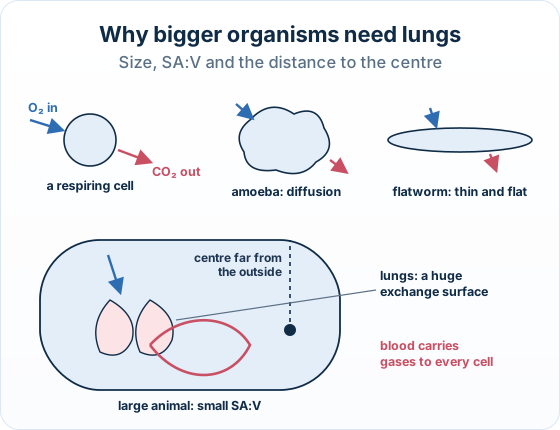
Real example: a flatworm: Planarian flatworms are only a fraction of a millimetre thick, so oxygen reaches every cell by diffusion across the skin: they have no lungs, gills or blood.
Free preview
This is the free notes preview
You're reading the free notes. Aimnova Pro unlocks the full study experience — and you can try it with your first topic free to keep:
- FlashcardsLock in vocabulary and key terms with spaced repetition.
- Practice questionsAnswer exam-style questions and get instant AI marking.
- Mock exams & past-paper vaultSit full mocks and see exactly how examiners award marks.
- Personalised study planA daily plan built around your exam date and weak areas.
Start Studying Free Full access to Aimnova Pro · cancel anytime
How it is asked: Expect this idea inside other questions: why an organism needs lungs or gills, or why a flat shape helps. Link size to SA:V and to distance.
IB-style questionExplain[3 marks]
Explain why large animals need a specialized gas-exchange surface, but very small animals do not.
Model answer plan
See the answer broken into clear points, with guidance on how each point earns marks.