The big idea: Adult stem cells live in special places called niches; the niche keeps them as stem cells or tells them to divide and differentiate.
The points to remember
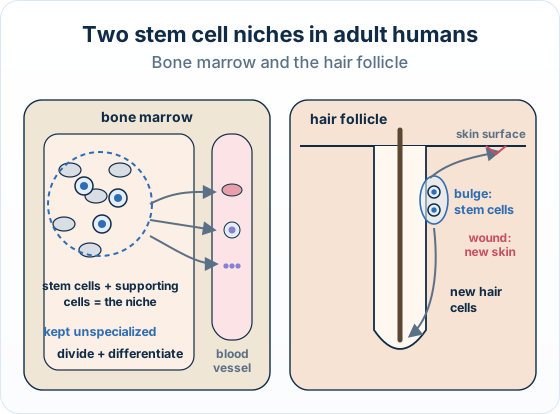
- A stem cell niche is the place in a tissue where stem cells live, with the supporting cells around them.
- Signals from the niche can maintain the stem cells: keep them unspecialized, dividing slowly.
- Or the niche can promote proliferation (more divisions) and differentiation, when new cells are needed.
- Bone marrow: stem cells that make red blood cells, white blood cells and platelets.
- Hair follicles: stem cells in the bulge make new hair cells, and skin cells after a wound.
- Adult stem cells are multipotent: they repair and maintain their own tissue.
Remember it as: The niche is home: it keeps stem cells waiting, then sends them to work.
Real example: a bone marrow transplant: In a bone marrow transplant for leukaemia, stem cells from a donor are put into the patient's blood. They settle in niches in the patient's bone marrow and go on making every kind of blood cell.
Free preview
This is the free notes preview
You're reading the free notes. Aimnova Pro unlocks the full study experience — and you can try it with your first topic free to keep:
- FlashcardsLock in vocabulary and key terms with spaced repetition.
- Practice questionsAnswer exam-style questions and get instant AI marking.
- Mock exams & past-paper vaultSit full mocks and see exactly how examiners award marks.
- Personalised study planA daily plan built around your exam date and weak areas.
Start Studying Free Full access to Aimnova Pro · cancel anytime
How it is asked: Expect a short Paper 2 Discuss or Outline on where adult stem cells are and what they do, or a Paper 1A item asking for a stem cell's type and its location.
IB-style questionDiscuss[3 marks]
Discuss the location and function of stem cells in adult humans.
Model answer plan
See the answer broken into clear points, with guidance on how each point earns marks.