Not all stem cells are equal. Some can become any cell type, while others are limited to just a few.
Ranking by potency: We rank them by potency — the number of different cell types they can differentiate into. There are four named tiers, from most powerful to least.
| Term | What it can become | Example |
|---|---|---|
| Totipotent | Any cell type plus the placenta | The zygote (fertilized egg) and the very early embryo |
| Pluripotent | A wide range of body cell types, but not the placenta | Embryonic stem cells |
| Multipotent | A limited family of related cell types | Adult stem cells, such as the blood-forming cells in red bone marrow |
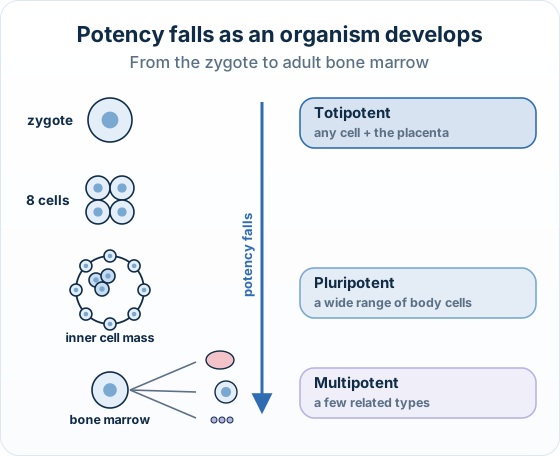
Potency falls as cells specialize: Read the hierarchy top to bottom: potency decreases and specialization increases as you go down.
How options narrow
- Early in development a cell can become almost anything (totipotent).
- As the embryo develops and cells start to differentiate, their options narrow.
- Most stem cells in the adult body are only multipotent.
Key contrast for the exam: Totipotent includes the placenta; pluripotent does not. That single difference is how the two top tiers are told apart.
| Potency term | Can become… | Example (and where it is found) |
|---|---|---|
| Totipotent | ANY cell type PLUS the placenta | The zygote and the very early embryo |
| Pluripotent | A WIDE RANGE of body cell types (but not the placenta) | Embryonic stem cells (in the early embryo) |
| Multipotent | A limited family of related cell types | Adult stem cells — e.g. blood-forming cells in red bone marrow |
Potency AND niche — name both: An exam can ask you to classify a stem cell two ways at once: its potency type and its niche (where it is found in the body).
The classic example: A blood-forming (haematopoietic) stem cell is multipotent (it makes the family of blood cells) and its niche is the red bone marrow.
Give both answers: So 'what kind of stem cell' often needs both answers — the potency tier and the location.
| Stem cell | Potency type | Niche (where it is found) |
|---|---|---|
| Zygote / very early embryo | Totipotent | The fertilized egg, before the embryo specializes |
| Embryonic stem cell | Pluripotent | The inner cell mass of the early embryo |
| Blood-forming (haematopoietic) stem cell | Multipotent | Red bone marrow |
Totipotent vs pluripotent
- Totipotent: any cell type + the placenta
- Example: the zygote / very early embryo
- Pluripotent: a wide range of body cells, but not the placenta
- Example: embryonic stem cells
Multipotent: adult stem cells
- Multipotent: a limited family of related cell types
- Example: bone-marrow (blood-forming) stem cells
- Typical of the adult body
An easy way to remember: Toti = total (any cell + the placenta).
Pluri = plural / many (a wide range of body cells).
Multi = multiple but limited (a related family, e.g. blood cells).
Free preview
This is the free notes preview
You're reading the free notes. Aimnova Pro unlocks the full study experience — and you can try it with your first topic free to keep:
- FlashcardsLock in vocabulary and key terms with spaced repetition.
- Practice questionsAnswer exam-style questions and get instant AI marking.
- Mock exams & past-paper vaultSit full mocks and see exactly how examiners award marks.
- Personalised study planA daily plan built around your exam date and weak areas.
How this is tested: On Paper 1A potency is tested in three common ways.
What you may be asked
- A 1-mark question often asks you to name the potency term for a described cell — for example, a very early embryo / zygote is totipotent.
- Another common format asks you to choose the correct description of potency for a given tissue — match the tier to how many cell types it can form (pluripotent = a wide range of body cells; multipotent = a limited family).
- A trickier version asks you to classify a stem cell by both its potency type and its location — e.g. a blood-forming stem cell is multipotent and is found in the red bone marrow.
Exam-style question — classify a blood-forming stem cell
A stem cell taken from red bone marrow gives rise to red blood cells, white blood cells and platelets, but no other cell types. State the potency type of this stem cell and identify its niche. [2]
How to score both marks
- Decide the potency. The cell makes several related cell types (the blood cells) but not every cell type in the body — so it is multipotent.
- Name the niche. The question tells you it was taken from red bone marrow — that is its niche (the location where this stem cell is found). (Mark 1: multipotent. Mark 2: red bone marrow.)
Final answer
Multipotent — it can form a limited family of related cell types (the blood cells); its niche is the red bone marrow.
Why this scores full marks: The giveaway is 'a limited family of related cell types' — that is the definition of multipotent, not pluripotent.
A common slip is calling it pluripotent. Pluripotent cells can become a wide range of body cells; this one only makes blood cells, so it is multipotent.
| Potency term | Can become… | Example (and where it is found) |
|---|---|---|
| Totipotent | ANY cell type PLUS the placenta | The zygote and the very early embryo |
| Pluripotent | A WIDE RANGE of body cell types (but not the placenta) | Embryonic stem cells (in the early embryo) |
| Multipotent | A limited family of related cell types | Adult stem cells — e.g. blood-forming cells in red bone marrow |
Two traps: Pluripotent means a wide range of body cells: 'any' or 'every' cell type is not accepted.
You may see unipotent (one cell type) among the options; the three types to know are totipotent, pluripotent and multipotent.
A 3-mark Distinguish, in the Paper 2 style:
Distinguish between totipotent, pluripotent and multipotent stem cells, giving an example of where each is found.
Model answer plan
See the answer broken into clear points, with guidance on how each point earns marks.