The big idea: A cell membrane is selectively (partially) permeable: it lets some substances cross but not others.
Key points
- Small, non-polar molecules (like oxygen) slip through easily
- Large molecules (like starch or proteins) cannot pass through the bilayer at all
- To study this, scientists use a model — dialysis (Visking) tubing behaves like a partially permeable membrane
- Selective (partial) permeability
- A property of a membrane that allows some substances to pass through while blocking others, depending mainly on their size and chemical nature.
- Dialysis (Visking) tubing
- An artificial partially permeable membrane used to model a cell membrane: it has tiny pores that let small molecules through but hold back large ones.
- Model
- A simplified, controllable stand-in for a real system, used to test ideas safely — here, tubing standing in for a living membrane.
Why 'selective' matters: If the membrane let everything through, the cell could not control its internal conditions.
Selective permeability is what lets a cell keep what it needs and exclude what it doesn't — the basis of every transport process in this topic.
Free preview
This is the free notes preview
You're reading the free notes. Aimnova Pro unlocks the full study experience — and you can try it with your first topic free to keep:
- FlashcardsLock in vocabulary and key terms with spaced repetition.
- Practice questionsAnswer exam-style questions and get instant AI marking.
- Mock exams & past-paper vaultSit full mocks and see exactly how examiners award marks.
- Personalised study planA daily plan built around your exam date and weak areas.
Whether a particle crosses the membrane comes down to two things: its size and whether it is polar.
Three cases
- Small, non-polar molecules dissolve into the bilayer and pass straight through
- Ions and small polar molecules need a protein to help them
- Large molecules cannot cross the bilayer at all
What gets through, and what doesn't: Through the bilayer freely: small, non-polar molecules such as oxygen and carbon dioxide (and, with aquaporins, water).
Only with a protein: ions and small polar molecules such as glucose (facilitated diffusion or active transport).
Not at all through the bilayer: large molecules such as starch and proteins — these are simply too big.
| Type of particle | Can it cross the membrane easily? | How it crosses (if it can) |
|---|---|---|
| Small, non-polar (e.g. O₂, CO₂) | Yes — freely | Simple diffusion straight through the bilayer |
| Water | Yes | Osmosis, helped by aquaporin channel proteins |
| Small ions and polar molecules (e.g. glucose) | Only with help | Facilitated diffusion or active transport through proteins |
| Large molecules (e.g. starch, proteins) | No — too big | They cannot pass through the bilayer |
Modelling a membrane with dialysis tubing: Because real membranes are hard to study, biologists use a model. Dialysis (Visking) tubing is an artificial partially permeable membrane.
The tubing experiment
The pores
Its pores let small molecules (like glucose) pass through, but hold back large ones (like starch).
Set up
Fill the tubing with a glucose-and-starch mixture, and sit it in water.
Result
After a while you find glucose has moved out into the water while starch has stayed inside — exactly what a selectively permeable membrane should do.
Small out, large stays in
| In the dialysis-tubing model | What it represents in the body | Why |
|---|---|---|
| The dialysis tubing | The partially permeable cell / intestinal membrane | It has tiny pores that let only small molecules through |
| Glucose passing through the tubing | Small digested products being absorbed | Glucose is small enough to cross the selective barrier |
| Starch staying inside the tubing | Undigested large molecules NOT being absorbed | Starch is too large to pass through the pores |
| Water in the beaker outside | Blood / tissue fluid receiving the absorbed glucose | It is where the small molecules end up |
Stop wasting time on topics you know
Our AI identifies your weak areas and focuses your study time where it matters. No more overstudying easy topics.
The big idea: A membrane is selectively permeable because of its proteins. The bilayer alone only sorts particles by size and polarity.
The points to remember
- Simple diffusion is not selective: it depends only on size and whether a particle is hydrophilic or hydrophobic.
- Facilitated diffusion is selective: each channel lets only specific ions through.
- Active transport is selective: each pump moves only specific particles.
- So the cell controls what crosses by which proteins it puts in its membrane, and when they are open.
Remember it as: The bilayer sorts by size; the proteins choose.
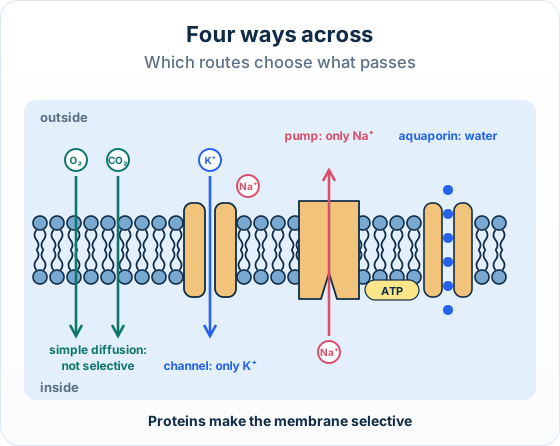
Real example: red blood cells: Oxygen crosses a red blood cell's membrane freely, whatever else is in the plasma. Potassium crosses only through its own channels and pumps, so the cell keeps about 30 times more potassium than the plasma.
How this is tested: Membrane transport is a data-question favourite.
| Where | What you are asked | What scores |
|---|---|---|
| Paper 1B / Paper 3 | A dialysis-tubing experiment: predict how the concentration of a small molecule (glucose) and a large molecule (starch) change inside vs outside the tubing | Then explain the result from the tubing being partially permeable |
Watch the data: Only the small molecule moves; the large one stays put because it cannot fit through the pores.
Exam-style question — reason from the dialysis-tubing data
Dialysis tubing was filled with a mixture of glucose and starch and placed in a beaker of distilled water. After 30 minutes, glucose was detected in the water outside the tubing, but starch was not. Explain how this models the selective permeability of a cell membrane. [4]
How to score all four marks
- Name the property being modelled. The tubing is partially (selectively) permeable — it lets some molecules through but not others, just like a real cell membrane.
- Explain the glucose result. Glucose molecules are small enough to pass through the pores in the tubing, so they diffuse out of the tubing into the surrounding water (down their concentration gradient).
- Explain the starch result. Starch molecules are too large to fit through the pores, so they cannot cross the tubing and stay inside.
- Link back to a real membrane. This mirrors a cell / intestinal membrane, which absorbs small digested products (glucose) but holds back large undigested molecules (starch). (Award 1 mark each: tubing is partially permeable; glucose is small so it passes out; starch is too large so it stays in; the model represents selective absorption across a real membrane.)
Final answer
The tubing is partially permeable: glucose is small enough to diffuse out through the pores, but starch is too large to pass, so it stays inside — exactly how a selectively permeable membrane lets small molecules cross while blocking large ones.
Why this scores full marks: Each mark is a distinct, data-linked point: the property (partially permeable), the small molecule (glucose passes), the large molecule (starch blocked), and the link to a real membrane.
Explain the result by molecule size; do not just restate it.
A seven-mark question, in the Paper 2 Section B style:
Explain the roles of proteins in the transport of substances across the plasma membrane of a root hair cell.
Model answer plan
See the answer broken into clear points, with guidance on how each point earns marks.