The big idea: Proteins are built from 20 different amino acids. Your body can make some of them itself, but it cannot make the others — those ones have to come from the food you eat.
Essential amino acid
- The body cannot make it
- You must eat it
Non-essential amino acid
- The body can make it
- You don't have to eat it
- Amino acid
- The small subunit (monomer) that proteins are built from. There are 20 different kinds in humans.
- Essential amino acid
- An amino acid the body cannot synthesise (make) for itself, so it must be obtained from the diet. There are about nine of these in humans.
- Non-essential amino acid
- An amino acid the body can synthesise (make) for itself, so it does not have to be supplied by the diet.
- Synthesise
- To build or make a molecule inside the body from simpler materials.
Don't be fooled by the names: Non-essential does NOT mean unimportant. Every amino acid is needed to build proteins.
The word essential here means only one thing: it is essential in the diet because the body cannot make it.
So 'essential' = must be eaten, not 'more important'.
Free preview
This is the free notes preview
You're reading the free notes. Aimnova Pro unlocks the full study experience — and you can try it with your first topic free to keep:
- FlashcardsLock in vocabulary and key terms with spaced repetition.
- Practice questionsAnswer exam-style questions and get instant AI marking.
- Mock exams & past-paper vaultSit full mocks and see exactly how examiners award marks.
- Personalised study planA daily plan built around your exam date and weak areas.
To build its proteins, the body needs a supply of all 20 amino acids at once.
Why diet matters
- The body can make the non-essential ones whenever it needs them
- The essential ones can only be topped up by eating protein
- If even one essential amino acid is missing from the food, the body cannot build the proteins that need it
- Balanced (complete) protein
- A protein source that supplies all of the essential amino acids in one food.
- Protein deficiency
- A shortage caused when the diet does not supply enough protein, or is missing one or more essential amino acids, so the body cannot make all the proteins it needs.
Animal vs plant protein: Most animal proteins (meat, fish, eggs, dairy) contain all nine essential amino acids in a single food — so one source can cover them all.
Many single plant proteins are missing one or more essential amino acids. For example, grains tend to be low in one, and beans low in another.
| Type of protein source | Which essential amino acids it supplies | What the eater must do |
|---|---|---|
| Most animal proteins (meat, eggs, dairy) | Usually all nine essential amino acids in one food | Nothing extra — one source can supply them all |
| A single plant protein (e.g. rice alone, beans alone) | Often missing one or more essential amino acids | Should not rely on it alone |
| Combined plant proteins (e.g. rice + beans) | Together they supply all nine essential amino acids | Combine different plant foods so the gaps are filled |
What a vegan or plant-based eater must do: Someone who eats no animal products can still get every essential amino acid — but they have to plan it.
How to plan plant protein
Combine plant proteins
Eat different plant proteins together, for example rice with beans, or bread with lentils.
Fill the gaps
The amino acids one food lacks are supplied by the other.
Over the day
Eaten together over the day, the combination supplies all nine essential amino acids.
Combine → fill the gaps → all nine
An easy way to remember: Essential = Eat it (the body can't make it).
Plant eaters mix and match plant proteins so the gaps in one food are filled by another — together they make a complete set.
Learn what examiners really want
See exactly what to write to score full marks. Our AI shows you model answers and the key phrases examiners look for.
The big idea: The body can turn some amino acids into others, but not all of them. The ones it cannot make must be eaten, every day, in the right amounts.
The points to remember
- Essential amino acids cannot be made in the body: food is their only source.
- Non-essential amino acids can be made in the body from other amino acids.
- A protein is built only when every amino acid in its sequence is available.
- A vegan diet must supply enough of every essential amino acid.
- Grains are low in lysine and beans in methionine: eaten together over the day, each fills the other's gap.
Remember it as: Essential: eat it. Non-essential: make it from others.
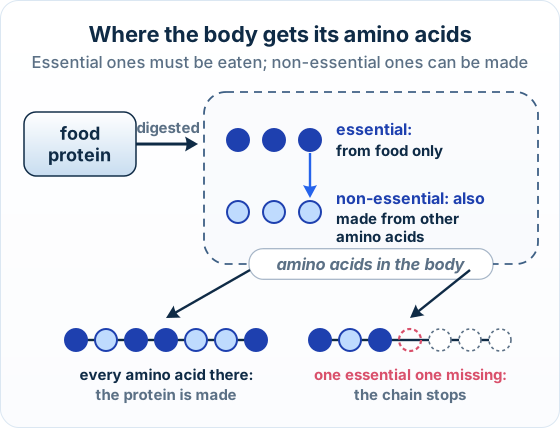
Real example: tyrosine: The body makes the non-essential amino acid tyrosine from phenylalanine, an essential amino acid that has to be eaten.
How this is tested: Two papers test this: a Distinguish question on Paper 2, and diet or table questions on Paper 1A.
| Paper | What you are asked | What to give |
|---|---|---|
| Paper 2 (2 marks, Distinguish) | The difference between essential and non-essential amino acids in the diet | The contrast for each type: the body cannot make essential ones, so they must be eaten; it can make non-essential ones |
| Paper 1A | Determine what a vegan must ensure | Combine plant proteins so all essential amino acids are supplied |
| Paper 1A | Draw a conclusion about an amino acid from a table | Use the table's label: essential or non-essential |
Exam-style question — distinguish the two types
Distinguish between essential and non-essential amino acids in the human diet. [2]
How to score both marks
- State the essential side. An essential amino acid cannot be synthesised (made) by the body, so it must be obtained from the diet.
- State the non-essential side. A non-essential amino acid can be synthesised by the body, so it does not have to be supplied by the diet. (Mark 1: essential = not made by the body / must be eaten. Mark 2: non-essential = can be made by the body / need not be eaten.)
Final answer
Essential amino acids cannot be made by the body and must come from the diet; non-essential amino acids can be made by the body, so they need not be supplied in food.
Why this scores full marks: 'Distinguish' wants a paired contrast. Each mark covers one type, and the two statements line up: cannot make → must eat versus can make → need not eat.
Writing only about essential amino acids (and ignoring non-essential) caps you at 1 mark.
| Feature | Essential amino acid | Non-essential amino acid |
|---|---|---|
| Can the body make it? | No — the body cannot synthesise it | Yes — the body can synthesise it |
| Where it must come from | The diet (food) — there is no other source | The diet OR made inside the body |
| If it is missing from food | The body runs short — protein cannot be built normally | No problem — the body simply makes more |
| Roughly how many in humans | About nine of the twenty amino acids | About eleven of the twenty amino acids |
| Example wording in an answer | 'Must be obtained from the diet' | 'Can be synthesised by the body' |
Paper 1A: spot the false statement: 'Essential amino acids are only found in animal food' is false: plants supply them too, just not always all in one food.
'Non-essential amino acids can only be obtained from food' is false: the body makes them from other amino acids.
'Non-essential amino acids are not used by the body' is false: every amino acid builds proteins.
A three-mark Explain in the Paper 2 style:
Explain why a person who follows a vegan diet needs to plan their protein intake.
Model answer plan
See the answer broken into clear points, with guidance on how each point earns marks.