The big idea: Proteins are built from small subunits called amino acids. Two amino acids join together by a reaction called condensation.
What condensation does
- It forms a new covalent bond called a peptide bond.
- It releases one molecule of water (H₂O).
- Two amino acids joined this way make a dipeptide.
- Many joined in a chain make a polypeptide — the basis of every protein.
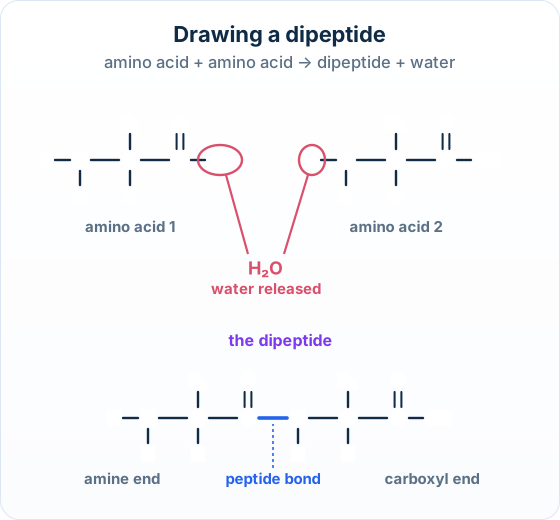
Condensation joins two amino acids: an –OH from one carboxyl group and an –H from the other amino group leave together as water, and the carbon and nitrogen left behind join by a new peptide bond (CO–NH).
Interactive diagram
Explore the labelled diagram, charts and maps for this topic in full study mode.
- Amino acid
- The small subunit (monomer) that proteins are built from. Every amino acid has an amino group (—NH₂) at one end and a carboxyl group (—COOH) at the other.
- Peptide bond
- The covalent bond (CO—NH) that joins two amino acids together. It forms by condensation.
- Condensation
- A reaction that joins two subunits and releases one molecule of water (H₂O) as the new bond forms.
- Dipeptide
- Two amino acids joined by a single peptide bond.
- Polypeptide
- A long chain of many amino acids joined by peptide bonds — the chain that folds into a protein.
Which groups react: The carboxyl group (—COOH) of one amino acid reacts with the amino group (—NH₂) of the next.
This is always the pairing the exam wants: carboxyl meets amino — the two ends that give an amino acid its name.
Free preview
This is the free notes preview
You're reading the free notes. Aimnova Pro unlocks the full study experience — and you can try it with your first topic free to keep:
- FlashcardsLock in vocabulary and key terms with spaced repetition.
- Practice questionsAnswer exam-style questions and get instant AI marking.
- Mock exams & past-paper vaultSit full mocks and see exactly how examiners award marks.
- Personalised study planA daily plan built around your exam date and weak areas.
When the peptide bond forms, some atoms are removed. They leave as one molecule of water (H₂O) — this is why the reaction is condensation.
Which atoms are removed
- An —OH is taken from the carboxyl group of one amino acid.
- An —H is taken from the amino group of the other.
- Together these make one molecule of water (H₂O).
| Group involved | Which amino acid | What it provides |
|---|---|---|
| Carboxyl group (—COOH) | The first amino acid | Gives up an —OH |
| Amino group (—NH₂) | The second amino acid | Gives up an —H |
| These removed atoms (—OH + —H) | From the two reacting groups | Join to form one water molecule (H₂O) |
| Peptide bond (CO—NH) | Forms between the two amino acids | The new covalent bond that links them |
The atoms that are removed: Exam questions love to ask which atoms are lost when two amino acids join.
The answer: an —OH from one carboxyl group and an —H from the other amino group, which leave together as one water molecule (H₂O).
So a peptide bond forming and a water molecule leaving always happen together.
Breaking the bond: hydrolysis: The reverse reaction is hydrolysis: one water molecule is added across the peptide bond, splitting the dipeptide back into two separate amino acids.
This is how a protein you eat is digested back into amino acids.
Hydrolysis is the reverse: a water molecule is added across the peptide bond, splitting the dipeptide back into two separate amino acids.
Interactive diagram
Explore the labelled diagram, charts and maps for this topic in full study mode.
Condensation (joining)
- Forms a peptide bond
- Removes an —OH and an —H → one water molecule out
- Builds a dipeptide (then a polypeptide)
- Carboxyl —COOH reacts with amino —NH₂
Hydrolysis (breaking)
- Breaks a peptide bond
- Adds one water molecule across the bond
- Splits the chain back into amino acids
- Happens during digestion of protein
Counting peptide bonds in a chain: Each peptide bond joins one pair of amino acids, so a single chain always has one fewer bond than amino acids.
A chain of 5 amino acids has 4 peptide bonds; a chain of 100 amino acids has 99.
More than one chain: If a protein is made of more than one chain, count each chain separately, or use the quick rule: total amino acids minus the number of chains.
| Situation | How to count the peptide bonds | Example |
|---|---|---|
| One single chain | Number of amino acids minus 1 (each bond links a pair) | 5 amino acids in 1 chain → 4 peptide bonds |
| More than one chain | Each separate chain has one fewer bond than its amino acids | Two chains of 21 + 30 → 20 + 29 = 49 peptide bonds |
| Quick rule | Total amino acids minus the number of chains | 51 amino acids in 2 chains → 51 − 2 = 49 bonds |
An easy way to remember: Condensation connects (and water comes out). Peptide bonds, like fence panels between posts, are always one fewer than the things they connect.
Study smarter, not longer
Most students waste 40% of study time on topics they already know. Our AI tracks your progress and optimizes every minute.
The big idea: The word equation is amino acid + amino acid → dipeptide + water. In the drawing, the carbon of one carboxyl group bonds to the nitrogen of the next amine group.
The points to remember
- Draw two amino acids side by side, the carboxyl group of the first facing the amine group of the second.
- Take the OH from that carboxyl group and one H from that amine group: together they leave as water.
- Join the C to the N with a single line: the peptide bond, with C=O on one side and N–H on the other.
- The dipeptide still has a free amine end and a free carboxyl end, so more amino acids can join on.
Remember it as: Carboxyl gives the OH, amine gives the H, and C joins N.
Real example: aspartame: The sweetener aspartame is built from two amino acids, aspartic acid and phenylalanine, joined by one peptide bond: a dipeptide.
How this is tested: Paper 1A asks how amino acids link and which atoms leave. A Calculate item asks you to count peptide bonds.
What you may be asked
- A common multiple-choice item shows two amino acids and asks you to identify how they link to form a dipeptide. The answer is condensation, forming a peptide bond.
- A frequent variant labels the atoms or groups and asks which atoms are removed (an —OH and an —H, leaving as water).
- Or it asks which groups join (the carboxyl —COOH and the amino —NH₂).
- A Calculate item gives an amino-acid count and the number of polypeptide chains and asks for the number of peptide bonds.
Exam-style question — atoms removed and the bond formed
Two amino acids react together to form a dipeptide. State the name of the reaction, identify the atoms that are removed, and name the bond that forms. [3]
How to score all three marks
- Name the reaction. The two amino acids join by condensation.
- Identify the atoms removed. An —OH is removed from the carboxyl group (—COOH) of one amino acid and an —H from the amino group (—NH₂) of the other; together they leave as one water molecule (H₂O).
- Name the bond. The new covalent bond joining the two amino acids is a peptide bond (CO—NH). (Mark 1: condensation. Mark 2: —OH and —H removed / water released. Mark 3: peptide bond.)
Final answer
Condensation: an —OH (from a carboxyl group) and an —H (from an amino group) are removed as one water molecule, and a peptide bond forms between the two amino acids.
Why this scores full marks: Each part is a separate scoring point: the reaction (condensation), the atoms lost (—OH + —H → water), and the bond (peptide).
Saying 'water is lost' is good, but naming which groups the —OH and —H come from makes the answer watertight.
| Group involved | Which amino acid | What it provides |
|---|---|---|
| Carboxyl group (—COOH) | The first amino acid | Gives up an —OH |
| Amino group (—NH₂) | The second amino acid | Gives up an —H |
| These removed atoms (—OH + —H) | From the two reacting groups | Join to form one water molecule (H₂O) |
| Peptide bond (CO—NH) | Forms between the two amino acids | The new covalent bond that links them |
A three-mark Outline in the Paper 2 style:
Outline the general structure of a peptide.
Model answer plan
See the answer broken into clear points, with guidance on how each point earns marks.
And the one-mark word equation:
State the products of a condensation reaction between two amino acids.
Model answer plan
See the answer broken into clear points, with guidance on how each point earns marks.