The big idea: All proteins are built from the same 20 amino acids, yet proteins carry out an enormous variety of jobs — more than any other type of molecule in a living thing.
Why so many jobs?
- The reason is shape
- The order of amino acids folds each protein into a specific 3-D shape
- That shape decides exactly what the protein can do
- So 'protein' is not one job — it is a whole toolkit: catalysts, building materials, carriers, messengers, defenders and more
Proteins do many different jobs. Each role category is shown with a named example — the same kind of molecule, doing very different work.
Interactive diagram
Explore the labelled diagram, charts and maps for this topic in full study mode.
- Protein
- A molecule made of one or more chains of amino acids folded into a specific 3-D shape. The shape determines the protein's function.
- Function (of a protein)
- The specific job a protein does — for example catalysing a reaction, carrying a substance, or signalling between cells.
- Functional diversity
- The very wide range of different jobs that proteins, as a group, are able to carry out.
- Deficiency
- A shortage of, or a fault in, a particular protein, so that the job it normally does cannot be carried out properly.
Why so many jobs from one kind of molecule?: Because the 20 amino acids can be ordered in countless ways, an almost unlimited number of different shapes is possible.
Each different shape gives a different function — so proteins can specialise to do almost any task the cell needs.
Free preview
This is the free notes preview
You're reading the free notes. Aimnova Pro unlocks the full study experience — and you can try it with your first topic free to keep:
- FlashcardsLock in vocabulary and key terms with spaced repetition.
- Practice questionsAnswer exam-style questions and get instant AI marking.
- Mock exams & past-paper vaultSit full mocks and see exactly how examiners award marks.
- Personalised study planA daily plan built around your exam date and weak areas.
Learn the main role categories with one clear example each.
How to read the table
- A named role linked to a named protein earns the mark, not a vague 'proteins are important'
- Read each row as a pair: the role, and a named example that does it
| Protein role | What it does | A named example |
|---|---|---|
| Enzyme (catalyst) | Speeds up a specific chemical reaction in the cell | Amylase — breaks down starch into sugar |
| Structural | Gives strength and support to tissues | Collagen — strengthens skin, tendons and bone |
| Transport | Carries a specific substance from one place to another | Haemoglobin — carries oxygen in red blood cells |
| Hormone | A chemical message that travels in the blood | Insulin — signals cells to take up glucose |
| Antibody (defence) | Binds to a specific pathogen to help destroy it | Antibodies — recognise and bind invading microbes |
| Movement (contractile) | Generates force so structures can move | Actin and myosin — make muscle contract |
| Receptor | Detects a specific signal and triggers a cell response | Membrane receptors — bind a hormone such as insulin |
| Pigment | Absorbs light to drive a light-dependent process | Rhodopsin — absorbs light in the rod cells of the eye |
A few examples worth memorising: Enzymes are catalysts — e.g. amylase digests starch.
Haemoglobin is a transport protein — it carries oxygen in red blood cells.
Collagen is structural — it strengthens skin, tendons and bone.
Insulin is a hormone — it signals cells to take up glucose.
Rhodopsin is a pigment in the eye — it absorbs light so we can see.
The exam often turns this around. Instead of asking 'what does protein X do?', it asks: 'protein X is missing or faulty — what goes wrong?'
The logic is always the same. Find the job that protein did, then say that job can no longer happen.
How to reason about a protein deficiency: This 'job → lost job → consequence' chain is exactly what scores the marks.
Three steps
Name the protein's job
What does this protein normally do?
Remove it
If the protein is missing or non-functional, that job is not carried out.
State the consequence
Name the specific process or structure that now fails (e.g. no rhodopsin → light is not detected → vision is impaired).
job → lost job → consequence
| If this protein is missing or faulty… | …this is the job it did… | …so this fails |
|---|---|---|
| Haemoglobin | carries oxygen in the blood | Oxygen delivery to tissues falls — tiredness, breathlessness |
| Insulin | signals cells to take up glucose | Blood glucose stays high — it cannot be controlled |
| Collagen | gives skin, tendons and bone strength | Tissues become weak and fragile |
| Rhodopsin (a pigment) | absorbs light in the rod cells of the retina | The eye cannot detect light well — vision (especially in dim light) is impaired |
| Antibodies | bind pathogens so they are destroyed | Infections are harder to fight off |
Protein present (works)
- The protein folds into its correct shape
- It can do its specific job (carry, catalyse, signal…)
- The physiological process runs normally
- e.g. rhodopsin present → the eye detects light
Protein deficient (job lost)
- The protein is missing or non-functional
- Its specific job is not carried out
- The process that relied on it fails
- e.g. rhodopsin missing → the eye cannot detect light well (vision impaired)
An easy way to remember: No protein, no job. To predict the effect of a deficiency, just ask 'what was this protein for?' — the answer that's lost is your consequence.
Stop wasting time on topics you know
Our AI identifies your weak areas and focuses your study time where it matters. No more overstudying easy topics.
The big idea: Three facts multiply together: 20 kinds of amino acid, any order, any length. The result is far more possible polypeptides than any organism could ever make.
The points to remember
- 20 amino acids are coded for in the genetic code, so each position in a chain has 20 options.
- Amino acids can join in any order: every extra position multiplies the possibilities by 20.
- Chains can be any length, from a few amino acids to many thousands.
- So the number of possible polypeptides is almost infinite, and each sequence folds into its own shape.
Remember it as: 20 kinds, any order, any length.
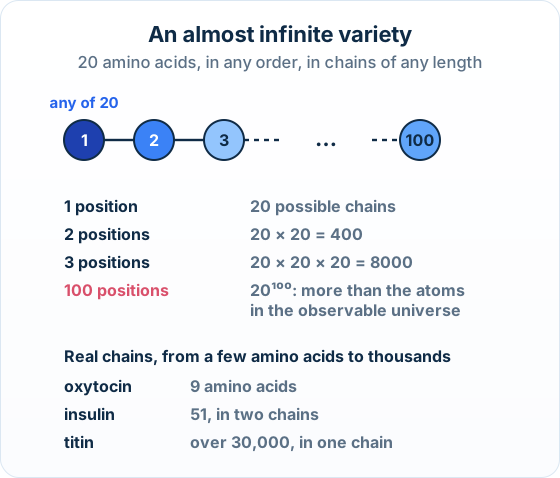
Real example: oxytocin and titin: Oxytocin, a hormone, is a chain of just 9 amino acids; titin, a spring-like protein in muscle, has over 30,000.
How this is tested: The skill that earns the marks is linking a specific protein to a specific job, and then reasoning what is lost if that protein is absent.
| Paper | What you are asked | What to give |
|---|---|---|
| Paper 1A (multiple choice) | Given a protein (or its job), identify which deficiency would impair a specific body function | For example, which missing protein would most affect vision: the light-absorbing pigment rhodopsin |
| Paper 2 | Outline the functional diversity of proteins | Several distinct roles, each with a named example |
Exam-style question — a protein deficiency and a lost function
A person produces very little of the pigment protein found in the rod cells of the retina. Suggest, with a reason, which physiological function is most likely to be impaired. [2]
How to score both marks
- Identify the function impaired. The most likely impaired function is vision (in particular, seeing in dim light).
- Give the reason — link protein to job. The pigment protein in rod cells (rhodopsin) normally absorbs light to start a nerve signal; with very little of it, the rod cells cannot detect light properly, so vision is impaired. (Mark 1: vision / sight is affected. Mark 2: because the pigment normally absorbs light to allow detection, and it is missing.)
Final answer
Vision is impaired, because the rod-cell pigment (rhodopsin) that normally absorbs light to trigger a nerve signal is in short supply, so light is not detected properly.
Why this scores full marks: It does two things: names the function lost (vision) and explains it by the protein's job (absorbing light).
A deficiency answer needs the link — 'the protein normally does X, so without it X fails' — not just the name of the disease or symptom.
| If this protein is missing or faulty… | …this is the job it did… | …so this fails |
|---|---|---|
| Haemoglobin | carries oxygen in the blood | Oxygen delivery to tissues falls — tiredness, breathlessness |
| Insulin | signals cells to take up glucose | Blood glucose stays high — it cannot be controlled |
| Collagen | gives skin, tendons and bone strength | Tissues become weak and fragile |
| Rhodopsin (a pigment) | absorbs light in the rod cells of the retina | The eye cannot detect light well — vision (especially in dim light) is impaired |
| Antibodies | bind pathogens so they are destroyed | Infections are harder to fight off |
A two-mark Describe in the Paper 2 style:
Describe how an infinite variety of different polypeptide chains is possible.
Model answer plan
See the answer broken into clear points, with guidance on how each point earns marks.