The big idea: Amino acids are the small subunits (monomers) that join together to build proteins. Every amino acid is built around one central carbon atom.
Four things bonded to the central carbon
- An amino group (—NH₂)
- A carboxyl group (—COOH)
- A single hydrogen (—H)
- A variable R group (a side chain)
Only one part changes: Three of these four are identical in every amino acid — only the R group changes.
The generalized amino acid: one central carbon bonded to an amino group (—NH₂), a carboxyl group (—COOH), a hydrogen (—H) and a variable R group (the side chain).
Interactive diagram
Explore the labelled diagram, charts and maps for this topic in full study mode.
- Amino acid
- The monomer (subunit) that proteins are built from. It has a central carbon bonded to an amino group, a carboxyl group, a hydrogen and a variable R group.
- Central carbon
- The single carbon atom at the centre of every amino acid; the four groups are all attached to it.
- Amino group (—NH₂)
- A nitrogen-containing group found in every amino acid. Its name gives the 'amino' in 'amino acid'.
- Carboxyl group (—COOH)
- An acidic group found in every amino acid. It gives the 'acid' in 'amino acid'.
- R group (side chain)
- The part of an amino acid that varies from one amino acid to the next. There are 20 different R groups, so there are 20 different amino acids.
Where the name comes from: The name amino acid is a clue to its two key groups:
amino = the amino group (—NH₂), and acid = the carboxyl group (—COOH).
Both of these groups appear in every amino acid.
Free preview
This is the free notes preview
You're reading the free notes. Aimnova Pro unlocks the full study experience — and you can try it with your first topic free to keep:
- FlashcardsLock in vocabulary and key terms with spaced repetition.
- Practice questionsAnswer exam-style questions and get instant AI marking.
- Mock exams & past-paper vaultSit full mocks and see exactly how examiners award marks.
- Personalised study planA daily plan built around your exam date and weak areas.
If three of the four groups are the same in every amino acid, then the R group must be the part that makes them different.
There are 20 different amino acids in living things, and they differ only in their R group — everything else about the core structure is identical.
The variable R group: The R group is the side chain: a different chemical group sticking off the central carbon in each amino acid.
Because there are 20 different R groups, there are 20 different amino acids.
How R groups differ
- The R group can be small (just a hydrogen in glycine) or large.
- It can be charged, water-loving or water-hating.
- These differences in the R groups are what give finished proteins their wide range of properties.
The variable R group (highlighted) is the only part that differs between the 20 amino acids; the rest of the structure is identical in all of them.
Interactive diagram
Explore the labelled diagram, charts and maps for this topic in full study mode.
Element composition — look for nitrogen: Amino acids (and the proteins built from them) always contain the elements carbon (C), hydrogen (H), oxygen (O) and nitrogen (N).
Why nitrogen is the clue: The nitrogen comes from the amino group (—NH₂), and it is the element that carbohydrates and lipids do NOT have.
So if a molecule's elements include nitrogen, it could be a protein / amino acid — but never a carbohydrate or a fat.
| Molecule | Elements it contains | Key point |
|---|---|---|
| Carbohydrate | C, H, O | No nitrogen |
| Lipid (fat) | C, H, O | No nitrogen |
| Amino acid / protein | C, H, O AND N (some also S) | Nitrogen is present — this is the giveaway |
Same in every amino acid
- The central carbon
- The amino group (—NH₂)
- The carboxyl group (—COOH)
- The single hydrogen (—H)
Different in every amino acid
- The R group (side chain)
- 20 different R groups = 20 amino acids
- R groups vary in size, charge and water-loving / water-hating nature
- These differences give proteins their variety
An easy way to remember: R = 'Rest of it' = the part that's different. The amino group, carboxyl group and hydrogen are the fixed core; the R group is the changeable bit.
And: nitrogen = protein. Carbohydrates and lipids have C, H and O only — only proteins add N.
Stop wasting time on topics you know
Our AI identifies your weak areas and focuses your study time where it matters. No more overstudying easy topics.
The big idea: Draw an amino acid as one alpha carbon with four groups around it, each group drawn and labelled.
The points to remember
- Start with the alpha carbon: the central carbon, with four single bonds.
- Amine group: an N with two H atoms (NH₂), bonded to the alpha carbon.
- Carboxyl group: a C with a double bond to O and a single bond to OH (COOH).
- A single hydrogen atom on the alpha carbon.
- The R-group on the alpha carbon: write R, or the real group (CH₃ in alanine).
Remember it as: Amine left, carboxyl right, H down, R up.
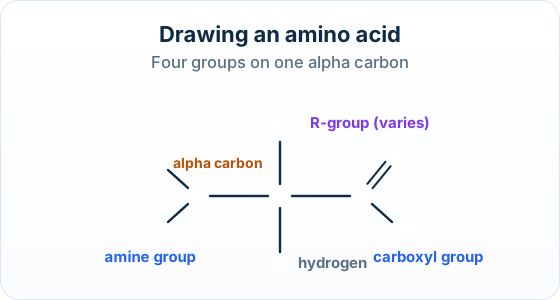
Real example: glycine and valine: In glycine the R-group is just H; in valine it is CH(CH₃)₂. Everything else in the drawing is the same.
How this is tested: Paper 1A tests the R group and element composition. Paper 2 tests the whole structure.
What you may be asked
- Paper 1A: a multiple-choice question often shows the structure of a named amino acid (such as leucine). You identify the part that is the variable R group — the side chain that makes one amino acid differ from another.
- Paper 1A: you are given the element composition of two molecules and asked which one is the protein / amino acid. The answer is the one that contains nitrogen.
- Paper 2: you may be asked to draw or label the generalized structure of an amino acid, showing all four groups on the central carbon.
Exam-style question — draw a labelled amino acid
Draw the generalized structure of an amino acid and label its four groups. [3]
How to score all three marks
- Start with the central carbon. Draw one central carbon atom in the middle, with four bonds coming off it (up, down, left and right).
- Add the three fixed groups. Label an amino group (—NH₂), a carboxyl group (—COOH) and a single hydrogen (—H) on three of the four bonds. (These are the same in every amino acid.)
- Add the variable group. Label the fourth bond as the variable R group (side chain). (Award 1 mark for the central carbon with four bonds, 1 mark for correctly labelling the amino + carboxyl groups, 1 mark for the H and the R group.)
Final answer
A central carbon bonded to: an amino group (—NH₂), a carboxyl group (—COOH), a hydrogen (—H) and a variable R group.
The generalized amino acid: one central carbon bonded to an amino group (—NH₂), a carboxyl group (—COOH), a hydrogen (—H) and a variable R group (the side chain).
Interactive diagram
Explore the labelled diagram, charts and maps for this topic in full study mode.
What the diagram must show: All four groups must be on the one central carbon: amino group, carboxyl group, hydrogen and the R group.
Marking down usually comes from leaving out the R group or forgetting that the amino and carboxyl groups are both present.
| Group on the central carbon | Chemical formula | Same or different between amino acids? |
|---|---|---|
| Amino group | —NH₂ (contains nitrogen) | Same in all amino acids |
| Carboxyl group | —COOH (an acid group) | Same in all amino acids |
| Hydrogen | —H | Same in all amino acids |
| R group (side chain) | varies (—R) | DIFFERENT — this is what makes the 20 amino acids distinct |
A three-mark drawing in the Paper 2 style:
Draw the generalized structure of an amino acid.
Model answer plan
See the answer broken into clear points, with guidance on how each point earns marks.