aımnova
DashboardMy LearningCrash CoursesStudy Plan

Aimnova site navigation

Stay in the loop

Get the latest study resources and updates

New features, study tips and exam insights — straight to your inbox.

IB Diploma

  • IB Past Papers
  • IB Study Notes
  • IB Question Bank
  • IB Mock Exams
  • IB Revision

IB Subjects

  • IB Math AA
  • IB Math AI
  • IB Economics
  • IB Business Management
  • IB Physics
  • IB Biology
  • View all IB subjects→

IB Past Papers

  • IB Math AA HL Past Papers
  • IB Math AA SL Past Papers
  • IB Math AI HL Past Papers
  • IB Math AI SL Past Papers
  • IB Economics HL Past Papers
  • IB Economics SL Past Papers
  • IB ESS Past Papers
  • View all past papers→

Study Resources

  • Study Notes
  • Question Bank
  • Mock Exams
  • Crash Courses
  • Flashcards
  • Revision Guide
  • Exam Skills
  • Command Terms
  • Grade Calculator
  • Exam Timetable 2026

Aimnova

  • Features
  • Pricing
  • For Teachers
  • For Schools
  • For Parents
  • About Us
  • Blog
  • Contact
aımnova

IB study, practice and feedback built around the real exam.

TermsPrivacyCookies·© 2026 Aimnova. All rights reserved.c90f7ab

Aimnova is not affiliated with or endorsed by the International Baccalaureate Organization (IB).

NotesBiologyTopic 2.1Non-polar steroids pass through the phospholipid bilayer
Back to Biology Topics
2.1.133 min read

Non-polar steroids pass through the phospholipid bilayer

IB Biology · Unit 2

AI-powered feedback

Stop guessing — know where you lost marks

Get instant, examiner-style feedback on every answer. See exactly how to improve and what the markscheme expects.

Try It Free

Contents

  1. 1Recognising a steroid
  2. 2Steroids pass through the bilayer
  3. 3Exam-style question (step by step)
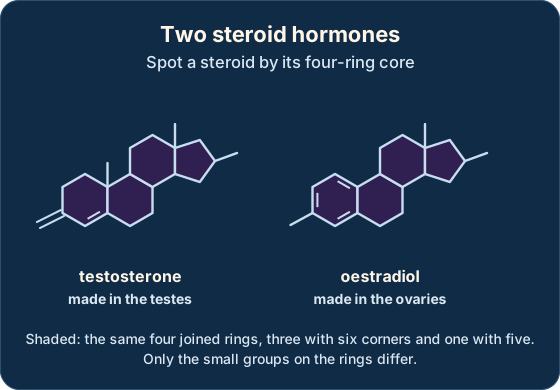
The big idea: A steroid is a lipid with a core of four joined rings. Spot the rings and you have spotted a steroid.

The points to remember

  • Steroids are lipids.
  • Every steroid has the same core: four joined rings, three with six corners and one with five.
  • Testosterone and oestradiol are steroid hormones; cholesterol is a steroid too.
  • Steroids differ only in the small groups on the rings (=O, -OH, CH₃) and any side chain.
  • To identify a steroid in a diagram, look for the 6-6-6-5 rings.
Remember it as: Six, six, six, five: a steroid.
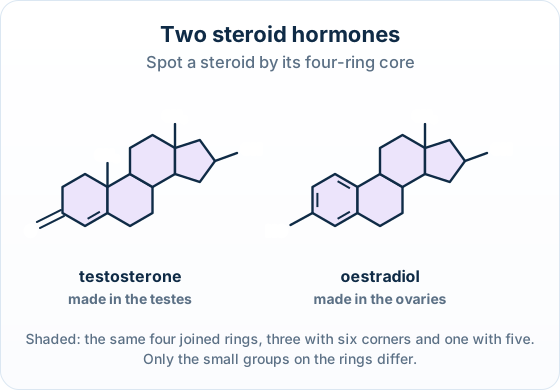
Testosterone and oestradiol drawn side by side, each on the same shaded core of three six-sided rings and one five-sided ring, with small groups such as OH, a C=O and CH3 on the ringsTestosterone and oestradiol drawn side by side, each on the same shaded core of three six-sided rings and one five-sided ring, with small groups such as OH, a C=O and CH3 on the rings
Same four-ring core, different small groups.
Real example: testosterone: Testosterone, made in the testes, travels in the blood to muscle cells and passes straight into them, where it helps build muscle.

Free preview

This is the free notes preview

You're reading the free notes. Aimnova Pro unlocks the full study experience — and you can try it with your first topic free to keep:

  • FlashcardsLock in vocabulary and key terms with spaced repetition.
  • Practice questionsAnswer exam-style questions and get instant AI marking.
  • Mock exams & past-paper vaultSit full mocks and see exactly how examiners award marks.
  • Personalised study planA daily plan built around your exam date and weak areas.
Start Studying Free Full access to Aimnova Pro · cancel anytime
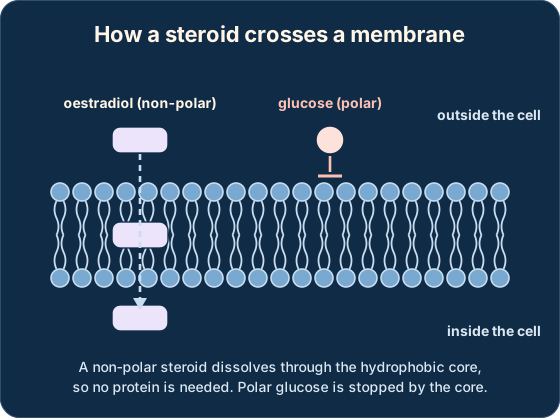
The big idea: Steroids are non-polar, so they dissolve through the hydrophobic core of a membrane and need no protein to cross it.

The points to remember

  • Steroids are almost entirely carbon and hydrogen, so they are non-polar.
  • Non-polar molecules dissolve in the hydrophobic core of the phospholipid bilayer.
  • So steroids pass freely between the phospholipids, with no protein needed.
  • Polar molecules such as glucose and ions are stopped by the core and need proteins.
  • Steroid hormones can therefore act inside their target cells.
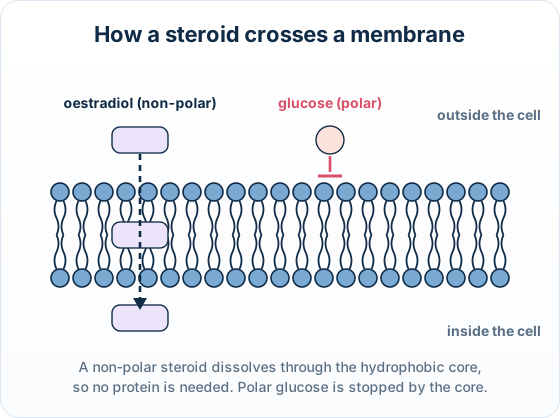
A phospholipid bilayer: oestradiol, non-polar, passes straight through the middle; glucose, polar, is stopped at the surfaceA phospholipid bilayer: oestradiol, non-polar, passes straight through the middle; glucose, polar, is stopped at the surface
Non-polar steroids dissolve through the hydrophobic core.

Steroids (non-polar)

  • Oestradiol, testosterone
  • Dissolve in the hydrophobic core
  • Pass freely, no protein

Polar molecules

  • Glucose, ions, amino acids
  • Repelled by the core
  • Need channel or carrier proteins
Not amphipathic, not through channels: A steroid crosses between the phospholipids because it is non-polar. It does not need a channel protein, and it is not amphipathic like a phospholipid.

Learn what examiners really want

See exactly what to write to score full marks. Our AI shows you model answers and the key phrases examiners look for.

Try AI Feedback FreeYour first topic is free to keep • No credit card required
How it is asked: Multiple-choice items: a steroid drawn as a diagram to identify and describe, how oestradiol crosses a membrane, and which molecule passes through which part of the membrane.
IB-style questionIdentify[1 mark]

Oestradiol is a steroid hormone. How does oestradiol cross plasma membranes?

Model answer plan

See the answer broken into clear points, with guidance on how each point earns marks.

Claim your free topic

And a diagram item:

IB-style questionIdentify[1 mark]

A simplified diagram of a molecule with four joined rings, OH groups and two CH₃ groups is shown. What describes the molecule?

Model answer plan

See the answer broken into clear points, with guidance on how each point earns marks.

Claim your free topic

Try an IB Exam Question — Free AI Feedback

Test yourself on Non-polar steroids pass through the phospholipid bilayer. Write your answer and get instant AI feedback — just like a real IB examiner.

Testosterone is made in the testes but acts inside muscle cells.

how testosterone can enter muscle cells.
[2 marks]

Related Biology Topics

Continue learning with these related topics from the same unit:

2.1.1Chemical properties of carbon that allow diverse compounds2.1.2Production of macromolecules by condensation reactions2.1.3Digestion of polymers into monomers by hydrolysis reactions2.1.4Form and function of monosaccharides
View all Biology topics
Improve your exam techniqueCommand terms, paper structure, and mark-scheme tips for Biology
Previous2.1.12Formation of phospholipid bilayers from hydrophilic and hydrophobic regionsNextGeneralized structure of an amino acid2.2.1

13 exam-style questions ready for you

Students who practice on Aimnova improve their scores by 15% on average. Get instant feedback that shows exactly how to improve your answers.

Practice Now — FreeView All Biology Topics