aımnova
DashboardMy LearningCrash CoursesStudy Plan

Aimnova site navigation

Stay in the loop

Get the latest study resources and updates

New features, study tips and exam insights — straight to your inbox.

IB Diploma

  • IB Past Papers
  • IB Study Notes
  • IB Question Bank
  • IB Mock Exams
  • IB Revision

IB Subjects

  • IB Math AA
  • IB Math AI
  • IB Economics
  • IB Business Management
  • IB Physics
  • IB Biology
  • View all IB subjects→

IB Past Papers

  • IB Math AA HL Past Papers
  • IB Math AA SL Past Papers
  • IB Math AI HL Past Papers
  • IB Math AI SL Past Papers
  • IB Economics HL Past Papers
  • IB Economics SL Past Papers
  • IB ESS Past Papers
  • View all past papers→

Study Resources

  • Study Notes
  • Question Bank
  • Mock Exams
  • Crash Courses
  • Flashcards
  • Revision Guide
  • Exam Skills
  • Command Terms
  • Grade Calculator
  • Exam Timetable 2026

Aimnova

  • Features
  • Pricing
  • For Teachers
  • For Schools
  • For Parents
  • About Us
  • Blog
  • Contact
aımnova

IB study, practice and feedback built around the real exam.

TermsPrivacyCookies·© 2026 Aimnova. All rights reserved.06bfe1b

Aimnova is not affiliated with or endorsed by the International Baccalaureate Organization (IB).

NotesBiologyTopic 2.10Adaptations of herbivores for feeding on plants and of plants for resisting herbivory
Back to Biology Topics
2.10.93 min read

Adaptations of herbivores for feeding on plants and of plants for resisting herbivory

IB Biology · Unit 2

IB exam ready

Study like the top scorers do

Access a smart study planner, AI tutor, and exam vault — everything you need to hit your target grade.

Start Free

Contents

  1. 1Herbivores: adapted to eat plants
  2. 2Plants: resisting herbivores
  3. 3Exam-style question (step by step)
The big idea: Plants are tough to eat and hard to digest. Herbivores have adaptations for getting at them, breaking them down and coping with their toxins.
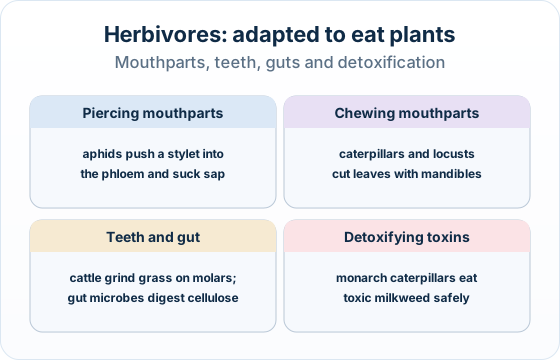
Four cards appearing one at a time: piercing mouthparts of aphids, chewing mouthparts of caterpillars and locusts, the grinding teeth and long gut of cattle, and monarch caterpillars eating toxic milkweed
Herbivore adaptations, one at a time.

The points to remember

  • Piercing mouthparts: aphids and other bugs suck sap through a stylet.
  • Chewing mouthparts: caterpillars and locusts bite leaves with mandibles.
  • Mammals: grinding molars, a long gut, and microbes that digest cellulose.
  • Some herbivores can detoxify the toxins in plants.

Real example: the giraffe. Giraffes strip leaves from thorny acacia trees with a long, tough tongue and thick saliva, so the thorns do little to stop them.

Free preview

This is the free notes preview

You're reading the free notes. Aimnova Pro unlocks the full study experience — and you can try it with your first topic free to keep:

  • FlashcardsLock in vocabulary and key terms with spaced repetition.
  • Practice questionsAnswer exam-style questions and get instant AI marking.
  • Mock exams & past-paper vaultSit full mocks and see exactly how examiners award marks.
  • Personalised study planA daily plan built around your exam date and weak areas.
Start Studying Free Full access to Aimnova Pro · cancel anytime
The big idea: Plants cannot run away. They resist herbivores with physical structures and with toxic secondary compounds in their leaves and seeds.
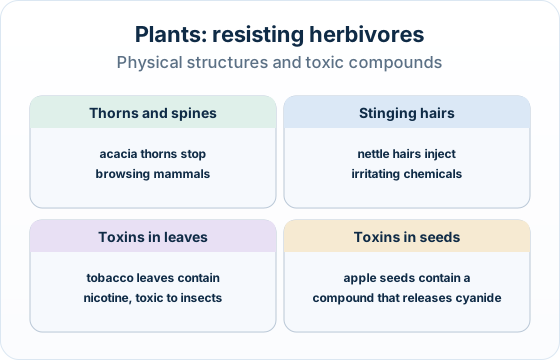
Four cards appearing one at a time: acacia thorns, nettle stinging hairs, nicotine in tobacco leaves and a cyanide-releasing compound in apple seeds
Plant defences, one at a time.

The points to remember

  • Physical: thorns, spines and stinging hairs.
  • Chemical: toxic secondary compounds in leaves and seeds.
  • Some herbivores evolve ways to detoxify them: an arms race.
Remember it as: Herbivores: get in, break down, detoxify. Plants: spike, sting, poison.

Real example: monarch caterpillars. Milkweed leaves contain toxins that poison most animals; monarch butterfly caterpillars eat them safely and store the toxins, which makes them distasteful to birds.

Trap: Questions often ask for both sides: give herbivore adaptations and plant defences, with an example of each.

Study smarter, not longer

Most students waste 40% of study time on topics they already know. Our AI tracks your progress and optimizes every minute.

Try Smart Study FreeYour first topic is free to keep • No credit card required
How it is asked: Expect one way plants resist herbivores, the benefit of plant toxins, or herbivore adaptations and plant defences together in a longer answer.
IB-style questionOutline[4 marks]

Outline adaptations of herbivores for feeding on plants and of plants for resisting herbivory.

Model answer plan

See the answer broken into clear points, with guidance on how each point earns marks.

Claim your free topic

Try an IB Exam Question — Free AI Feedback

Test yourself on Adaptations of herbivores for feeding on plants and of plants for resisting herbivory. Write your answer and get instant AI feedback — just like a real IB examiner.

Acacia trees grow in African savannas, where giraffes and antelopes browse.

one way in which plants can protect themselves from herbivores.
[1 mark]

Related Biology Topics

Continue learning with these related topics from the same unit:

2.1.1Chemical properties of carbon that allow diverse compounds2.1.2Production of macromolecules by condensation reactions2.1.3Digestion of polymers into monomers by hydrolysis reactions2.1.4Form and function of monosaccharides
View all Biology topics
Improve your exam techniqueCommand terms, paper structure, and mark-scheme tips for Biology
Previous2.10.8Relationship between dentition and the diet of omnivorous and herbivorous representative members of the family HominidaeNextAdaptations of predators for finding, catching and killing prey and of prey animals for resisting predation2.10.10

19 questions to test your understanding

Reading is just the start. Students who tested themselves scored 82% on average — try IB-style questions with AI feedback.

Start FreeView All Biology Topics