aımnova
DashboardMy LearningCrash CoursesStudy Plan

Aimnova site navigation

Stay in the loop

Get the latest study resources and updates

New features, study tips and exam insights — straight to your inbox.

IB Diploma

  • IB Past Papers
  • IB Study Notes
  • IB Question Bank
  • IB Mock Exams
  • IB Revision

IB Subjects

  • IB Math AA
  • IB Math AI
  • IB Economics
  • IB Business Management
  • IB Physics
  • IB Biology
  • View all IB subjects→

IB Past Papers

  • IB Math AA HL Past Papers
  • IB Math AA SL Past Papers
  • IB Math AI HL Past Papers
  • IB Math AI SL Past Papers
  • IB Economics HL Past Papers
  • IB Economics SL Past Papers
  • IB ESS Past Papers
  • View all past papers→

Study Resources

  • Study Notes
  • Question Bank
  • Mock Exams
  • Crash Courses
  • Flashcards
  • Revision Guide
  • Exam Skills
  • Command Terms
  • Grade Calculator
  • Exam Timetable 2026

Aimnova

  • Features
  • Pricing
  • For Teachers
  • For Schools
  • For Parents
  • About Us
  • Blog
  • Contact
aımnova

IB study, practice and feedback built around the real exam.

TermsPrivacyCookies·© 2026 Aimnova. All rights reserved.06bfe1b

Aimnova is not affiliated with or endorsed by the International Baccalaureate Organization (IB).

NotesBiologyTopic 2.10Adaptations of predators for finding, catching and killing prey and of prey animals for resisting predation
Back to Biology Topics
2.10.103 min read

Adaptations of predators for finding, catching and killing prey and of prey animals for resisting predation

IB Biology · Unit 2

Your first topic is free to keep

Know exactly what to write for full marks

Practice with exam questions and get AI feedback that shows you the perfect answer — what examiners want to see.

Start Free

Contents

  1. 1Predators: find, catch, kill
  2. 2Prey: resisting predation
  3. 3Exam-style question (step by step)
The big idea: Predators have chemical, physical and behavioural adaptations for finding, catching and killing their prey.
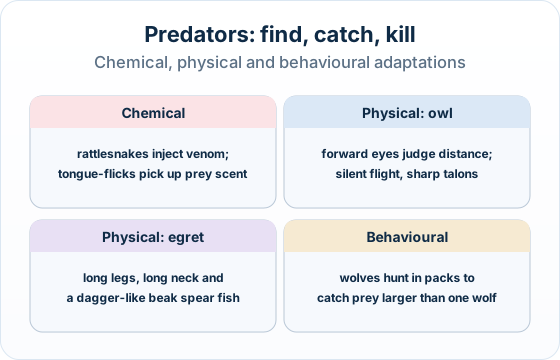
Four cards appearing one at a time: rattlesnake venom and tongue-flicking, the barn owl's eyes, silent flight and talons, the great egret's long legs, neck and beak, and wolves hunting in packs
Predator adaptations, one at a time.

The points to remember

  • Chemical: venom to kill or paralyse; a keen sense of smell to find prey.
  • Physical: forward-facing eyes, sharp talons, claws or teeth, long legs and beaks, speed.
  • Behavioural: hunting in packs, ambushing, stalking, hunting when prey are active.

Real example: the barn owl. Barn owls hunt in the dark: their dish-shaped face funnels sound to ears set at different heights, so they can pinpoint a mouse by hearing alone, and soft feathers make their flight almost silent.

Free preview

This is the free notes preview

You're reading the free notes. Aimnova Pro unlocks the full study experience — and you can try it with your first topic free to keep:

  • FlashcardsLock in vocabulary and key terms with spaced repetition.
  • Practice questionsAnswer exam-style questions and get instant AI marking.
  • Mock exams & past-paper vaultSit full mocks and see exactly how examiners award marks.
  • Personalised study planA daily plan built around your exam date and weak areas.
Start Studying Free Full access to Aimnova Pro · cancel anytime
The big idea: Prey resist predation with chemical, physical and behavioural adaptations: they avoid being found, caught or eaten.
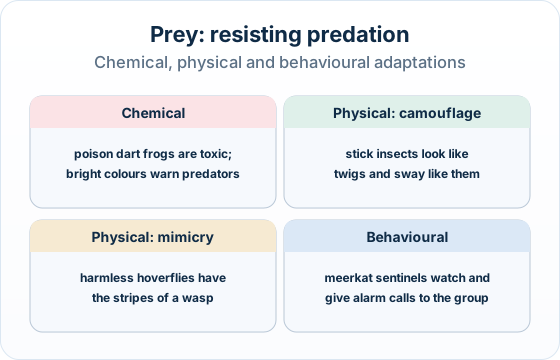
Four cards appearing one at a time: toxic poison dart frogs with warning colours, stick insect camouflage, hoverflies mimicking wasps, and meerkat sentinels giving alarm calls
Prey adaptations, one at a time.

The points to remember

  • Chemical: toxins or foul tastes, often with warning colours.
  • Physical: camouflage, spines, shells, mimicry of a dangerous species.
  • Behavioural: vigilance, alarm calls, living in groups, signals such as stotting.
Remember it as: Sort every adaptation: chemical, physical or behavioural?

Real example: stotting gazelles. Thomson's gazelles that spot a cheetah often stot, leaping stiff-legged into the air; cheetahs are less likely to chase a gazelle that stots, perhaps because it signals that it is fit and will be hard to catch.

Trap: Classify carefully: looking like a bee is physical; feeding among bees is behavioural.

Never wonder what to study next

Get a personalized daily plan based on your exam date, progress, and weak areas. We'll tell you exactly what to review each day.

Try Free Study PlanYour first topic is free to keep • No credit card required
How it is asked: Expect an adaptation of a named predator or prey, classifying adaptations as chemical, physical or behavioural, or data from an experiment on predator and prey behaviour.
IB-style questionSuggest[3 marks]

Suggest three ways in which a small bird feeding on the ground can reduce its risk of being eaten.

Model answer plan

See the answer broken into clear points, with guidance on how each point earns marks.

Claim your free topic

Try an IB Exam Question — Free AI Feedback

Test yourself on Adaptations of predators for finding, catching and killing prey and of prey animals for resisting predation. Write your answer and get instant AI feedback — just like a real IB examiner.

In oystercatchers, females have longer bills than males. Females eat more worms dug from mud; males eat more mussels from rocks.

a reason for the prey preference of the females compared with the males.
[1 mark]

Related Biology Topics

Continue learning with these related topics from the same unit:

2.1.1Chemical properties of carbon that allow diverse compounds2.1.2Production of macromolecules by condensation reactions2.1.3Digestion of polymers into monomers by hydrolysis reactions2.1.4Form and function of monosaccharides
View all Biology topics
Improve your exam techniqueCommand terms, paper structure, and mark-scheme tips for Biology
Previous2.10.9Adaptations of herbivores for feeding on plants and of plants for resisting herbivoryNextAdaptations of plant form for harvesting light2.10.11

19 questions to test your understanding

Reading is just the start. Students who tested themselves scored 82% on average — try IB-style questions with AI feedback.

Start FreeView All Biology Topics