aımnova
DashboardMy LearningCrash CoursesStudy Plan

Aimnova site navigation

Stay in the loop

Get the latest study resources and updates

New features, study tips and exam insights — straight to your inbox.

IB Diploma

  • IB Past Papers
  • IB Study Notes
  • IB Question Bank
  • IB Mock Exams
  • IB Revision

IB Subjects

  • IB Math AA
  • IB Math AI
  • IB Economics
  • IB Business Management
  • IB Physics
  • IB Biology
  • View all IB subjects→

IB Past Papers

  • IB Math AA HL Past Papers
  • IB Math AA SL Past Papers
  • IB Math AI HL Past Papers
  • IB Math AI SL Past Papers
  • IB Economics HL Past Papers
  • IB Economics SL Past Papers
  • IB ESS Past Papers
  • View all past papers→

Study Resources

  • Study Notes
  • Question Bank
  • Mock Exams
  • Crash Courses
  • Flashcards
  • Revision Guide
  • Exam Skills
  • Command Terms
  • Grade Calculator
  • Exam Timetable 2026

Aimnova

  • Features
  • Pricing
  • For Teachers
  • For Schools
  • For Parents
  • About Us
  • Blog
  • Contact
aımnova

IB study, practice and feedback built around the real exam.

TermsPrivacyCookies·© 2026 Aimnova. All rights reserved.06bfe1b

Aimnova is not affiliated with or endorsed by the International Baccalaureate Organization (IB).

NotesBiologyTopic 2.10Relationship between dentition and the diet of omnivorous and herbivorous representative members of the family Hominidae
Back to Biology Topics
2.10.83 min read

Relationship between dentition and the diet of omnivorous and herbivorous representative members of the family Hominidae

IB Biology · Unit 2

Your first topic is free to keep

Know exactly what to write for full marks

Practice with exam questions and get AI feedback that shows you the perfect answer — what examiners want to see.

Start Free

Contents

  1. 1Teeth and diet in the Hominidae
  2. 2Exam-style question (step by step)
The big idea: Teeth reveal diet. By comparing the skulls of living and extinct members of the Hominidae, we can deduce whether each was an omnivore or a herbivore.
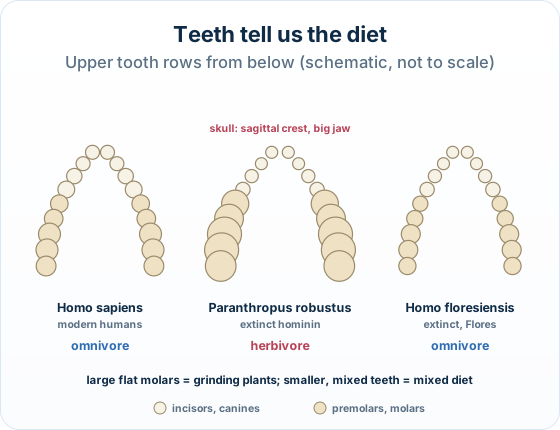
Three upper tooth rows seen from below: Homo sapiens with small front teeth and medium molars, Paranthropus robustus with very large molars and a note on its sagittal crest, and Homo floresiensis with small teeth, then the rule linking large grinding molars to plant food
Three skulls, one at a time.

The points to remember

  • Herbivore features: large, flat premolars and molars, thick enamel, big jaw, a sagittal crest for large chewing muscles.
  • Omnivore features: smaller molars and a mix of tooth types for plants and meat.
  • Paranthropus robustus: herbivore. Homo sapiens and Homo floresiensis: omnivores.
  • Theories from living mammals let us deduce the diet of extinct species.
Remember it as: Big flat grinders = plants; smaller mixed teeth = mixed diet.

Real example: Paranthropus robustus. Skulls of Paranthropus robustus, about 1 to 2 million years old, come from cave sites in South Africa; their huge, thick-enamelled molars point to a diet of tough plant food.

Trap: Name the feature and link it to what it does with the food: 'large molars' alone is not enough; 'large, flat molars that grind tough plants' is.

Free preview

This is the free notes preview

You're reading the free notes. Aimnova Pro unlocks the full study experience — and you can try it with your first topic free to keep:

  • FlashcardsLock in vocabulary and key terms with spaced repetition.
  • Practice questionsAnswer exam-style questions and get instant AI marking.
  • Mock exams & past-paper vaultSit full mocks and see exactly how examiners award marks.
  • Personalised study planA daily plan built around your exam date and weak areas.
Start Studying Free Full access to Aimnova Pro · cancel anytime
How it is asked: Expect skull or teeth features to interpret, a comparison of an omnivore and a herbivore, or how the diet of an extinct species can be deduced.
IB-style questionDeduce[3 marks]

A fossil hominin skull has very large, flat molars with thick enamel, a heavy jaw and a sagittal crest. Deduce its diet, giving reasons.

Model answer plan

See the answer broken into clear points, with guidance on how each point earns marks.

Claim your free topic

Try an IB Exam Question — Free AI Feedback

Test yourself on Relationship between dentition and the diet of omnivorous and herbivorous representative members of the family Hominidae. Write your answer and get instant AI feedback — just like a real IB examiner.

A fossil hominin skull has small incisors and canines and medium-sized molars with thin enamel. There is no sagittal crest.

the likely diet of this hominin, giving a reason.
[2 marks]

Related Biology Topics

Continue learning with these related topics from the same unit:

2.1.1Chemical properties of carbon that allow diverse compounds2.1.2Production of macromolecules by condensation reactions2.1.3Digestion of polymers into monomers by hydrolysis reactions2.1.4Form and function of monosaccharides
View all Biology topics
Improve your exam techniqueCommand terms, paper structure, and mark-scheme tips for Biology
Previous2.10.7Diversity of nutrition in archaeaNextAdaptations of herbivores for feeding on plants and of plants for resisting herbivory2.10.9

6 questions to test your understanding

Reading is just the start. Students who tested themselves scored 82% on average — try IB-style questions with AI feedback.

Start FreeView All Biology Topics