The big idea: A species' niche is its full role — the conditions it can tolerate, the resources it uses and how it interacts with other species.
Competitive exclusion: When two species need the same limited resource, they compete. The competitive exclusion principle says two species cannot occupy the exact same niche indefinitely — one is driven out, or they divide the resource between them.
Fundamental niche
- The niche a species could occupy
- Often bigger than the realized niche
Realized niche
- The niche it actually occupies once competitors are present
- Smaller, because of competition
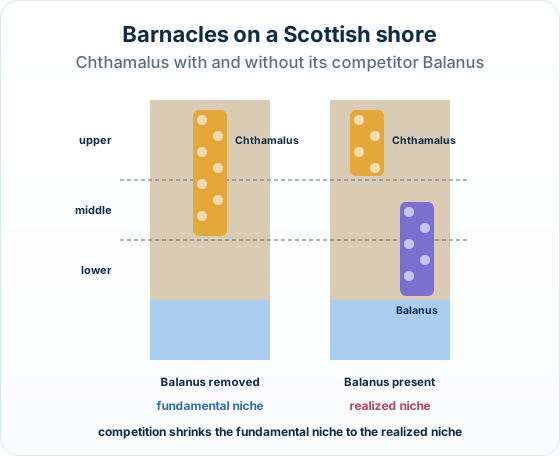
Species A alone occupies its full fundamental niche; add competitor B and each species is restricted to a smaller realized niche along the resource gradient — the competitive exclusion principle.
Interactive diagram
Explore the labelled diagram, charts and maps for this topic in full study mode.
- Ecological niche
- An organism's role in its ecosystem: the abiotic conditions it tolerates, the resources it uses, and its interactions with other species.
- Competition (interspecific)
- An interaction in which two different species both need the same limited resource, so each reduces the amount available to the other.
- Competitive exclusion principle
- Two species cannot occupy exactly the same niche in the same place indefinitely; the stronger competitor excludes the weaker, unless they divide the resource.
- Fundamental niche
- The full range of conditions and resources a species COULD use if there were no competitors present.
- Realized niche
- The smaller part of the fundamental niche a species ACTUALLY occupies once competition from other species restricts it.
- Resource partitioning
- When competing species divide a shared resource (by space, time or type) so each uses a different part and they can coexist.
Fundamental = potential, realized = actual: Think of it as could versus does.
The fundamental niche is what a species could occupy with no rivals.
The realized niche is what it actually occupies once a competitor squeezes it into a smaller space. The realized niche is therefore never larger than the fundamental one.
Free preview
This is the free notes preview
You're reading the free notes. Aimnova Pro unlocks the full study experience — and you can try it with your first topic free to keep:
- FlashcardsLock in vocabulary and key terms with spaced repetition.
- Practice questionsAnswer exam-style questions and get instant AI marking.
- Mock exams & past-paper vaultSit full mocks and see exactly how examiners award marks.
- Personalised study planA daily plan built around your exam date and weak areas.
The big idea: The fundamental niche is set by a species' adaptations and tolerance limits. The realized niche is the part it actually occupies when competitors are present.
The points to remember
- Fundamental niche: the potential range, with no competitors.
- Realized niche: the actual range, with competitors present.
- The realized niche is never larger than the fundamental niche.
- In data: the species alone shows its fundamental niche; with a competitor, its realized niche.
Remember it as: Fundamental = could; realized = does.
Real example: Connell's barnacles. On the Isle of Cumbrae in Scotland in the 1950s, Joseph Connell removed Balanus barnacles from patches of rock: Chthamalus barnacles then settled and survived lower down the shore than before.
Trap: Do not call the fundamental niche 'perfect' or 'ideal': say it is the potential niche, limited only by adaptations and tolerance.
Never wonder what to study next
Get a personalized daily plan based on your exam date, progress, and weak areas. We'll tell you exactly what to review each day.
How it is asked: Expect graphs or descriptions of a species alone and with a competitor, or a request to distinguish the two niches.
A grass grows from 0 to 60 cm above a stream when alone, but only from 0 to 20 cm when a taller grass grows beside it. Identify the type of niche shown in each case.
Model answer plan
See the answer broken into clear points, with guidance on how each point earns marks.