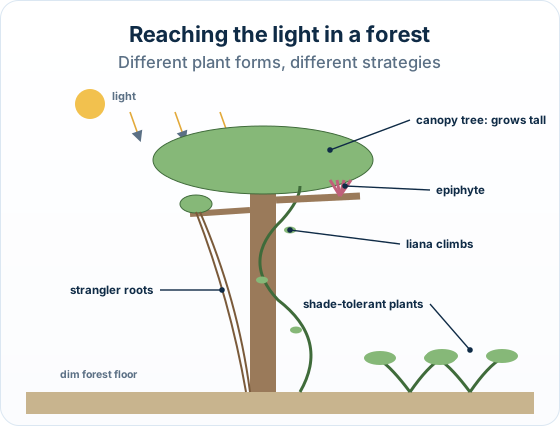
The big idea: In a forest, light is the resource in shortest supply. Plants have different forms that let them harvest it: by growing tall, climbing, perching, or coping with shade.
The points to remember
- Canopy trees grow tall to spread leaves in full sun.
- Lianas climb other trees to reach the light without a thick trunk.
- Epiphytes grow on high branches; strangler epiphytes also send roots to the soil.
- Shade-tolerant shrubs and herbs have large, thin leaves for the dim forest floor.
Remember it as: Tall, climb, perch, strangle, or tolerate shade.
Real example: strangler figs. In rainforests, birds drop fig seeds high on tree branches; the young strangler fig grows in the light, sends roots down to the soil and can eventually surround and kill its host tree.
Trap: Epiphytes are not parasites: they use the tree for support and light, not for food or water.
Free preview
This is the free notes preview
You're reading the free notes. Aimnova Pro unlocks the full study experience — and you can try it with your first topic free to keep:
- FlashcardsLock in vocabulary and key terms with spaced repetition.
- Practice questionsAnswer exam-style questions and get instant AI marking.
- Mock exams & past-paper vaultSit full mocks and see exactly how examiners award marks.
- Personalised study planA daily plan built around your exam date and weak areas.
Start Studying Free Full access to Aimnova Pro · cancel anytime
How it is asked: Expect the advantage of growing on a branch, how a named forest plant reaches light, or a description of several forest strategies.
IB-style questionExplain[3 marks]
Explain how a strangler fig is adapted to obtain light in a rainforest.
Model answer plan
See the answer broken into clear points, with guidance on how each point earns marks.