When a species lives alone, it spreads across its whole fundamental niche — every part of the gradient (light, depth, temperature, food size) that it can tolerate.
Add a competitor that needs the same resource, and the overlap becomes a battleground. Whichever species is the better competitor in a given part of the gradient wins that part; the other is pushed out of it.
Two ways competition can end: There are two possible outcomes when species compete for the same niche.
1. Competitive exclusion
- One species is the stronger competitor everywhere
- The weaker one cannot persist and disappears from that habitat
- Only one species remains
2. Resource partitioning
- Each species is the better competitor in a different part of the gradient
- They split the resource and coexist in separate zones
- Each ends up in a realized niche smaller than its fundamental one
| Outcome of competition | What happens | Result you see in the field |
|---|---|---|
| Competitive exclusion | The stronger competitor takes the shared resource; the weaker one cannot persist there | Only one species is found in that habitat / zone |
| Resource partitioning | Each species shifts to the part of the resource it uses best | The two species coexist but in SEPARATE, non-overlapping zones or habitats |
Why species end up in separate zones: This is the cause–effect chain to give:
two species need the same resource → they compete where their tolerances overlap → each is the better competitor in one part of the gradient → each is excluded from the part it loses → the result is separate, non-overlapping zones or habitats, with each species in its realized (not fundamental) niche.
Fundamental niche (alone)
- The full range the species could use
- Measured with no competitors present
- Larger — the species' whole potential
- Set only by the species' own abiotic tolerances
Realized niche (with competitor)
- The part the species actually uses
- Measured with a competitor present
- Smaller — squeezed by competition
- Set by tolerances plus competition from other species
Reading the data: On a graph or transect, the separate, non-overlapping distribution of two species is the fingerprint of competition.
Where one species grows alone you are seeing its fundamental niche; where the two grow together and each is squeezed into a narrower band, you are seeing their realized niches.
Free preview
This is the free notes preview
You're reading the free notes. Aimnova Pro unlocks the full study experience — and you can try it with your first topic free to keep:
- FlashcardsLock in vocabulary and key terms with spaced repetition.
- Practice questionsAnswer exam-style questions and get instant AI marking.
- Mock exams & past-paper vaultSit full mocks and see exactly how examiners award marks.
- Personalised study planA daily plan built around your exam date and weak areas.
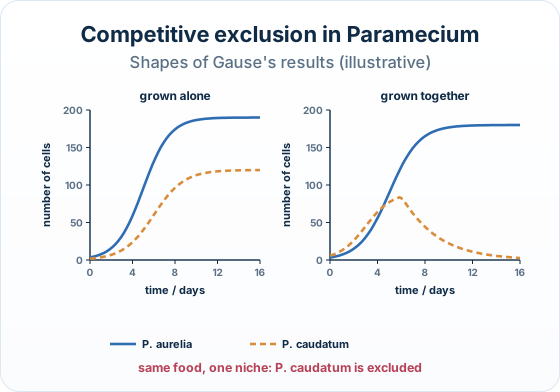
The big idea: Each species has a unique niche. Two species cannot share exactly the same niche for long: the competitive exclusion principle.
The points to remember
- Two species competing for the same limited resources cannot coexist indefinitely.
- Outcome 1: one species is eliminated from the area (competitive exclusion).
- Outcome 2: both are restricted to part of their fundamental niche, often in separate zones.
- So no two species in a community have exactly the same niche.
Remember it as: Same niche, one winner; overlapping niches, both shrink.
Real example: red and grey squirrels. Grey squirrels, brought to Britain from North America, have replaced native red squirrels across most of England; greys get more energy from acorns, so where both live, the reds lose the competition.
Trap: Competition between different species is interspecific. Do not call it intraspecific, which is competition within one species.
Never wonder what to study next
Get a personalized daily plan based on your exam date, progress, and weak areas. We'll tell you exactly what to review each day.
How this is tested: This micro is a data-question favourite.
| Question | What it asks | How to score |
|---|---|---|
| Two graphs | Graphs of two species grown separately and together: identify which niche type each graph shows | Alone is the fundamental niche, together is the narrower realized niche |
| 2-mark Outline | The factors that lead two related species to occupy separate habitats | Competition for the same resource, with each excluded from the part it loses (resource partitioning) |
| 3-mark Discuss | A transect: why do two species occupy different, non-overlapping zones? | Competitive exclusion and zonation |
Exam-style question — identify the niche from the data
Two barnacle species were studied on a rocky shore. When grown on its own, species P spread across the whole height of the shore. When species Q was also present, species P was found only on the upper shore. Identify the niche type shown by species P in each case, and explain your answer. [3]
How to score all three marks
- Name the niche when alone. When species P grows alone it covers the whole shore — this is its fundamental niche (the full range it can tolerate with no competitor).
- Name the niche when the competitor is present. With species Q present, P is restricted to the upper shore — this smaller range is P's realized niche.
- Explain the cause. Species Q is the better competitor on the lower shore, so it excludes P from there; P only persists where it competes successfully.
Final answer
Alone, P shows its fundamental niche (the whole shore); with Q present, P shows a smaller realized niche (upper shore only) because Q out-competes and excludes P from the lower shore.
Why this works: It pairs the data pattern with the correct term: whole range alone = fundamental, restricted range with a competitor = realized.
The third mark comes from the cause — the competitor excludes the species from the part it loses. Name the niches and explain the exclusion.
| Feature | Fundamental niche | Realized niche |
|---|---|---|
| What it is | The full range of conditions and resources a species COULD use | The smaller part a species ACTUALLY uses |
| Competitors present? | Imagined with NO competitors | With competitors present |
| Size | Larger — the species' full potential | Smaller — restricted by competition |
| Seen when | A species grows ALONE | A species grows ALONGSIDE a competitor |
| Set by | Abiotic tolerances of the species itself | Tolerances PLUS competition from other species |
Another question in the papers' style:
Explain why two species with identical niches cannot coexist in the same habitat for long.
Model answer plan
See the answer broken into clear points, with guidance on how each point earns marks.