aımnova
DashboardMy LearningCrash CoursesStudy Plan

Aimnova site navigation

Stay in the loop

Get the latest study resources and updates

New features, study tips and exam insights — straight to your inbox.

IB Diploma

  • IB Past Papers
  • IB Study Notes
  • IB Question Bank
  • IB Mock Exams
  • IB Revision

IB Subjects

  • IB Math AA
  • IB Math AI
  • IB Economics
  • IB Business Management
  • IB Physics
  • IB Biology
  • View all IB subjects→

IB Past Papers

  • IB Math AA HL Past Papers
  • IB Math AA SL Past Papers
  • IB Math AI HL Past Papers
  • IB Math AI SL Past Papers
  • IB Economics HL Past Papers
  • IB Economics SL Past Papers
  • IB ESS Past Papers
  • View all past papers→

Study Resources

  • Study Notes
  • Question Bank
  • Mock Exams
  • Crash Courses
  • Flashcards
  • Revision Guide
  • Exam Skills
  • Command Terms
  • Grade Calculator
  • Exam Timetable 2026

Aimnova

  • Features
  • Pricing
  • For Teachers
  • For Schools
  • For Parents
  • About Us
  • Blog
  • Contact
aımnova

IB study, practice and feedback built around the real exam.

TermsPrivacyCookies·© 2026 Aimnova. All rights reserved.c90f7ab

Aimnova is not affiliated with or endorsed by the International Baccalaureate Organization (IB).

NotesBiologyTopic 1.6Diversity in chromosome numbers of plant and animal species
Back to Biology Topics
1.6.63 min read

Diversity in chromosome numbers of plant and animal species

IB Biology · Unit 1

IB exam ready

Study like the top scorers do

Access a smart study planner, AI tutor, and exam vault — everything you need to hit your target grade.

Start Free

Contents

  1. 1Chromosome numbers differ between species
  2. 2How chromosome numbers change
  3. 3Exam-style question (step by step)
The big idea: Each species has its own number of chromosomes, and in body cells that number is always even.

The points to remember

  • Species differ in their chromosome number: there is great diversity.
  • Humans have 46 chromosomes; chimpanzees have 48.
  • Body cells are diploid: written 2n.
  • Chromosomes come in pairs, so a diploid number is always even.
  • Gametes are haploid (one set, n), so they hold half: 23 in a human egg or sperm.
Remember it as: Two of every kind: diploid numbers are even.
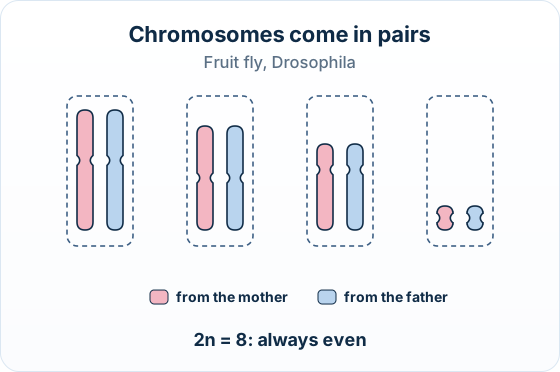
Four pairs of chromosomes of a fruit fly: in each pair one pink chromosome from the mother and one blue from the father, boxed together; note: 2n = 8, always even
One set from each parent: the total is even.
Real example: you and a chimpanzee: Your body cells hold 46 chromosomes in 23 pairs. A chimpanzee's hold 48 in 24 pairs, even though the two species share most of their genes.

Free preview

This is the free notes preview

You're reading the free notes. Aimnova Pro unlocks the full study experience — and you can try it with your first topic free to keep:

  • FlashcardsLock in vocabulary and key terms with spaced repetition.
  • Practice questionsAnswer exam-style questions and get instant AI marking.
  • Mock exams & past-paper vaultSit full mocks and see exactly how examiners award marks.
  • Personalised study planA daily plan built around your exam date and weak areas.
Start Studying Free Full access to Aimnova Pro · cancel anytime
The big idea: Chromosome numbers change over evolution: chromosomes can join, split, or whole sets can double.

The points to remember

  • Fusion: two chromosomes join, so the number falls (human chromosome 2 matches chimpanzee 12 and 13).
  • Fission: a chromosome splits in two, so the number rises.
  • Polyploidy: whole sets double, for example when all chromosomes fail to separate in meiosis, or DNA is copied without the cell dividing.
  • A change in chromosome number can lead to new species.
1

Fusion

Two join into one: 48 to 46 in the human line.

2

Fission

One splits into two: the number rises.

3

Polyploidy

Whole sets double: common in plants such as wheat.

Polyploidy, not an extra chromosome: One extra chromosome (a trisomy) is not polyploidy. Polyploidy doubles every chromosome set.

Feeling unprepared for exams?

Get a clear study plan, practice with real questions, and know exactly where you stand before exam day. No more guessing.

Get Exam Ready FreeYour first topic is free to keep • No credit card required
How it is tested: Paper 1B gives a table of chromosome numbers: notice that they are all even. HL Paper 2 can ask how the numbers came to differ.
IB-style questionSuggest[1 mark]

A table gives the chromosome numbers of the chimpanzee (48), dog (78), rice (24) and potato (48). Suggest, giving a reason, whether gametes or body cells were used to obtain these numbers.

Model answer plan

See the answer broken into clear points, with guidance on how each point earns marks.

Claim your free topic
The two numbers to know: Human 46, chimpanzee 48. Other numbers will be given to you.

IB Exam Questions on Diversity in chromosome numbers of plant and animal species

Practice with IB-style questions filtered to Topic 1.6.6. Get instant AI feedback on every answer.

Practice Topic 1.6.6 QuestionsBrowse All Biology Topics

How Diversity in chromosome numbers of plant and animal species Appears in IB Exams

Examiners use specific command terms when asking about this topic. Here's what to expect:

  • Define

    Give the precise meaning of key terms related to Diversity in chromosome numbers of plant and animal species.

    AO1
  • Describe

    Give a detailed account of processes or features in Diversity in chromosome numbers of plant and animal species.

    AO2
  • Explain

    Give reasons WHY — cause and effect within Diversity in chromosome numbers of plant and animal species.

    AO3
  • Evaluate

    Weigh strengths AND limitations of approaches in Diversity in chromosome numbers of plant and animal species.

    AO3
  • Discuss

    Present arguments FOR and AGAINST with a balanced conclusion.

    AO3

See the full IB Command Terms guide

Related Biology Topics

Continue learning with these related topics from the same unit:

1.1.1Water as the medium for life1.1.2Hydrogen bonds from the polar covalent bonds in water1.1.3Cohesion of water and its consequences for organisms1.1.4Adhesion of water to polar or charged materials
View all Biology topics
Improve your exam techniqueCommand terms, paper structure, and mark-scheme tips for Biology
Previous1.6.5Difficulties distinguishing between populations and speciesNextKaryotyping and karyograms1.6.7

5 questions to test your understanding

Reading is just the start. Students who tested themselves scored 82% on average — try IB-style questions with AI feedback.

Start FreeView All Biology Topics