The big idea: A karyogram shows a cell's chromosomes sorted into pairs. Making one is called karyotyping.
The points to remember
- Cells are stopped in metaphase, when chromosomes are most condensed and easy to see.
- The chromosomes are stained and photographed under a microscope.
- Each chromosome is matched with its homologous partner.
- Pairs are arranged by length, from the longest to the shortest, and numbered.
- The sex chromosomes go last: XX in a female, XY in a male.
Remember it as: Photograph, pair, line up by size.
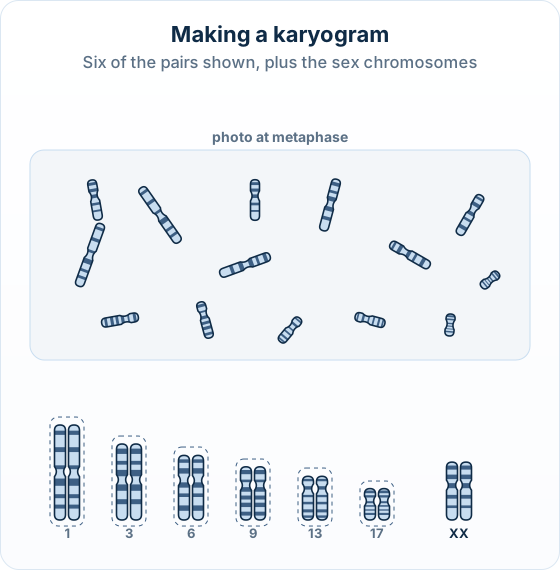
Real example: a hospital genetics lab: Hospital labs grow white blood cells from a blood sample, stop them at metaphase and photograph the chromosomes. A karyogram can show a missing or extra chromosome, such as the third chromosome 21 in Down syndrome.
Free preview
This is the free notes preview
You're reading the free notes. Aimnova Pro unlocks the full study experience — and you can try it with your first topic free to keep:
- FlashcardsLock in vocabulary and key terms with spaced repetition.
- Practice questionsAnswer exam-style questions and get instant AI marking.
- Mock exams & past-paper vaultSit full mocks and see exactly how examiners award marks.
- Personalised study planA daily plan built around your exam date and weak areas.
Start Studying Free Full access to Aimnova Pro · cancel anytime
The big idea: Chromosomes are classified by three features: length, the position of the centromere and the banding pattern.
The points to remember
- Length: pair 1 is the longest, the smallest come last.
- Centromere position: in the middle, off-centre, or near one end (acrocentric).
- Banding pattern: stains give each chromosome its own stripes, the same on both partners.
- Count every chromosome for the number: 46 in humans, 48 in chimpanzees.
- Look at the last pair for the sex: two matching X, female; a large X and a small Y, male.
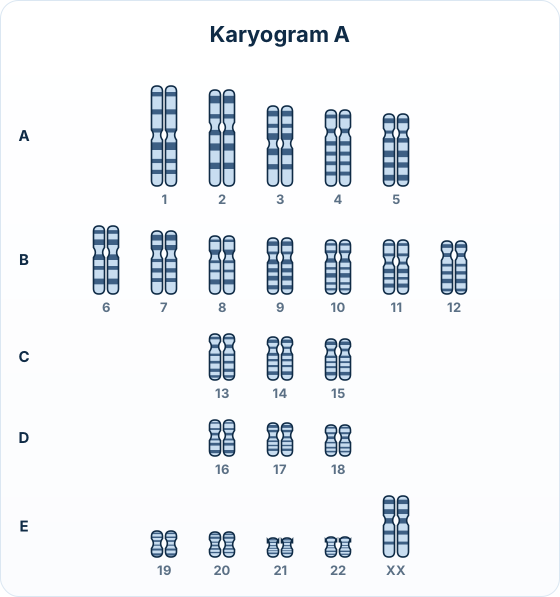
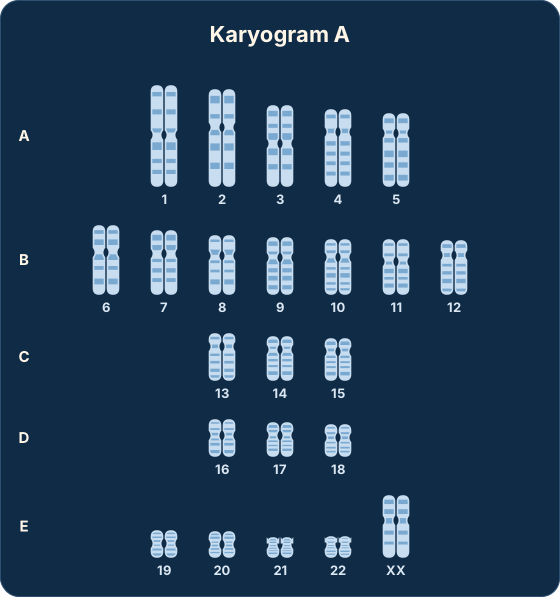
Size, not shape: Say length, centromere position or banding. 'Shape' alone is too vague, and 'no Y' is not a reason: say the pair matches in size.
Study smarter, not longer
Most students waste 40% of study time on topics they already know. Our AI tracks your progress and optimizes every minute.
Try Smart Study FreeYour first topic is free to keep • No credit card required
The big idea: Humans have one pair fewer than other great apes. The hypothesis: human chromosome 2 formed when two ape chromosomes fused.
The points to remember
- The bands of human 2 match those of chimpanzee 12 and 13 laid end to end.
- Telomere DNA, normally only at chromosome ends, is found in the middle of human 2.
- Human 2 has a second, inactive centromere where the second chimpanzee chromosome's would be.
- So the evidence supports fusion in our ancestors after the split from chimpanzees.
- The idea is a testable hypothesis: evidence can support or reject it. 'Humans are special' is not testable.
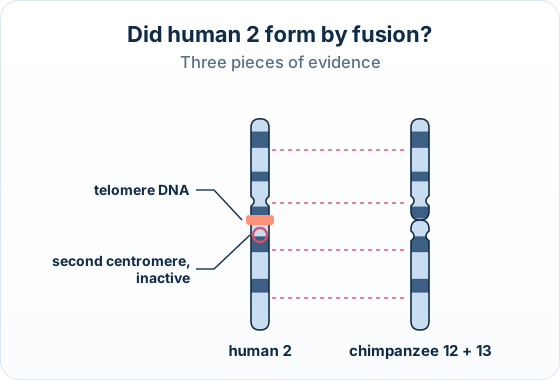
Evaluate it: Three independent lines of evidence point the same way, which makes the hypothesis strong. It is still a hypothesis: new data could test it further.
How it is tested: Paper 1B gives a karyogram: count the chromosomes, find a row by centromere position, deduce the sex and describe how it was made. Paper 1A asks which species or sex a karyogram is from.
IB-style questionDescribe[2 marks]
Describe how a karyogram is constructed.
Model answer plan
See the answer broken into clear points, with guidance on how each point earns marks.
Deduce the sex with a reason: Female: the last pair matches in size. Male: one large X and one small Y.