aımnova
DashboardMy LearningCrash CoursesStudy Plan

Aimnova site navigation

Stay in the loop

Get the latest study resources and updates

New features, study tips and exam insights — straight to your inbox.

IB Diploma

  • IB Past Papers
  • IB Study Notes
  • IB Question Bank
  • IB Mock Exams
  • IB Revision

IB Subjects

  • IB Math AA
  • IB Math AI
  • IB Economics
  • IB Business Management
  • IB Physics
  • IB Biology
  • View all IB subjects→

IB Past Papers

  • IB Math AA HL Past Papers
  • IB Math AA SL Past Papers
  • IB Math AI HL Past Papers
  • IB Math AI SL Past Papers
  • IB Economics HL Past Papers
  • IB Economics SL Past Papers
  • IB ESS Past Papers
  • View all past papers→

Study Resources

  • Study Notes
  • Question Bank
  • Mock Exams
  • Crash Courses
  • Flashcards
  • Revision Guide
  • Exam Skills
  • Command Terms
  • Grade Calculator
  • Exam Timetable 2026

Aimnova

  • Features
  • Pricing
  • For Teachers
  • For Schools
  • For Parents
  • About Us
  • Blog
  • Contact
aımnova

IB study, practice and feedback built around the real exam.

TermsPrivacyCookies·© 2026 Aimnova. All rights reserved.c90f7ab

Aimnova is not affiliated with or endorsed by the International Baccalaureate Organization (IB).

NotesBiologyTopic 1.6Species as groups of organisms with shared traits
Back to Biology Topics
1.6.23 min read

Species as groups of organisms with shared traits

IB Biology · Unit 1

Smart study tools

Turn reading into results

Move beyond passive notes. Answer exam-style questions, get AI feedback, and build the skills that earn top marks.

Get Started Free

Contents

  1. 1Linnaeus grouped organisms by shared traits
  2. 2Where looks can mislead
  3. 3Exam-style question (step by step)
The big idea: A species is a group of organisms that share traits. Linnaeus decided species by the traits he could see.

The points to remember

  • Carl Linnaeus (1707-1778) was a Swedish biologist who named thousands of species.
  • He put organisms that share visible traits into one species.
  • Visible traits are the organism's morphology.
  • So this is called the morphological species concept: the original way of defining a species.
  • Members still vary a little; they are grouped by what they share.
Remember it as: Looks alike? Same species, said Linnaeus.
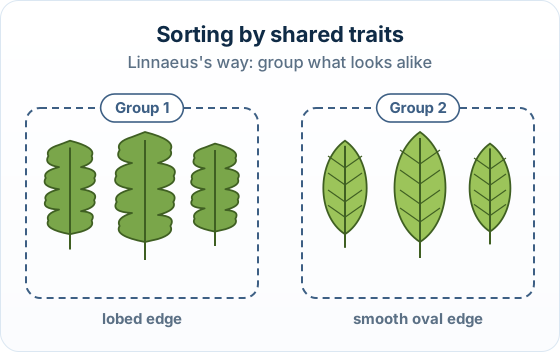
Six leaves: three lobed oak leaves and three smooth oval beech leaves, then a dashed box round each group labelled group 1, lobed edge and group 2, smooth oval edge
Group what shares visible traits: two species.
Real example: the honey bee: In 1758 Linnaeus named the honey bee Apis mellifera. He placed it with other bees because of the body features they share, such as a hairy body and two pairs of wings.

Free preview

This is the free notes preview

You're reading the free notes. Aimnova Pro unlocks the full study experience — and you can try it with your first topic free to keep:

  • FlashcardsLock in vocabulary and key terms with spaced repetition.
  • Practice questionsAnswer exam-style questions and get instant AI marking.
  • Mock exams & past-paper vaultSit full mocks and see exactly how examiners award marks.
  • Personalised study planA daily plan built around your exam date and weak areas.
Start Studying Free Full access to Aimnova Pro · cancel anytime
The big idea: Looks can mislead: one species can look like two, and two species can look like one.

The points to remember

  • Males and females of one species can look very different.
  • Young and adults can look nothing alike: a caterpillar and a butterfly.
  • Look-alike species can share almost every visible trait.
  • So biologists later added a test of breeding: the biological species concept.

One species, looks different

  • Male and female mallards
  • A caterpillar and its butterfly
  • Forms of one ladybird

Two species, look alike

  • Chiffchaff and willow warbler
  • Some sibling beetles
  • Told apart by song or breeding
Real example: the mallard: A male mallard has a green head; the female is brown all over. By looks alone they could be sorted into two species, but they are one.

Study smarter, not longer

Most students waste 40% of study time on topics they already know. Our AI tracks your progress and optimizes every minute.

Try Smart Study FreeYour first topic is free to keep • No credit card required
How it is tested: Paper 1B can set a short Outline [1] inside a data question: say what Linnaeus based a species on.
IB-style questionOutline[1 mark]

A museum holds hundreds of pressed leaves, which an early botanist sorted into groups by their shape and edges.

Outline Linnaeus's morphological concept of a species. [1]

Model answer plan

See the answer broken into clear points, with guidance on how each point earns marks.

Claim your free topic
Not the breeding test: Interbreeding and fertile offspring is the biological species concept. Linnaeus's concept is about looks only.

Try an IB Exam Question — Free AI Feedback

Test yourself on Species as groups of organisms with shared traits. Write your answer and get instant AI feedback — just like a real IB examiner.

A peacock (male Indian peafowl) has a long blue and green train of feathers; the peahen (female) is mainly brown with no train.

why grouping organisms into species by their visible traits alone could give a wrong answer for peafowl.
[2 marks]

Related Biology Topics

Continue learning with these related topics from the same unit:

1.1.1Water as the medium for life1.1.2Hydrogen bonds from the polar covalent bonds in water1.1.3Cohesion of water and its consequences for organisms1.1.4Adhesion of water to polar or charged materials
View all Biology topics
Improve your exam techniqueCommand terms, paper structure, and mark-scheme tips for Biology
Previous1.6.1Variation between organisms as a defining feature of lifeNextBinomial system for naming organisms1.6.3

6 questions to test your understanding

Reading is just the start. Students who tested themselves scored 82% on average — try IB-style questions with AI feedback.

Start FreeView All Biology Topics