The big idea: Biologists give every species one agreed scientific name made of two words. This is called binomial nomenclature ('binomial' = two names).
Why one agreed name
- Common names are messy — a 'robin' in Britain is a different bird from a 'robin' in North America.
- Example: the domestic cat is Felis catus everywhere in the world, in every language.
| Part of the name | What it is | How it is written |
|---|---|---|
| First word | the genus (a group of closely related species) | Capital first letter, italic |
| Second word | the species (the specific kind within that genus) | lower-case, italic |
| Both together | the full binomial name of one species | italic (or underlined if hand-written) |
The two-part name comes from the bottom of the classification ladder: the genus and species rungs together make the binomial (e.g. Panthera leo).
Interactive diagram
Explore the labelled diagram, charts and maps for this topic in full study mode.
Read the name like this: In Felis catus, the first word (Felis) is the genus and the second word (catus) is the species.
The genus is the bigger group; the species is the exact kind inside it.
Free preview
This is the free notes preview
You're reading the free notes. Aimnova Pro unlocks the full study experience — and you can try it with your first topic free to keep:
- FlashcardsLock in vocabulary and key terms with spaced repetition.
- Practice questionsAnswer exam-style questions and get instant AI marking.
- Mock exams & past-paper vaultSit full mocks and see exactly how examiners award marks.
- Personalised study planA daily plan built around your exam date and weak areas.
The system was created by Carl Linnaeus in the 1700s. The two-part name tells you two things at once.
Key points
- Linnaeus grouped organisms that looked alike into the same genus — this is the morphological species concept (judging a species by its physical features / appearance).
- The name tells you the species itself, and the genus (the group of close relatives) it belongs to.
- Binomial nomenclature
- The system of naming each species with a two-part Latin name: genus + species.
- Genus
- A group of closely related species — it is the FIRST word of the name.
- Species
- One particular kind of organism — named by the SECOND word, which only has meaning alongside the genus.
- Morphological species concept
- Linnaeus's idea of grouping organisms into species by their shared physical features (their form/appearance).
How to WRITE a binomial name
- Genus capitalised: Panthera
- Species lower-case: leo
- Whole name in italics: Panthera leo
- If hand-written, underline each word instead
Common mistakes to avoid
- Do not capitalise the species word (not Panthera Leo)
- Do not leave it un-italicised in print
- Do not use the species word on its own — it needs its genus
- Do not swap the order — genus always comes first
Why the genus matters most: Two species that share the same first word (same genus) are more closely related than two species in different genera.
So Panthera leo (lion) and Panthera tigris (tiger) are close relatives — both Panthera — while Felis catus (cat) sits in a different genus.
Know your predicted grade
Take timed mock exams and get detailed feedback on every answer. See exactly where you're losing marks.
The big idea: Species in the same genus have similar traits. The first word of each name tells you who is closely related.
The points to remember
- The first word is the genus; the second word tells the species apart.
- Species in the same genus share similar traits: they are closely related.
- Same species word, different genus: not closely related (Felis catus and Conus catus).
- To count genera in a list, count the different first words.
- Genus is one; genera is more than one.
Remember it as: Match the first word, not the second.
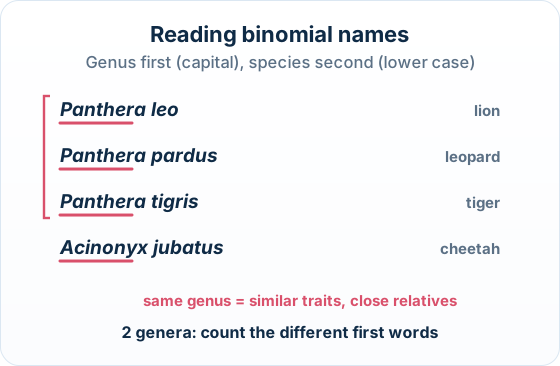
Real example: lion, leopard and tiger: Lion, leopard and tiger are all in the genus Panthera: big cats that can roar. The cheetah, Acinonyx jubatus, cannot roar and is in a genus of its own.
In a list of names, read the genus first and only then the species word.
The second word can trick you: Many species share a second word, such as catus or vulgaris. It tells you nothing about relatedness unless the genus is the same too.
How this is tested: Binomial names are tested in multiple-choice questions and in short state or outline questions.
Where it comes up
- Paper 1A (multiple choice): a common question gives you a list of binomial names and asks which two species are most closely related — the answer is the pair that share the same genus (same first word).
- Paper 2: state the genus an organism belongs to from its binomial name.
- Paper 2: outline Linnaeus's morphological species concept.
Exam-style question — which species are most closely related?
A student records four beetle species: Carabus auratus, Carabus violaceus, Harpalus affinis and Pterostichus niger. State which two species are the most closely related and explain your answer. [2]
How to score both marks
- Read the first word of each name (the genus). The genera here are Carabus, Carabus, Harpalus and Pterostichus.
- Find the pair that shares a genus. Only Carabus auratus and Carabus violaceus have the same first word (Carabus).
- Answer the command term. The most closely related pair is Carabus auratus and Carabus violaceus, because sharing the same genus means they are more closely related than species placed in different genera.
Final answer
Carabus auratus and Carabus violaceus — they share the same genus (Carabus), so they are more closely related than the species in other genera.
The reasoning that scores: Mark 1: identifying the pair that shares a genus (Carabus auratus + Carabus violaceus).
Mark 2: explaining that a shared genus means more closely related than species in different genera. Don't be distracted by similar-looking species words.
A field guide lists four snails: Cepaea nemoralis, Cepaea hortensis, Cornu aspersum and Helix pomatia. Which two species are the most closely related?
Model answer plan
See the answer broken into clear points, with guidance on how each point earns marks.