The big idea: No two living things are exactly alike in all their traits. These differences are called variation.
The points to remember
- Variation means differences in traits between individuals.
- A trait is a feature, such as size, colour, shape, blood group or behaviour.
- No two individuals are identical in all their traits, even within one species.
- Even identical twins differ: their fingerprints are not the same.
- Variation is a defining feature of life: every living thing is a little different.
Remember it as: Same species, never the same snail.
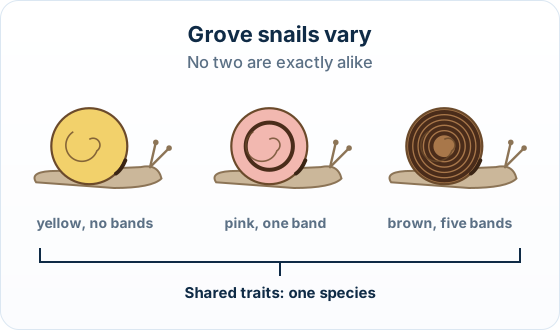
Real example: grove snails: The grove snail, Cepaea nemoralis, lives in hedges and gardens across Europe. Its shell can be yellow, pink or brown, with no dark bands or up to five. Every snail is a little different.
Free preview
This is the free notes preview
You're reading the free notes. Aimnova Pro unlocks the full study experience — and you can try it with your first topic free to keep:
- FlashcardsLock in vocabulary and key terms with spaced repetition.
- Practice questionsAnswer exam-style questions and get instant AI marking.
- Mock exams & past-paper vaultSit full mocks and see exactly how examiners award marks.
- Personalised study planA daily plan built around your exam date and weak areas.
Start Studying Free Full access to Aimnova Pro · cancel anytime
The big idea: Biologists group organisms that share traits. The patterns of variation show where one group ends and the next begins.
The points to remember
- Members of one species share most traits: variation within a species is small.
- Different species differ in many more traits: variation between species is larger.
- These patterns of variation are the basis for naming and classifying organisms.
- The patterns are complex: some traits change gradually (height), others come in a few types (shell colour).
- So deciding where one group ends is not always clear.
Within one species
- Grove snails: yellow, pink or brown shells
- Same body, same shell shape
- Can all breed together
Between two species
- Grove snail v garden snail (Cornu aspersum)
- Different shell shape and size
- Many more traits differ
A different colour is not a different species: Individuals can look very different and still be one species. Count the shared traits, not the differences.
Feeling unprepared for exams?
Get a clear study plan, practice with real questions, and know exactly where you stand before exam day. No more guessing.
Get Exam Ready FreeYour first topic is free to keep • No credit card required
How it is tested: Paper 1B gives a chart of the forms in a sample: read the bar, then work out a percentage. Paper 2 can ask you to outline what variation is.
IB-style questionState / Calculate[2 marks]
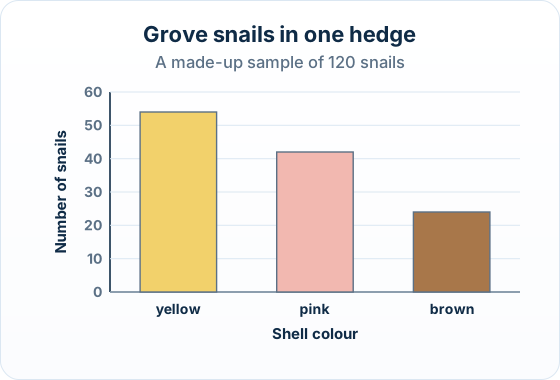
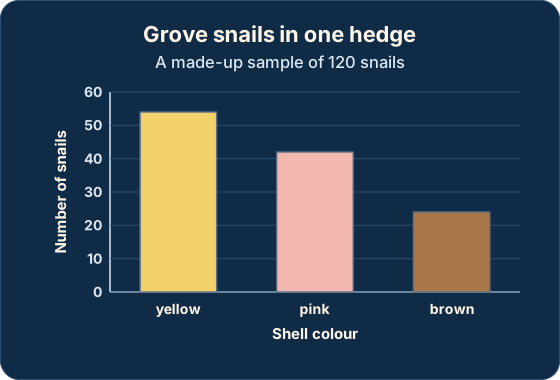
A student counted the grove snails in one hedge by shell colour. The bar chart shows a made-up sample of 120 snails.
(a) State the most common shell colour. [1]
(b) Calculate the percentage of the snails that had brown shells. [1]
Model answer plan
See the answer broken into clear points, with guidance on how each point earns marks.
Read the axis first: Check what one bar measures and the total in the sample before you calculate.