The big idea: Cells come in a huge range of shapes and sizes, but every single living cell — bacterial, plant, animal, fungal — shares the same four basic structures.
The four shared structures and their jobs
- DNA — stores the instructions.
- Cytoplasm — holds a place for reactions.
- Plasma membrane — controls the cell's boundary.
- Ribosomes — make proteins.
They are shared because every cell must do these same essential jobs.
- DNA
- The genetic material — the instructions for building and running the cell.
- Cytoplasm
- The watery jelly inside the cell where chemical reactions happen.
- Plasma membrane
- The thin outer boundary that controls what enters and leaves the cell.
- Ribosomes
- Tiny structures that build proteins by joining amino acids together.
However different cells look, the same four structures are in EVERY one (highlighted in blue): DNA, cytoplasm, the plasma membrane and ribosomes — shown here on both a prokaryotic and a eukaryotic cell.
Interactive diagram
Explore the labelled diagram, charts and maps for this topic in full study mode.
An easy way to remember: Think D-C-M-R: DNA, Cytoplasm, Membrane, Ribosomes.
If a structure is NOT one of these four, it is not guaranteed to be in every cell.
Free preview
This is the free notes preview
You're reading the free notes. Aimnova Pro unlocks the full study experience — and you can try it with your first topic free to keep:
- FlashcardsLock in vocabulary and key terms with spaced repetition.
- Practice questionsAnswer exam-style questions and get instant AI marking.
- Mock exams & past-paper vaultSit full mocks and see exactly how examiners award marks.
- Personalised study planA daily plan built around your exam date and weak areas.
Each of the four shared structures does a job that no cell can live without.
What a cell would lose
- Without DNA a cell has no instructions.
- Without cytoplasm there is no place for reactions.
- Without a plasma membrane the cell cannot stay separate from its surroundings.
- Without ribosomes the cell cannot build proteins.
- Organelle
- A specialised structure inside a cell that has a particular function — for example a ribosome, nucleus or mitochondrion.
- Ribosome
- The organelle (found in ALL cells) that builds proteins. The plasma membrane also counts as an organelle; the cytoplasm does not.
- Prokaryotic cell
- A cell with NO nucleus and no membrane-bound organelles (for example a bacterium).
- Eukaryotic cell
- A cell WITH a nucleus and membrane-bound organelles (for example plant, animal and fungal cells).
Careful — 'common to all cells' is exact: A nucleus is NOT common to all cells — prokaryotes have no nucleus; their DNA floats free in the cytoplasm.
A cell wall, mitochondria and chloroplasts are also NOT universal — they are missing from many cell types.
Only DNA, cytoplasm, plasma membrane and ribosomes are in every cell.
| Feature | In prokaryotic cells? | In eukaryotic cells? |
|---|---|---|
| DNA (genetic material) | yes | yes |
| Cytoplasm | yes | yes |
| Plasma membrane | yes | yes |
| Ribosomes | yes | yes |
Where is DNA actually kept?: Every cell contains DNA, but it is not always in the same place.
Where the DNA sits
- In eukaryotic cells (animal, plant, fungal) most DNA sits inside the nucleus — so the nucleus is the usual answer to 'name an organelle that contains DNA'.
- But the nucleus is not the only DNA-containing organelle. Mitochondria carry their own small loop of DNA, and in plant cells the chloroplasts do too.
- In prokaryotic cells there is no nucleus at all: the DNA lies free in the cytoplasm in a region called the nucleoid.
- Nucleus
- The membrane-bound organelle in eukaryotic cells that holds most of the cell's DNA. A DNA base pair could be located here.
- Mitochondrion
- An organelle that releases energy and also carries its own small loop of DNA — so a DNA base pair can be located inside a mitochondrion too.
- Chloroplast
- The organelle in plant (and algal) cells where photosynthesis happens; it also contains its own DNA, so a DNA base pair could be located here.
- Nucleoid
- Not an organelle — the region of a prokaryotic cell's cytoplasm where its free DNA is found. Prokaryotes have no nucleus.
| Cell type | Where the DNA is | Organelle(s) that contain DNA |
|---|---|---|
| Animal / fungal (eukaryotic) | inside the nucleus and inside mitochondria | nucleus, mitochondria |
| Plant (eukaryotic) | inside the nucleus, mitochondria and chloroplasts | nucleus, mitochondria, chloroplasts |
| Prokaryotic (bacteria) | free in the cytoplasm (nucleoid region) | none — there is no nucleus |
Naming an organelle that holds DNA: If a question asks you to name an organelle in which a DNA base pair could be located, the safe answer is the nucleus.
A mitochondrion (or a chloroplast in a plant cell) is also accepted, because each of these organelles contains its own DNA.
Get feedback like a real examiner
Submit your answers and get instant feedback — what you did well, what's missing, and exactly what to write to score full marks.
The big idea: Each shared structure is there for a reason: a cell needs instructions, a watery place for reactions, a boundary, and a way to make proteins.
The points to remember
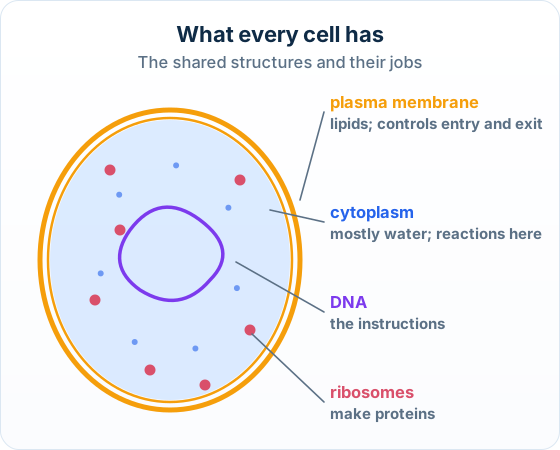
- DNA is the genetic material: it holds the instructions for making the cell's proteins.
- The cytoplasm is made mostly of water, with enzymes dissolved in it: the site of the cell's metabolic reactions.
- The plasma membrane is made of lipids (a double layer) with proteins: it controls what enters and leaves.
- Ribosomes carry out protein synthesis: they make enzymes and the other proteins the cell needs.
- A cytoskeleton of protein fibres gives the cell its shape and moves things around inside it.
Remember it as: DNA instructs, cytoplasm hosts, the membrane controls, ribosomes build.
Real example: a gut bacterium and a liver cell: The bacterium Escherichia coli and a human liver cell look nothing alike, yet both have DNA, a watery cytoplasm, a plasma membrane and ribosomes doing the same jobs.
Water is the medium for life, so a cytoplasm that is mostly water can hold the dissolved substances the reactions need.
Give the role, not just the name: When asked for the roles of these structures, say what each one does. Adding a structure that not every cell has, such as a nucleus, cell wall or mitochondrion, costs a mark.
How this is tested: This sub-topic is asked as a multiple-choice identify question and as a short State / List question.
Where it comes up
- Paper 1A (multiple choice): which structure is found in all cells, in all three domains of life, or in both prokaryotes and eukaryotes — the answer is almost always ribosomes (a shared structure that is also an organelle, like the plasma membrane).
- Paper 1B / Paper 2: a short State / List question can ask you to name the structures common to all cells, so learn all four.
Exam-style question — name the universal structures
A bacterium, a human liver cell and a yeast cell look very different from one another. State the four structures that all three of these cells must contain. [2]
How to score both marks
- Recall what 'common to all cells' means. It means the structure is present in every cell type — prokaryotic and eukaryotic alike.
- List the four universal structures: DNA, cytoplasm, plasma membrane and ribosomes. (1 mark for any two correct; 2 marks for all four.)
- Answer the command term — state the four: all three cells must contain DNA, cytoplasm, a plasma membrane and ribosomes.
Final answer
DNA, cytoplasm, a plasma membrane and ribosomes — these four structures are present in every cell, whether prokaryotic or eukaryotic.
The structures you should name: Make sure your answer has all four: DNA, cytoplasm, plasma membrane and ribosomes.
Do not write 'nucleus' or 'cell wall' — those are not present in every cell.
- DNA
- The genetic material — the instructions for building and running the cell.
- Cytoplasm
- The watery jelly inside the cell where chemical reactions happen.
- Plasma membrane
- The thin outer boundary that controls what enters and leaves the cell.
- Ribosomes
- Tiny structures that build proteins by joining amino acids together.
A soil bacterium and a human white blood cell are very different cells. Describe the roles of the components that both of these cells have.
Model answer plan
See the answer broken into clear points, with guidance on how each point earns marks.