The big idea: Every cell on Earth is one of two basic types. The single biggest difference to remember: a nucleus, or no nucleus.
The two types
- Prokaryotic — a simple cell with no nucleus. Its DNA floats free in the cytoplasm. All bacteria are prokaryotic.
- Eukaryotic — a more complex cell with a true nucleus that holds the DNA, plus other membrane-bound organelles. Animal, plant and fungal cells are eukaryotic.
Prokaryotic cell
- No nucleus — DNA is free in the cytoplasm
- No membrane-bound organelles
- Small (about 1–5 µm)
- Example: a bacterium
Eukaryotic cell
- Has a nucleus that encloses the DNA
- Has membrane-bound organelles (e.g. mitochondria)
- Larger (about 10–100 µm)
- Examples: animal, plant, fungal cells
A prokaryotic cell (left) has no nucleus — its circular DNA lies free in the cytoplasm — while a eukaryotic cell (right) keeps its DNA in a nucleus and has membrane-bound organelles. Both still share a plasma membrane, cytoplasm, DNA and ribosomes.
Interactive diagram
Explore the labelled diagram, charts and maps for this topic in full study mode.
What 'membrane-bound organelle' means: An organelle is a structure inside a cell with its own job.
A membrane-bound organelle is wrapped in its own membrane — like the nucleus or a mitochondrion.
Prokaryotes have none of these; eukaryotes have many.
Free preview
This is the free notes preview
You're reading the free notes. Aimnova Pro unlocks the full study experience — and you can try it with your first topic free to keep:
- FlashcardsLock in vocabulary and key terms with spaced repetition.
- Practice questionsAnswer exam-style questions and get instant AI marking.
- Mock exams & past-paper vaultSit full mocks and see exactly how examiners award marks.
- Personalised study planA daily plan built around your exam date and weak areas.
Prokaryotic and eukaryotic cells share some parts and differ in others. A comparison is never 'all different' — always name the shared parts too.
What to compare
- Shared: the four structures every cell has — a plasma membrane, cytoplasm, DNA and ribosomes.
- Different: how the DNA is organised and whether the cell has membrane-bound compartments.
- Prokaryotic cell
- A cell with no nucleus and no membrane-bound organelles; its DNA lies free in the cytoplasm. All bacteria are prokaryotic.
- Eukaryotic cell
- A cell with a true (membrane-bound) nucleus that encloses the DNA, plus other membrane-bound organelles. Animal, plant and fungal cells are eukaryotic.
- Nucleus
- A membrane-bound organelle that holds the cell's DNA — present in eukaryotes, absent in prokaryotes.
- Histone
- A protein that eukaryotic DNA wraps around to package the long chromosomes. Prokaryotic DNA has no histones — it is 'naked'.
- Plasmid
- A small extra ring of DNA found in many prokaryotes, separate from the main loop of DNA.
- Flagellum
- A long whip-like tail that some prokaryotes spin to move the cell through liquid.
Look closely at the DNA. In a prokaryote the DNA is one circular loop lying naked in the cytoplasm, often with small extra rings called plasmids. In a eukaryote the DNA is in several long, linear chromosomes wound around histone proteins and sealed inside the nucleus.
| Feature | Prokaryotic cell | Eukaryotic cell |
|---|---|---|
| Nucleus | no nucleus (DNA is free in the cytoplasm) | true nucleus (DNA enclosed by a membrane) |
| DNA shape | one circular loop, naked (no histones) | long linear chromosomes wrapped on histones |
| Membrane-bound organelles | none (e.g. no mitochondria) | present (mitochondria, ER, Golgi, etc.) |
| Ribosomes | small (70S) | large (80S) |
| Typical size | small (about 1–5 µm) | larger (about 10–100 µm) |
| Examples | bacteria | animal, plant, fungal & protist cells |
Don't forget what they share: Both prokaryotic and eukaryotic cells have a plasma membrane, cytoplasm, DNA and ribosomes.
A 'compare and contrast' answer must give a similarity as well as a difference — answers that list only differences lose the similarity mark.
Memorize terms 3x faster
Smart flashcards show you cards right before you forget them. Perfect for definitions and key concepts.
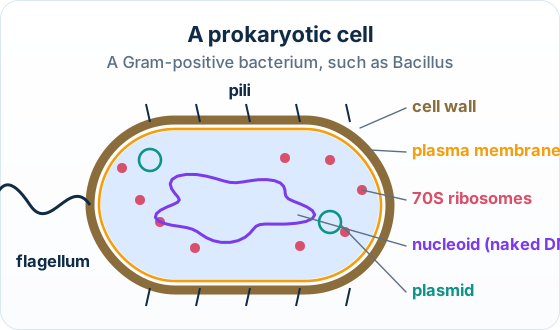
The big idea: A bacterium is small and simple: a wall, a membrane, cytoplasm full of small ribosomes, and one loop of naked DNA.
The points to remember
- A cell wall outside the membrane keeps the cell's shape and stops it bursting. In Gram-positive bacteria it is thick.
- The plasma membrane controls what enters and leaves the cell.
- The cytoplasm holds many 70S ribosomes, smaller than the 80S ribosomes of eukaryotic cells.
- The DNA is naked (no histones) and forms one loop, in a region called the nucleoid: there is no nucleus.
- Many bacteria also have plasmids (small extra loops of DNA), and some have a flagellum and pili.
- Prokaryote structure varies: this is a typical Gram-positive bacterium, not the only kind.
Remember it as: Wall, membrane, cytoplasm, 70S ribosomes, one naked loop.
Real example: Bacillus subtilis: Bacillus subtilis is a rod-shaped, Gram-positive bacterium that lives in soil. It is only a few micrometres long and swims with flagella.
When you draw a prokaryote, label the region with the DNA as the nucleoid, never the nucleus.
No eukaryotic organelles: A drawing of a prokaryote must not show a nucleus, mitochondria or other membrane-bound organelles. Adding one costs marks.
How this is tested: Questions ask you to identify, list or compare differences between the two cell types, and sometimes to draw a prokaryote.
Where it comes up
- Paper 1A (multiple choice): identify a key difference between the two cell types, or pick the structure they share.
- Paper 2: List, Outline or State differences, or State the function of a prokaryotic structure (flagella, ribosomes).
- Paper 1B: a 'compare and contrast' asks for a similarity AND a difference.
- Paper 3: a 3-mark Draw can ask for the internal structures of a prokaryotic cell.
Exam-style question — compare a bacterium with a liver cell
A scientist examines a bacterium and a human liver cell under a microscope. Compare and contrast the structure of the two cells. Give one similarity and two differences. [3]
Model answer
- Similarity (1 mark). Both cells have a plasma membrane, cytoplasm, DNA and ribosomes — give any one shared structure.
- Difference 1 (1 mark). The liver cell has a nucleus that encloses its DNA; the bacterium has no nucleus — its DNA is free in the cytoplasm.
- Difference 2 (1 mark). The liver cell has membrane-bound organelles (e.g. mitochondria); the bacterium has none. (DNA shape or ribosome size would also score.)
- Answer the command term. State the contrast clearly as paired points — one feature, both cells — so each similarity/difference is unmistakable.
Final answer
Similarity: both have a plasma membrane, cytoplasm, DNA and ribosomes. Differences: the liver cell has a nucleus and membrane-bound organelles; the bacterium has neither (its DNA is a naked loop free in the cytoplasm).
What scores the marks: The marks need paired points: the SAME feature compared in both cells (e.g. 'liver cell has a nucleus; bacterium has no nucleus'). A list of facts about only one cell does not count as a comparison.
Yeast is a eukaryote and Staphylococcus is a prokaryote. Outline three structural differences between these two kinds of cell.
Model answer plan
See the answer broken into clear points, with guidance on how each point earns marks.