The big idea: DNA is made of two strands twisted around each other into a double helix — the famous spiral-staircase shape.
How the two strands fit
- The two strands run in opposite directions (we say they are antiparallel).
- They are held together by their bases, which pair up in a fixed way: A with T, and G with C.
The two 'rails'
- Each strand has a sugar–phosphate backbone
- The backbones run in opposite directions (antiparallel)
- They form the outside of the helix
The 'rungs'
- The bases stick inwards from each backbone
- A base on one strand pairs with a base on the other
- Each rung = one base pair held by hydrogen bonds
DNA as a ladder: two antiparallel sugar–phosphate backbones (5′→3′ opposite ways) with rungs of paired bases — A–T (2 hydrogen bonds) and G–C (3).
Interactive diagram
Explore the labelled diagram, charts and maps for this topic in full study mode.
Who worked it out: Watson and Crick proposed the double-helix model in 1953, using X-ray data from Rosalind Franklin.
Their model's first big reveal was the double-helix shape — and that the two strands are held together by paired bases.
Free preview
This is the free notes preview
You're reading the free notes. Aimnova Pro unlocks the full study experience — and you can try it with your first topic free to keep:
- FlashcardsLock in vocabulary and key terms with spaced repetition.
- Practice questionsAnswer exam-style questions and get instant AI marking.
- Mock exams & past-paper vaultSit full mocks and see exactly how examiners award marks.
- Personalised study planA daily plan built around your exam date and weak areas.
DNA bases do not pair randomly. Each base has one partner that 'fits' it: this is called complementary base pairing.
The four bases and their partners
- The four bases of DNA are adenine (A), thymine (T), guanine (G) and cytosine (C).
- A always pairs with T.
- G always pairs with C.
- Complementary base pairing
- The rule that A pairs only with T, and G pairs only with C, on the two strands of DNA.
- Hydrogen bond
- A weak attraction that holds a base pair together; many of them along the molecule make the double helix stable.
- Antiparallel
- The two DNA strands run in opposite directions to each other.
- Base pair
- One base on one strand joined to its partner base on the other strand (A–T or G–C).
The two bases of a pair are joined by hydrogen bonds. Note that the bases are what bond across the helix — not the sugars or the phosphates.
An A–T pair is held by 2 hydrogen bonds; a G–C pair is held by 3. So a region rich in G–C pairs is held together a little more strongly.
| Base on one strand | Pairs with | Held by |
|---|---|---|
| Adenine (A) | Thymine (T) | 2 hydrogen bonds |
| Thymine (T) | Adenine (A) | 2 hydrogen bonds |
| Guanine (G) | Cytosine (C) | 3 hydrogen bonds |
| Cytosine (C) | Guanine (G) | 3 hydrogen bonds |
Chargaff's rule: Because A only ever pairs with T, the amount of A equals the amount of T.
In the same way, the amount of G equals the amount of C.
So if you know the percentage of one base, you can work out the others — a favourite Paper 2 calculation.
Practice with exam-style questions
Answer exam-style questions and get AI feedback that shows you exactly what examiners want to see in a full-marks response.
The big idea: When a question asks you to draw DNA, draw a short ladder, not a twisted helix: two antiparallel strands joined by base pairs.
The points to remember
- Each strand is a chain of nucleotides; draw two nucleotides per strand.
- In every nucleotide the phosphate joins carbon 5′ and the base joins carbon 1′ of the deoxyribose.
- The two strands are antiparallel: draw the second strand upside down, its sugars pointing the other way.
- A pairs with T, G pairs with C, the bases meeting in the middle.
- Join each pair with dashed hydrogen bonds and label at least one.
Remember it as: Upside down and opposite: A to T, G to C.
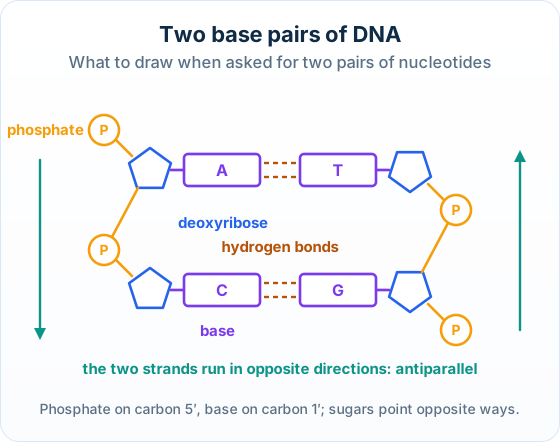
Easy marks to lose: Drawing both strands the same way up, so they are not antiparallel. Joining sugars or phosphates across the middle instead of bases. Writing a base as a letter when the question asks you to name it.
The model came from real evidence:
Real example: Photo 51: In 1952 Rosalind Franklin's X-ray image, known as Photo 51, showed the pattern of a helix. Watson and Crick used it to build their 1953 model: two antiparallel strands, bases paired inside.
How this is tested: This topic comes up on Paper 1A and on Paper 2.
Two question types
- On Paper 1A (multiple choice) you are often asked to identify which DNA components are joined by hydrogen bonds (the bases), or which complementary base pairs are correct (A–T, G–C).
- On Paper 2 a 2-mark Explain/Deduce question gives the percentage of one base and asks you to work out another, using Chargaff's rule.
IB-style question — work out a missing base percentage
A sample of DNA from a fungus is found to contain 28% adenine. Deduce the percentage of cytosine in this DNA, showing your reasoning. [2]
How to score both marks
- Use the pairing rule. A pairs with T, so the percentage of thymine also equals 28%. Together A + T make up 28 + 28 = 56% of the bases.
- The rest must be G + C. That leaves 100 − 56 = 44% shared between guanine and cytosine. Since G pairs with C, they are present in equal amounts, so each is 44 ÷ 2.
- Answer the command term. Cytosine = 22%.
Final answer
Adenine = thymine = 28%, so A+T = 56%; the remaining 44% is split equally between G and C, giving cytosine = 22%.
Check your reasoning: Your working should show both ideas: %A = %T (so T is also 28%) and %G = %C (so the leftover 44% splits in half). The final answer is cytosine = 22%.