aımnova
DashboardMy LearningCrash CoursesStudy Plan

Aimnova site navigation

Stay in the loop

Get the latest study resources and updates

New features, study tips and exam insights — straight to your inbox.

IB Diploma

  • IB Past Papers
  • IB Study Notes
  • IB Question Bank
  • IB Mock Exams
  • IB Revision

IB Subjects

  • IB Math AA
  • IB Math AI
  • IB Economics
  • IB Business Management
  • IB Physics
  • IB Biology
  • View all IB subjects→

IB Past Papers

  • IB Math AA HL Past Papers
  • IB Math AA SL Past Papers
  • IB Math AI HL Past Papers
  • IB Math AI SL Past Papers
  • IB Economics HL Past Papers
  • IB Economics SL Past Papers
  • IB ESS Past Papers
  • View all past papers→

Study Resources

  • Study Notes
  • Question Bank
  • Mock Exams
  • Crash Courses
  • Flashcards
  • Revision Guide
  • Exam Skills
  • Command Terms
  • Grade Calculator
  • Exam Timetable 2026

Aimnova

  • Features
  • Pricing
  • For Teachers
  • For Schools
  • For Parents
  • About Us
  • Blog
  • Contact
aımnova

IB study, practice and feedback built around the real exam.

TermsPrivacyCookies·© 2026 Aimnova. All rights reserved.10c8990

Aimnova is not affiliated with or endorsed by the International Baccalaureate Organization (IB).

NotesBiologyTopic 1.2RNA as a polymer formed by condensation of nucleotides
Back to Biology Topics
1.2.53 min read

RNA as a polymer formed by condensation of nucleotides

IB Biology · Unit 1

IB exam ready

Study like the top scorers do

Access a smart study planner, AI tutor, and exam vault — everything you need to hit your target grade.

Start Free

Contents

  1. 1Nucleotides join by condensation
  2. 2Drawing an RNA polymer, step by step
  3. 3Exam-style question (step by step)
The big idea: RNA is a long chain of nucleotides. Each one is added by a condensation reaction, which releases water and makes a covalent bond.

The points to remember

  • A polymer is a long chain of small units called monomers.
  • RNA is a polymer; its monomers are RNA nucleotides.
  • Nucleotides are joined by condensation reactions.
  • Each condensation releases one water molecule (H₂O).
  • It makes a covalent bond from the sugar of one nucleotide to the phosphate of the next.
Remember it as: Condensation: join and lose water.
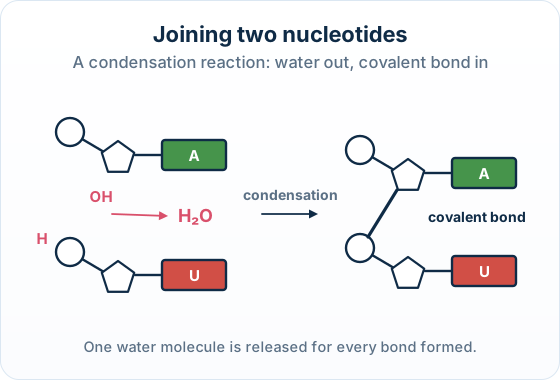
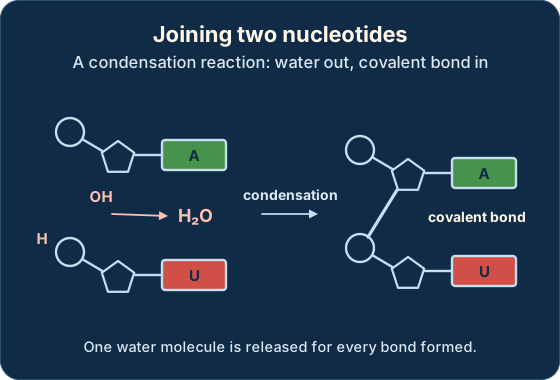
Two RNA nucleotides, with bases A and U, lose OH and H as one water molecule; after the condensation they are joined by a covalent bond from the first sugar to the second phosphateTwo RNA nucleotides, with bases A and U, lose OH and H as one water molecule; after the condensation they are joined by a covalent bond from the first sugar to the second phosphate
Condensation: water out, covalent bond in.
Do not swap the two reactions: Condensation joins monomers and releases water. Hydrolysis does the opposite: water is used to split the bond.

These chains can be very long:

Real example: a giant RNA: The RNA copy of the gene for titin, a protein in your muscles, is about 100 000 nucleotides long: about 100 000 condensation reactions in one molecule.

Free preview

This is the free notes preview

You're reading the free notes. Aimnova Pro unlocks the full study experience — and you can try it with your first topic free to keep:

  • FlashcardsLock in vocabulary and key terms with spaced repetition.
  • Practice questionsAnswer exam-style questions and get instant AI marking.
  • Mock exams & past-paper vaultSit full mocks and see exactly how examiners award marks.
  • Personalised study planA daily plan built around your exam date and weak areas.
Start Studying Free Full access to Aimnova Pro · cancel anytime
The big idea: To draw an RNA polymer, draw nucleotides one under another and join each ribose to the next phosphate.

The points to remember

  • RNA is a single strand: draw one chain only.
  • The sugar is ribose; the bases are A, C, G and U, never T.
  • Join each ribose to the phosphate of the next nucleotide.
  • All the bases stick out on the same side of the strand.
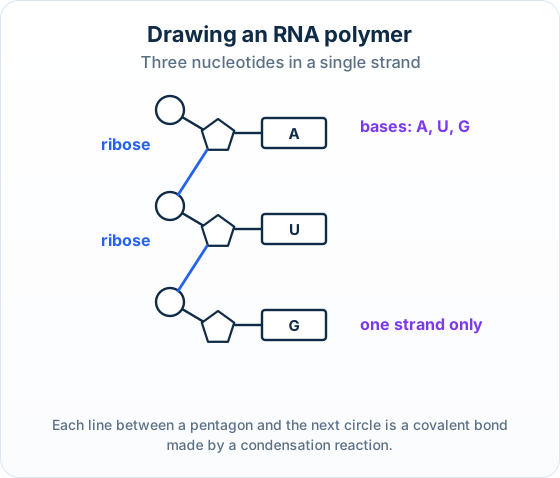
An RNA strand drawn one nucleotide at a time, bases A, U and G, each ribose joined to the next phosphate
How to draw an RNA polymer for full marks.
Three things that lose marks: Drawing two strands (that is DNA). Putting thymine in RNA. Joining the bases to each other instead of joining sugar to phosphate.

Get feedback like a real examiner

Submit your answers and get instant feedback — what you did well, what's missing, and exactly what to write to score full marks.

Try AI Tutor FreeYour first topic is free to keep • No credit card required
How it is asked: A one-mark State on the reaction, and drawing: a single nucleotide or a short RNA strand.
IB-style questionState[1 mark]

State the type of chemical reaction that joins two RNA nucleotides together.

Model answer plan

See the answer broken into clear points, with guidance on how each point earns marks.

Claim your free topic

And a drawing task in the same style:

IB-style questionDraw[3 marks]

Draw a labelled diagram of a short RNA polymer made of three nucleotides.

Model answer plan

See the answer broken into clear points, with guidance on how each point earns marks.

Claim your free topic

Try an IB Exam Question — Free AI Feedback

Test yourself on RNA as a polymer formed by condensation of nucleotides. Write your answer and get instant AI feedback — just like a real IB examiner.

The RNA in a ribosome is a polymer of about 5 000 nucleotides.

the type of reaction that joins the nucleotides in this RNA.
[1 mark]

Related Biology Topics

Continue learning with these related topics from the same unit:

1.1.1Water as the medium for life1.1.2Hydrogen bonds from the polar covalent bonds in water1.1.3Cohesion of water and its consequences for organisms1.1.4Adhesion of water to polar or charged materials
View all Biology topics
Improve your exam techniqueCommand terms, paper structure, and mark-scheme tips for Biology
Previous1.2.4Bases in each nucleic acid that form the basis of a codeNextDNA as a double helix of two antiparallel strands1.2.6

4 exam-style questions ready for you

Students who practice on Aimnova improve their scores by 15% on average. Get instant feedback that shows exactly how to improve your answers.

Practice Now — FreeView All Biology Topics