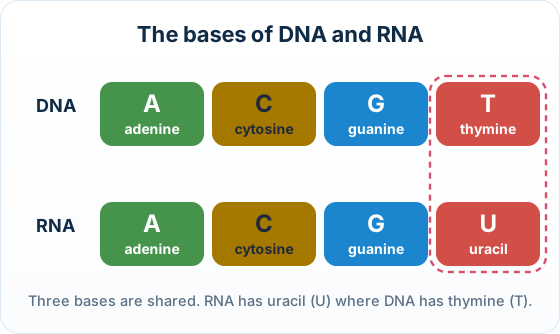
The big idea: Each nucleic acid uses four bases. Three are shared; DNA has thymine where RNA has uracil.
The points to remember
- DNA has four bases: adenine (A), cytosine (C), guanine (G) and thymine (T).
- RNA has four bases too: adenine, cytosine, guanine and uracil (U).
- Uracil takes the place of thymine: T only in DNA, U only in RNA.
- Each base is a nitrogenous base.
Remember it as: A, C and G in both: T for DNA, U for RNA.
Real example: your genome in four letters: The DNA in one of your cells is about 3.1 billion base pairs long, and all of it is written with just four bases: A, C, G and T.
When a question asks for a base by name, the full word earns the mark:
Spell the names in full: When a question asks you to name a base, write the full name: adenine, cytosine, guanine, thymine or uracil. And never put thymine in RNA or uracil in DNA.
Free preview
This is the free notes preview
You're reading the free notes. Aimnova Pro unlocks the full study experience — and you can try it with your first topic free to keep:
- FlashcardsLock in vocabulary and key terms with spaced repetition.
- Practice questionsAnswer exam-style questions and get instant AI marking.
- Mock exams & past-paper vaultSit full mocks and see exactly how examiners award marks.
- Personalised study planA daily plan built around your exam date and weak areas.
Start Studying Free Full access to Aimnova Pro · cancel anytime
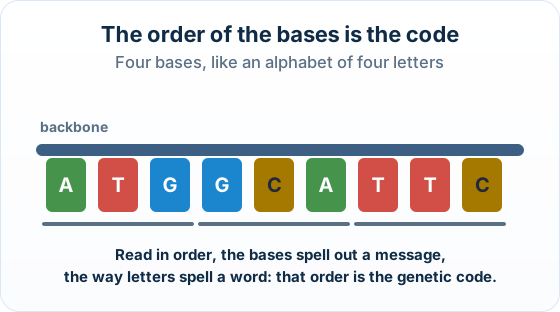
The big idea: The bases are the letters of the genetic code. The information is in their order along the strand.
The points to remember
- Every nucleotide carries one base, sticking out from the backbone.
- The backbone is the same all along a strand; only the bases vary.
- Bases can follow each other in any order.
- The order of the bases (the base sequence) carries the information, like the order of letters in a word.
Real example: one letter changed: In sickle cell anaemia, one base in the gene for part of haemoglobin is changed: an A becomes a T. That single change in the order alters the protein made, and the red blood cells change shape.
See how examiners mark answers
Answer exam-style questions with model answers. Learn exactly what earns marks and what doesn't.
Try Exam Vault FreeYour first topic is free to keep • No credit card required
How it is asked: One mark for one base, named in full.
IB-style questionState[1 mark]
State the name of the base that is found in DNA but not in RNA.
Model answer plan
See the answer broken into clear points, with guidance on how each point earns marks.
If two answers are written and one is wrong, the mark is usually lost, so give one name only.