The big idea: An animal in water is held up, slowed down, chilled quickly and kept at a steady temperature. An animal in air is none of these.
Four physical properties of water explain it: buoyancy, viscosity, thermal conductivity and specific heat capacity.
The points to remember
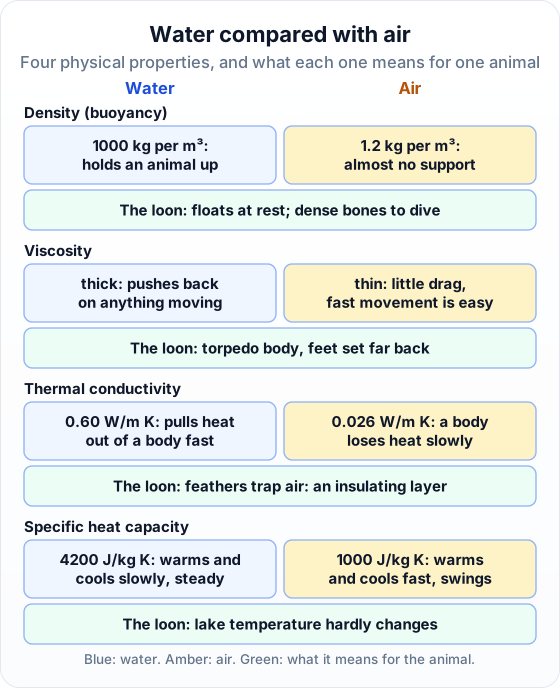
- Water is about 800 times denser than air, so it holds a body up (buoyancy). Air does not.
- Water is about 50 times more viscous than air: it pushes back on anything moving through it.
- Water conducts heat about 25 times faster than air, so a warm body loses heat fast in water.
- Water has a higher specific heat capacity than air, so it warms and cools slowly: a steady habitat.
Remember it as: Water holds you up, holds you back, steals your heat and keeps its temperature. Air does none of these.
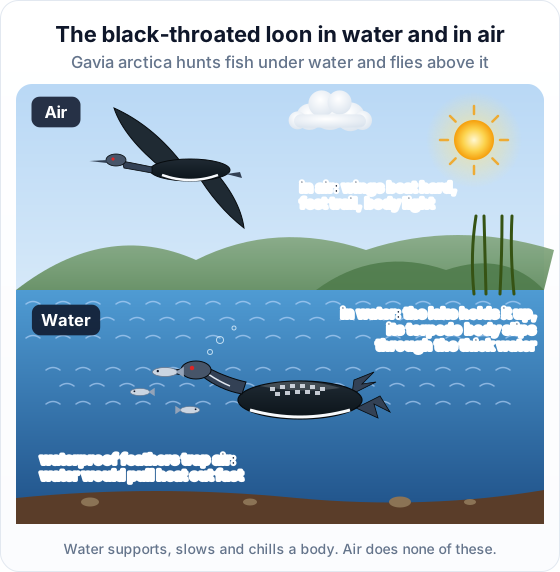
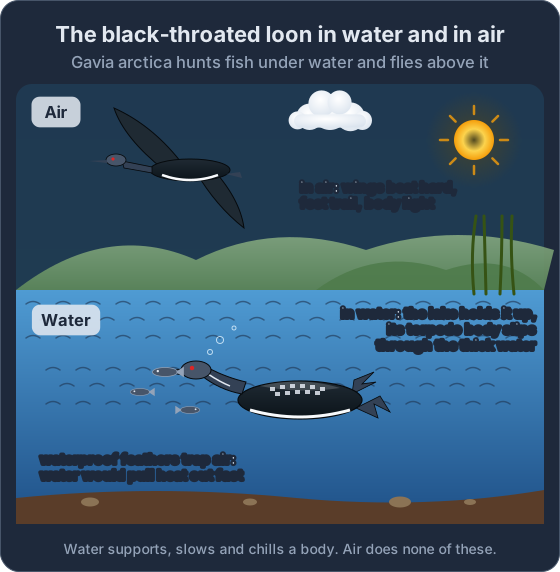
Real example: the black-throated loon (Gavia arctica) lives in both media. It hunts fish under the water of northern lakes and flies between lakes through the air, so every difference between water and air shows on this one bird.
Free preview
This is the free notes preview
You're reading the free notes. Aimnova Pro unlocks the full study experience — and you can try it with your first topic free to keep:
- FlashcardsLock in vocabulary and key terms with spaced repetition.
- Practice questionsAnswer exam-style questions and get instant AI marking.
- Mock exams & past-paper vaultSit full mocks and see exactly how examiners award marks.
- Personalised study planA daily plan built around your exam date and weak areas.
A litre of water has a mass of about 1 kg. A litre of air has a mass of about 1.2 g, roughly 800 times less.
A dense fluid pushes up hard on a body in it. That push is buoyancy, and it is why floating in water takes no effort, while nothing floats in air without flying.
The points to remember
- Buoyancy: water pushes up on a body in it, because water is dense. Floating takes no effort.
- Air is not dense enough to hold a body up: a land animal carries its own weight, a bird must fly.
- Many aquatic animals have no heavy supporting skeleton or carry fat or air that adds to their buoyancy.
In water
- The water carries the animal's weight.
- No thick leg bones are needed to stand.
- Fat, air sacs or a swim bladder fine-tune how high it floats.
In air or on land
- The animal carries its whole weight on legs.
- A bird must beat its wings to stay up.
- A thick skeleton holds the body up against gravity.
Real example: a loon floats at rest, and most birds float high, with air in their bones and feathers. The loon is different: its bones are solid, not air-filled, so it rides low and can dive quickly after fish.
Floating is buoyancy, not surface tension: A sea slug or a seal floating near the surface is held up by buoyancy, the push of dense water. Surface tension is a different property: the skin-like film at the surface that a pond skater's feet rest on. Name buoyancy for anything that floats in the water.
See how examiners mark answers
Answer exam-style questions with model answers. Learn exactly what earns marks and what doesn't.
Move your hand through air and you feel nothing. Move it through water and the water pushes back. That resistance is viscosity, and water is about 50 times more viscous than air.
The push a moving body feels is called drag. In water, drag is large, so shape matters.
The points to remember
- Viscosity: water is thick, so moving through it meets a lot of drag.
- Aquatic animals are streamlined (torpedo-shaped, smooth) and push with flippers, fins or webbed feet.
- Air is thin: little drag, so movement through air can be very fast, but it gives no push to swim against.
The shape
- A streamlined body: narrow, smooth, pointed at the front.
- No parts sticking out to catch the water.
The push
- Flippers, fins, a tail fluke or webbed feet give a wide surface to push the thick water with.
- Thick water is also something to push against.
In air
- Little drag, so very fast movement is possible.
- But air gives almost nothing to push against: wings must move a lot of air.
Real example: the loon's body is a torpedo, and its feet are set so far back that they work as paddles behind the body. The same feet make it clumsy on land: a loon can barely walk, and it needs a long run across the water to take off into the thin air.
Put one hand in water at 20 degrees and the other in air at 20 degrees. The water feels colder. It is not colder: it takes heat out of your hand faster, about 25 times faster.
That is thermal conductivity, and it is higher in water than in air.
The points to remember
- Thermal conductivity is higher in water than in air: heat moves from a warm body into water fast.
- So an animal in water loses more heat than the same animal in air at the same temperature.
- Aquatic mammals and birds have insulation: a thick layer of fat (blubber), or fur or feathers that trap air.
- Trapped air insulates because air is a poor conductor: that is the same fact the other way round.
Water conducts heat well
- higher thermal conductivity than air
Heat leaves the body fast
- more heat transferred to water than to air
Insulation slows it
- fat (blubber), or fur and feathers that trap air
Real example: a loon's feathers are waterproof and lie tight, trapping a thin layer of air next to the skin. Air is a poor conductor, so the trapped layer is the bird's insulation against the lake water that would otherwise pull heat out of it all day.
Blubber insulates: Blubber is a layer that slows heat loss. It does not make heat, and in this topic it is not an energy store: say insulation.
Study smarter, not longer
Most students waste 40% of study time on topics they already know. Our AI tracks your progress and optimizes every minute.
Heat a pan of water and a pan of air with the same flame: the air warms in seconds, the water takes minutes.
Water needs about 4,200 joules to warm one kilogram by one degree; air needs about 1,000. That is specific heat capacity, and water's is higher.
The points to remember
- Specific heat capacity is higher in water than in air: water needs more heat to change its temperature.
- So water warms and cools slowly: lakes and seas are a thermally stable habitat, with no sudden changes.
- Air changes temperature fast, so air temperature swings between day and night.
- The cause: heat has to break or stretch the many hydrogen bonds between water molecules first.
- Water also takes a lot of heat to evaporate, so sweat cools a body: water is a good evaporative coolant, air is not.
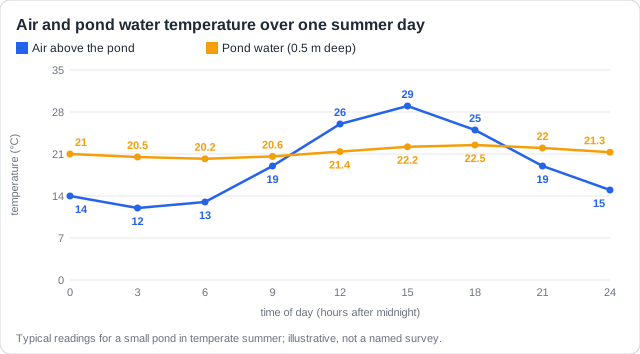
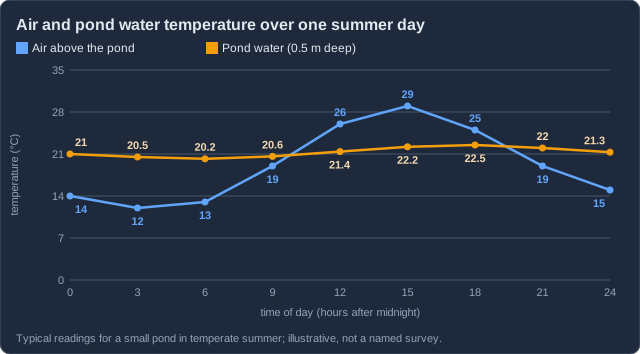
Real example: a small pond in summer. The air above it swings by 17 degrees in a day; the water moves by about 2. The fish, insect larvae and the loon's prey live in a habitat with no sudden temperature changes.
The cause of water's high specific heat capacity: the hydrogen bonds hold the molecules together, so heat energy goes into breaking and stretching them before the water warms. Air has no such bonds.
Interactive diagram
Explore the labelled diagram, charts and maps for this topic in full study mode.
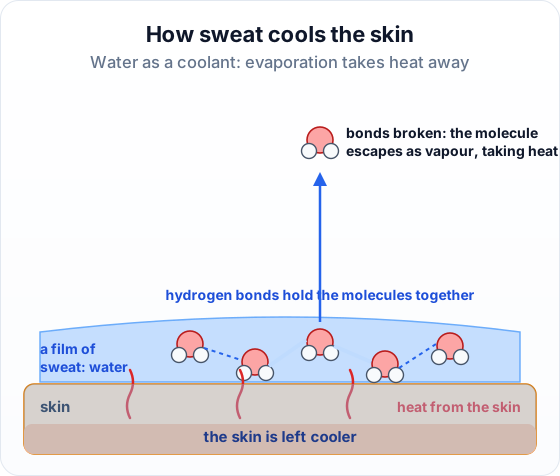
A wet hand feels cold as it dries. The water is not cold: as it evaporates it takes heat with it.
Sweating uses this. Water is a good coolant; air is not, because air does not evaporate from the skin.
The points to remember
- Sweat is water. Heat from the warm skin passes into it and makes its molecules move faster.
- With enough heat a molecule breaks its hydrogen bonds, separates from the rest and leaves as vapour: evaporation.
- That heat has been taken from the skin, so the body cools.
- Water has a high heat of vaporisation (about 2,260 joules per gram), so a little sweat removes a lot of heat.
- This is the heat of vaporisation at work, not specific heat capacity.
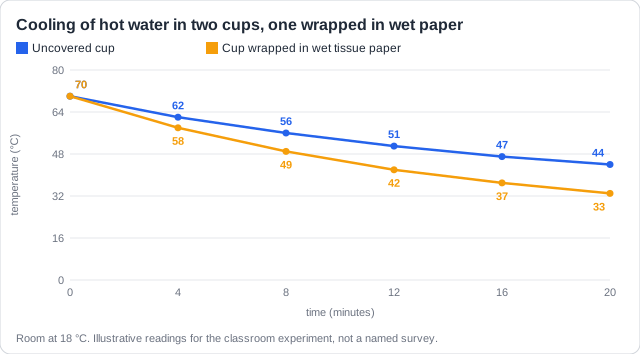
A classroom experiment shows the same thing without a body. Two cups of hot water cool in a room at 18 degrees; one is wrapped in tissue paper soaked in water. The wrapped cup cools faster, because the water evaporating from the paper takes heat from the cup, the way sweat takes heat from the skin.
Real example: a marathon runner can lose about a litre of sweat an hour. Evaporating that litre takes about 2.3 million joules of heat out of the body, which is why a runner in dry air stays cool and a runner in humid air, where sweat cannot evaporate, overheats.
Name the right property: Cooling by sweat is water's high heat of vaporisation: the heat needed to turn liquid into vapour. Specific heat capacity is a different property (the heat needed to change temperature), and naming it here does not score.
Practice with exam-style questions
Answer exam-style questions and get AI feedback that shows you exactly what examiners want to see in a full-marks response.
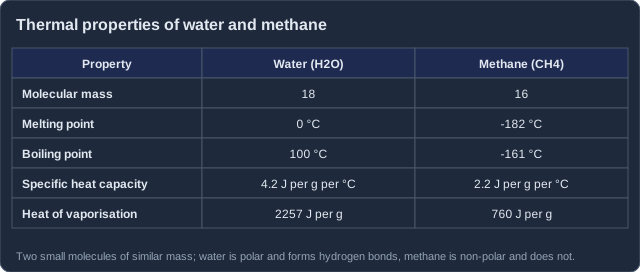
Methane is the gas in natural gas. Its molecule, CH4, is about the same size and mass as a water molecule, H2O. Yet at room temperature methane is a gas and water is a liquid.
The difference is the hydrogen bonds. Water has them, methane does not.
The points to remember
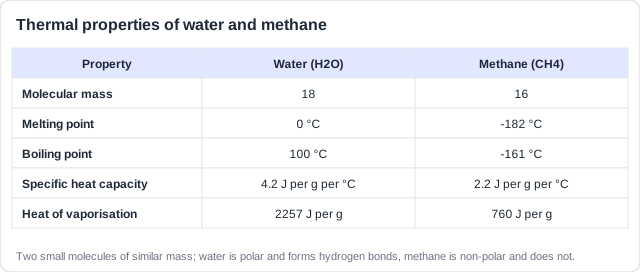
- Water (mass 18) and methane (mass 16) are both small molecules, yet water is a liquid at room temperature and methane a gas.
- Water is polar, so hydrogen bonds form between its molecules; methane is non-polar and forms none.
- Breaking hydrogen bonds takes energy, so water has the higher melting point (0 against minus 182) and boiling point (100 against minus 161).
- For the same reason water has the higher specific heat capacity (4.2 against 2.2 J per g) and heat of vaporisation (2,257 against 760 J per g).
- Earth is always warmer than minus 160, so methane is a gas here; water is liquid from 0 to 100: a habitat, and a coolant.
Remember it as: Same size, different manners: water holds hands (hydrogen bonds), methane does not.
Real example: on Titan, Saturn's largest moon, the surface is about minus 180 degrees, and there methane is the liquid: it fills lakes and falls as rain. On Earth, always far warmer than minus 161, methane is a gas and water is the liquid that fills lakes and seas.
Always give the cause: 'Water has a high boiling point' on its own does not score. Say why: water forms hydrogen bonds and methane does not, and breaking those bonds takes energy.
Ready to ace Physical properties of water and animals in aquatic habitats?
You've seen the preview. Here's what you'll unlock:
Bite-Sized Study Notes
Full syllabus broken into chunks that stick
Exam Practice
See exactly how to score full marks
AI Feedback
Know exactly what examiners want
Smart Study Plan
Know exactly what to study next