aımnova
DashboardMy LearningCrash CoursesStudy Plan

Aimnova site navigation

Stay in the loop

Get the latest study resources and updates

New features, study tips and exam insights — straight to your inbox.

IB Diploma

  • IB Past Papers
  • IB Study Notes
  • IB Question Bank
  • IB Mock Exams
  • IB Revision

IB Subjects

  • IB Math AA
  • IB Math AI
  • IB Economics
  • IB Business Management
  • IB Physics
  • IB Biology
  • View all IB subjects→

IB Past Papers

  • IB Math AA HL Past Papers
  • IB Math AA SL Past Papers
  • IB Math AI HL Past Papers
  • IB Math AI SL Past Papers
  • IB Economics HL Past Papers
  • IB Economics SL Past Papers
  • IB ESS Past Papers
  • View all past papers→

Study Resources

  • Study Notes
  • Question Bank
  • Mock Exams
  • Crash Courses
  • Flashcards
  • Revision Guide
  • Exam Skills
  • Command Terms
  • Grade Calculator
  • Exam Timetable 2026

Aimnova

  • Features
  • Pricing
  • For Teachers
  • For Schools
  • For Parents
  • About Us
  • Blog
  • Contact
aımnova

IB study, practice and feedback built around the real exam.

TermsPrivacyCookies·© 2026 Aimnova. All rights reserved.10c8990

Aimnova is not affiliated with or endorsed by the International Baccalaureate Organization (IB).

NotesBiologyTopic 1.2DNA as the genetic material of all living organisms
Back to Biology Topics
1.2.15 min read

DNA as the genetic material of all living organisms

IB Biology · Unit 1

Exam preparation

Practice the questions examiners actually ask

Our question bank mirrors real IB exam papers. Practice under timed conditions and track your progress across topics.

Start Practicing

Contents

  1. 1Every living organism uses DNA
  2. 2Viruses: some use RNA, but they are not alive
  3. 3Exam-style question (step by step)
The big idea: Every organism carries its own instructions, its genetic material. In every living organism, that molecule is DNA.

The points to remember

  • Genetic material: the molecule that stores the instructions for building and running an organism.
  • It is copied when cells divide and passed on to the next generation.
  • In all living organisms the genetic material is DNA (deoxyribonucleic acid).
  • Bacteria, plants, fungi and animals all use this same molecule.
Remember it as: Every living thing, one molecule: DNA.
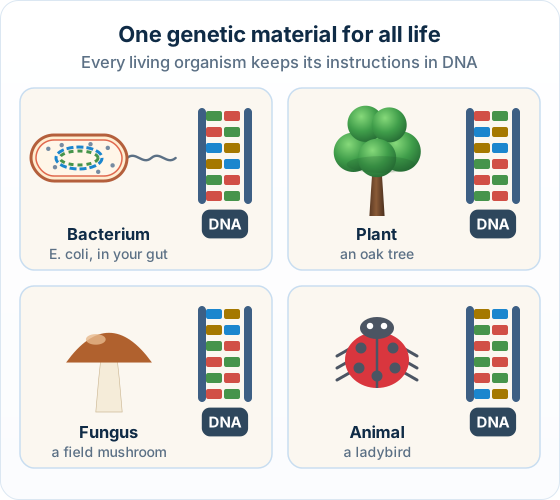
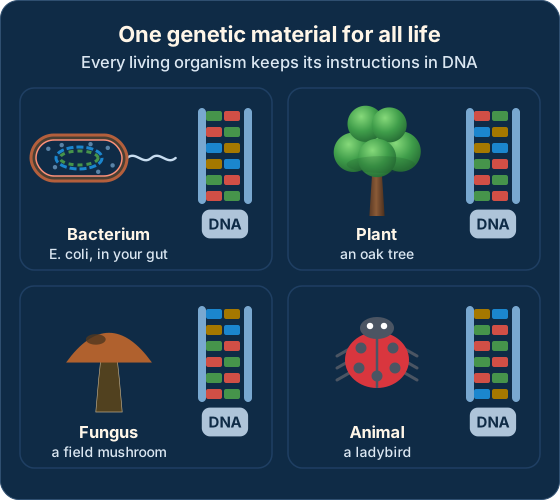
Four cards: a rod-shaped bacterium, an oak tree, a mushroom and a ladybird, each beside the same short DNA ladder labelled DNAFour cards: a rod-shaped bacterium, an oak tree, a mushroom and a ladybird, each beside the same short DNA ladder labelled DNA
A bacterium, a plant, a fungus and an animal: four very different organisms, one genetic material.
Real example: one breakfast, four kinds of organism: Yoghurt is made by bacteria, bread rises because of yeast (a fungus), the flour comes from wheat (a plant), and you are an animal. All four store their instructions in DNA.

In a school lab you can even see DNA: crushed strawberries, washing-up liquid, salt and ice-cold alcohol give white, stringy strands of it.

When a question asks you to name the genetic material, one word earns the mark:

Name the molecule exactly: Write DNA (or deoxyribonucleic acid). 'Nucleic acid' on its own is too vague, and 'RNA' is wrong for a living organism.

Free preview

This is the free notes preview

You're reading the free notes. Aimnova Pro unlocks the full study experience — and you can try it with your first topic free to keep:

  • FlashcardsLock in vocabulary and key terms with spaced repetition.
  • Practice questionsAnswer exam-style questions and get instant AI marking.
  • Mock exams & past-paper vaultSit full mocks and see exactly how examiners award marks.
  • Personalised study planA daily plan built around your exam date and weak areas.
Start Studying Free Full access to Aimnova Pro · cancel anytime
The big idea: Every virus carries genetic material, and in some viruses it is RNA, not DNA.

That does not break the rule, because viruses are not considered living.

The points to remember

  • Every virus carries genetic material: DNA in some viruses, RNA in others.
  • RNA viruses include the influenza virus and SARS-CoV-2, the virus that causes COVID-19.
  • Viruses are not considered living: they are not made of cells and have no metabolism of their own.
  • A virus is copied only inside a living host cell, using that cell's machinery.
  • So the rule stands: every living organism uses DNA.
Remember it as: RNA in a virus is no exception: a virus is not alive.
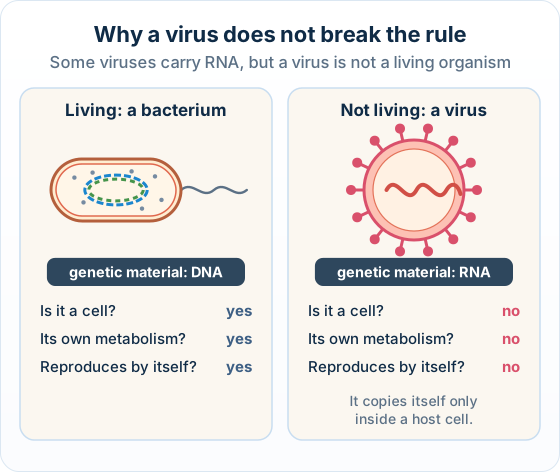
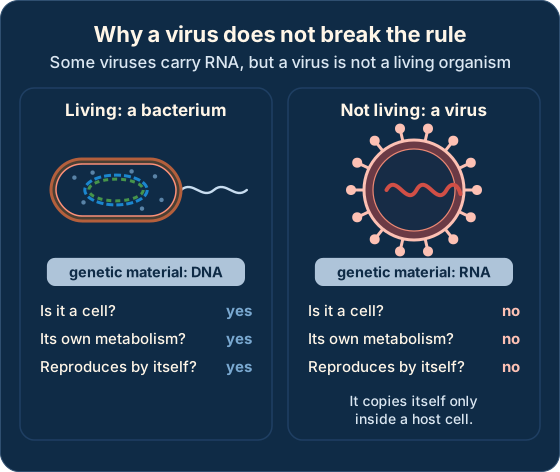
Two cards. Left: a living bacterium with a loop of DNA inside; it is a cell, has its own metabolism and reproduces by itself. Right: a spherical virus with spikes and a strand of RNA inside; it is not a cell, has no metabolism and does not reproduce by itself.Two cards. Left: a living bacterium with a loop of DNA inside; it is a cell, has its own metabolism and reproduces by itself. Right: a spherical virus with spikes and a strand of RNA inside; it is not a cell, has no metabolism and does not reproduce by itself.
A bacterium is a living cell with DNA. A virus is not a cell, and this one carries RNA.

Here is a real RNA virus at work inside a cell it has infected:
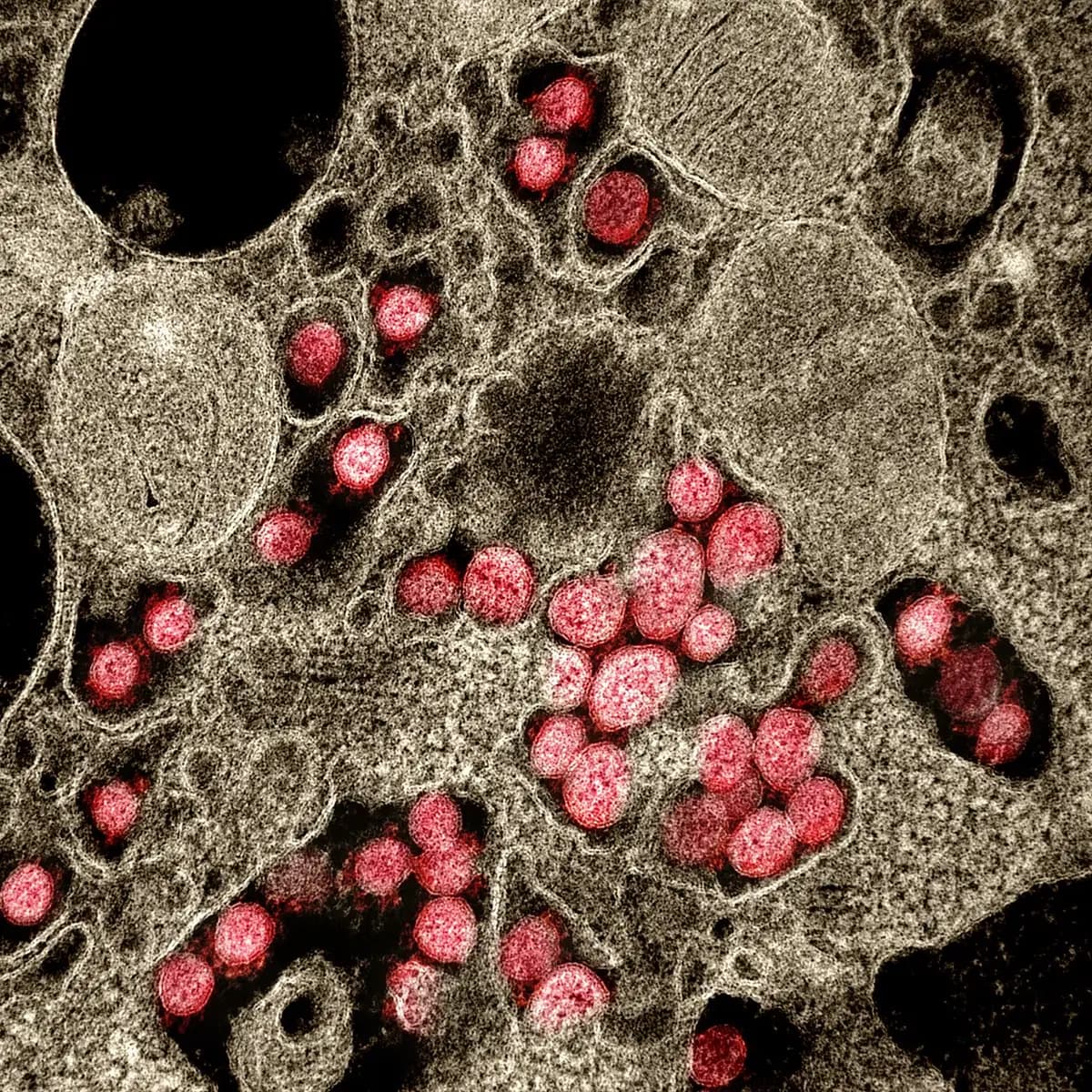
Electron micrograph of a cell packed with round virus particles, coloured red
SARS-CoV-2 particles (red) inside an infected cell, seen with an electron microscope. The virus is copied only inside a living cell. Photo: National Institute of Allergy and Infectious Diseases, https://www.niaid.nih.gov/, @ flikr, CC BY 2.0.
Real example: the COVID-19 virus: SARS-CoV-2 carries its genetic material as one long strand of RNA, about 30 000 bases long. On its own it does nothing. Inside a human cell it uses the cell's machinery to make thousands of copies of itself.

Know your predicted grade

Take timed mock exams and get detailed feedback on every answer. See exactly where you're losing marks.

Try Mock Exams FreeYour first topic is free to keep • No credit card required
How it is asked: Two shapes so far: a Paper 1A item that tests the rule and the virus exception together, and a one-mark Paper 2 State. Here is each, worked through.
IB-style questionIdentify[1 mark]

Which features are common to every virus? I. not living. II. carries genetic material. III. carries DNA. A. I and II only. B. I and III only. C. II and III only. D. I, II and III.

Model answer plan

See the answer broken into clear points, with guidance on how each point earns marks.

Claim your free topic

The Paper 2 version is one mark for one exact word:

IB-style questionState[1 mark]

Wheat plants grown from the seeds of one parent plant look very similar to each other. State the molecule that wheat plants use as their genetic material.

Model answer plan

See the answer broken into clear points, with guidance on how each point earns marks.

Claim your free topic
If the question is about a virus: Read whether it asks about a living organism or a virus. A student is told that the Zika virus carries RNA. The student concludes that not all living organisms use DNA as their genetic material. The reply is always the same: viruses are not living, so they are not exceptions to the rule.

Try an IB Exam Question — Free AI Feedback

Test yourself on DNA as the genetic material of all living organisms. Write your answer and get instant AI feedback — just like a real IB examiner.

Baker's yeast is a single-celled fungus. Each cell can produce a bud that grows into a new yeast cell.

the molecule that yeast cells use as their genetic material.
[1 mark]

Related Biology Topics

Continue learning with these related topics from the same unit:

1.1.1Water as the medium for life1.1.2Hydrogen bonds from the polar covalent bonds in water1.1.3Cohesion of water and its consequences for organisms1.1.4Adhesion of water to polar or charged materials
View all Biology topics
Improve your exam techniqueCommand terms, paper structure, and mark-scheme tips for Biology
Previous1.1.6Physical properties of water and animals in aquatic habitatsNextComponents of a nucleotide1.2.2

8 practice questions on DNA as the genetic material of all living organisms

Students who practiced this topic on Aimnova scored 82% on average. Try free practice questions and get instant AI feedback.

Try 3 Free QuestionsView All Biology Topics