aımnova
DashboardMy LearningCrash CoursesStudy Plan

Aimnova site navigation

Stay in the loop

Get the latest study resources and updates

New features, study tips and exam insights — straight to your inbox.

IB Diploma

  • IB Past Papers
  • IB Study Notes
  • IB Question Bank
  • IB Mock Exams
  • IB Revision

IB Subjects

  • IB Math AA
  • IB Math AI
  • IB Economics
  • IB Business Management
  • IB Physics
  • IB Biology
  • View all IB subjects→

IB Past Papers

  • IB Math AA HL Past Papers
  • IB Math AA SL Past Papers
  • IB Math AI HL Past Papers
  • IB Math AI SL Past Papers
  • IB Economics HL Past Papers
  • IB Economics SL Past Papers
  • IB ESS Past Papers
  • View all past papers→

Study Resources

  • Study Notes
  • Question Bank
  • Mock Exams
  • Crash Courses
  • Flashcards
  • Revision Guide
  • Exam Skills
  • Command Terms
  • Grade Calculator
  • Exam Timetable 2027

Aimnova

  • Features
  • Pricing
  • For Teachers
  • For Schools
  • For Parents
  • About Us
  • Blog
  • Contact
aımnova

IB study, practice and feedback built around the real exam.

TermsPrivacyCookies·© 2026 Aimnova. All rights reserved.d9e1c61

Aimnova is not affiliated with or endorsed by the International Baccalaureate Organization (IB).

NotesBiology HLTopic 4.9Osmoregulation by water reabsorption in the collecting ducts
Back to Biology HL Topics
4.9.103 min read

Osmoregulation by water reabsorption in the collecting ducts (Biology HL)

IB Biology · Unit 4

Your first topic is free to keep

Know exactly what to write for full marks

Practice with exam questions and get AI feedback that shows you the perfect answer — what examiners want to see.

Start Free

Contents

  1. 1ADH and the collecting ducts
  2. 2ADH: more water back to the blood
  3. 3Aquaporins switch place
  4. 4Exam-style question (step by step)
ADH and the collecting ducts: This statement is Higher Level only.

Practise this as you read

  • Describe the path from osmoreceptor to collecting duct.
  • Explain the role of aquaporins.

Free preview

This is the free notes preview

You're reading the free notes. Aimnova Pro unlocks the full study experience — and you can try it with your first topic free to keep:

  • FlashcardsLock in vocabulary and key terms with spaced repetition.
  • Practice questionsAnswer exam-style questions and get instant AI marking.
  • Mock exams & past-paper vaultSit full mocks and see exactly how examiners award marks.
  • Personalised study planA daily plan built around your exam date and weak areas.
Start Studying Free Full access to Aimnova Pro · cancel anytime
The big idea: Osmoreceptors in the hypothalamus monitor the blood. When it is too concentrated, the pituitary gland secretes more ADH, and the collecting ducts reabsorb more water.

See it drawn, step by step

In My Learning, handwritten diagrams build one step at a time. Play, pause and replay each explanation until it clicks. Create your free account to try it.

Claim your free topic
Remember it as: Too concentrated: more ADH. Too dilute: less ADH.

Feeling unprepared for exams?

Get a clear study plan, practice with real questions, and know exactly where you stand before exam day. No more guessing.

Get Exam Ready FreeYour first topic is free to keep • No credit card required
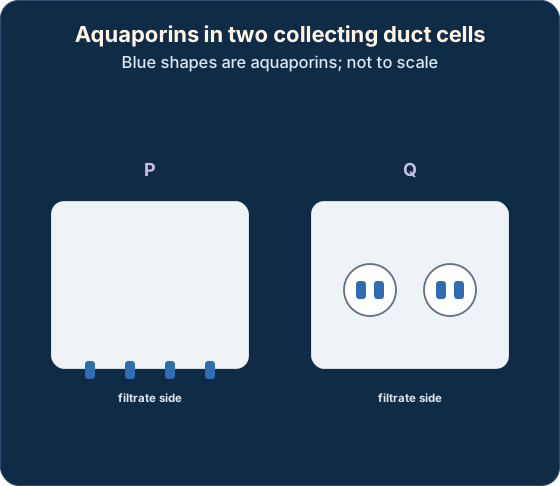
What ADH does to a collecting duct cell: Aquaporins are water channels. ADH makes the cell move them from vesicles into the cell membrane. With less ADH they move back into vesicles.
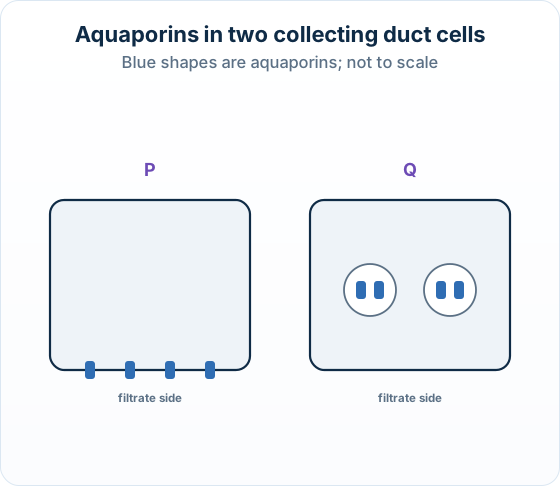
Two collecting duct cells: in P the aquaporins are in the cell membrane next to the filtrate; in Q they are in vesicles inside the cellTwo collecting duct cells: in P the aquaporins are in the cell membrane next to the filtrate; in Q they are in vesicles inside the cell
With ADH the aquaporins are in the membrane (P); without it they are stored in vesicles (Q).
More ADHLess ADH
AquaporinsIn the cell membraneIn vesicles inside the cell
Collecting ductVery permeable to waterAlmost impermeable to water
Water reabsorbedMoreLess
UrineSmall volume, concentratedLarge volume, dilute

The points to remember

  • Water moves through aquaporins by osmosis, into the concentrated medulla (4.9.9).
  • ADH = antidiuretic hormone, secreted by the pituitary gland.
Remember it as: More ADH, more aquaporins, more water saved.
How it is asked: Long Paper 2 answers on the hormonal control of osmoregulation, Paper 1B questions on aquaporins, and Paper 1A items on ADH.
IB-style questionExplain[7 marks]

Explain how the water content of the blood is controlled by a hormone when a person becomes dehydrated.

Model answer plan

See the answer broken into clear points, with guidance on how each point earns marks.

Claim your free topic

IB Exam Questions on Osmoregulation by water reabsorption in the collecting ducts

Practice with IB-style questions filtered to Topic 4.9.10. Get instant AI feedback on every answer.

Practice Topic 4.9.10 QuestionsBrowse All Biology HL Topics

How Osmoregulation by water reabsorption in the collecting ducts Appears in IB Exams

Examiners use specific command terms when asking about this topic. Here's what to expect:

  • Define

    Say exactly what the key terms in Osmoregulation by water reabsorption in the collecting ducts mean.

    AO1
  • Describe

    Say what the processes or features in Osmoregulation by water reabsorption in the collecting ducts are like, with the details that matter.

    AO2
  • Explain

    Give reasons WHY — cause and effect within Osmoregulation by water reabsorption in the collecting ducts.

    AO3
  • Evaluate

    Weigh strengths AND limitations of approaches in Osmoregulation by water reabsorption in the collecting ducts.

    AO3
  • Discuss

    Present arguments FOR and AGAINST with a balanced conclusion.

    AO3

See the full IB Command Terms guide

Related Biology HL Topics

Continue learning with these related topics from the same unit:

4.1.1DNA replication as production of exact copies of DNA with identical base sequences4.1.2Semi-conservative nature of DNA replication and role of complementary base pairing4.1.3Role of helicase and DNA polymerase in DNA replication4.1.4Polymerase chain reaction and gel electrophoresis as tools for amplifying and separating DNA
View all Biology HL topics
Improve your exam techniqueCommand terms, paper structure, and mark-scheme tips for Biology HL
Previous4.9.9Role of the loop of HenleNextChanges in blood supply to organs in response to changes in activity4.9.11

9 exam-style questions ready for you

Students who practice on Aimnova improve their scores by 15% on average. Get instant feedback that shows exactly how to improve your answers.

Practice Now — FreeView All Biology HL Topics