DNA replication before division at Higher Level: The same statement as SL. At HL it is the start of long answers on the cell cycle (4.4.13) and how mitosis keeps the chromosome number.
Practise this as you read
- Identify replication on a graph of DNA per cell.
- Outline why both daughter cells get the same genes.
Free preview
This is the free notes preview
You're reading the free notes. Aimnova Pro unlocks the full study experience — and you can try it with your first topic free to keep:
- FlashcardsLock in vocabulary and key terms with spaced repetition.
- Practice questionsAnswer exam-style questions and get instant AI marking.
- Mock exams & past-paper vaultSit full mocks and see exactly how examiners award marks.
- Personalised study planA daily plan built around your exam date and weak areas.
Start Studying Free Full access to Aimnova Pro · cancel anytime
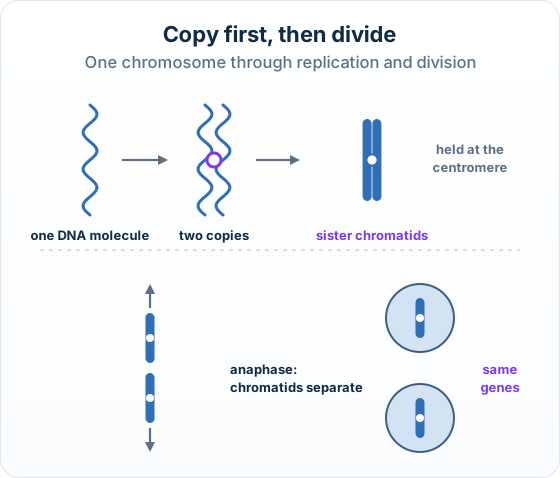
The big idea: Before mitosis or meiosis, every DNA molecule is replicated. Each chromosome is then two identical chromatids held together until anaphase.
The points to remember
- Before replication, a chromosome is one long DNA molecule.
- Replication happens in interphase, before the nucleus divides.
- After replication, each chromosome is two sister chromatids: two identical DNA molecules.
- The chromatids are held together at the centromere until anaphase.
- When they separate, each daughter nucleus gets one copy of every chromosome.
Remember it as: Copy, keep together, then pull apart.
Real example: how long copying takes. In a typical dividing human cell grown in the lab, replicating all the DNA takes about 8 hours, a large part of the time between one division and the next.
Study smarter, not longer
Most students waste 40% of study time on topics they already know. Our AI tracks your progress and optimizes every minute.
Try Smart Study FreeYour first topic is free to keep • No credit card required
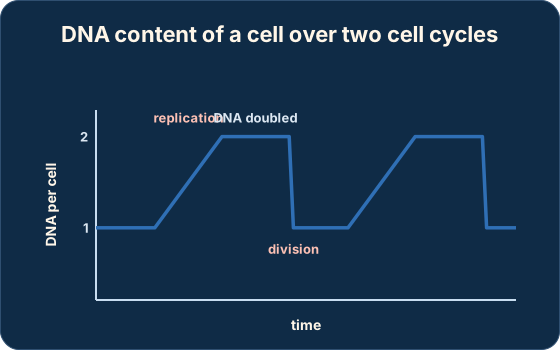
Reading the DNA graph: If you measure the DNA in one cell over time, it doubles during replication and halves when the cell divides.
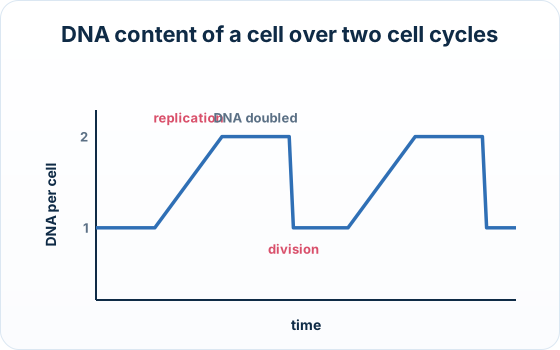
| Part of the graph | What is happening |
|---|---|
| Flat, low | The cell grows; DNA not yet copied |
| Rising | DNA replication: the DNA is being copied |
| Flat, high (double) | Each chromosome is now two chromatids |
| Sudden drop by half | Division: the DNA is shared between two cells |
Both divisions need it: Mitosis and meiosis both start with replicated chromosomes. At HL the stages of interphase are named G1 (growth), S (DNA replication) and G2 (growth), so 'S phase' is the rising part of the graph (4.4.13).
How it is asked: A 1A graph of DNA per cell (which point is replication?), a one-mark 'distinguish the DNA before and after replication', or as the first steps of a long answer on how mitosis keeps the chromosome number.
IB-style questionOutline[3 marks]
Outline how DNA replication before mitosis makes sure that both daughter cells receive the same genes.
Model answer plan
See the answer broken into clear points, with guidance on how each point earns marks.