Roles of mitosis and meiosis at Higher Level: The same statement as SL. At HL a four-mark 'distinguish between mitosis and meiosis' is a favourite Paper 2 opener.
Practise this as you read
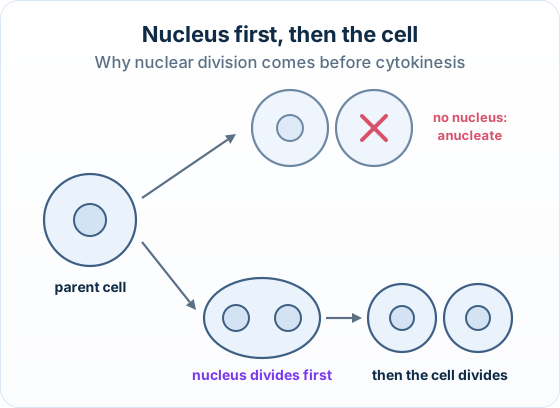
- State why the nucleus divides before the cell.
- Distinguish between mitosis and meiosis.
Free preview
This is the free notes preview
You're reading the free notes. Aimnova Pro unlocks the full study experience — and you can try it with your first topic free to keep:
- FlashcardsLock in vocabulary and key terms with spaced repetition.
- Practice questionsAnswer exam-style questions and get instant AI marking.
- Mock exams & past-paper vaultSit full mocks and see exactly how examiners award marks.
- Personalised study planA daily plan built around your exam date and weak areas.
Start Studying Free Full access to Aimnova Pro · cancel anytime
The big idea: In eukaryotes the nucleus divides before the cell does, so that no daughter cell is left anucleate (without a nucleus).
The points to remember
- The nucleus holds the cell's genes, which control the cell's activities.
- An anucleate cell cannot make new proteins for long and can never divide.
- So nuclear division (mitosis or meiosis) comes first.
- Then cytokinesis splits the cytoplasm between the new nuclei.
Remember it as: Divide the nucleus, then the cell.
Real example: phloem sieve tubes. The sieve tube cells of phloem lose their nucleus as they mature and can never divide again. A companion cell beside each one keeps its nucleus and supports it.
Never wonder what to study next
Get a personalized daily plan based on your exam date, progress, and weak areas. We'll tell you exactly what to review each day.
Try Free Study PlanYour first topic is free to keep • No credit card required
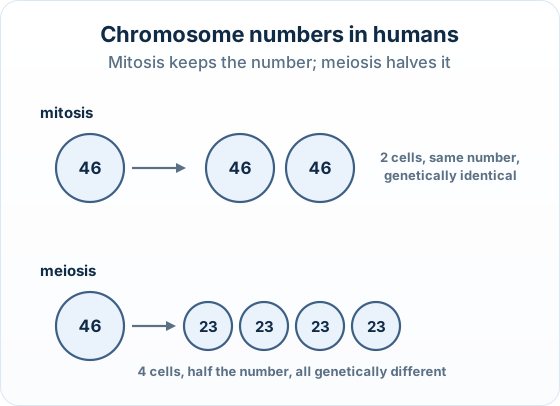
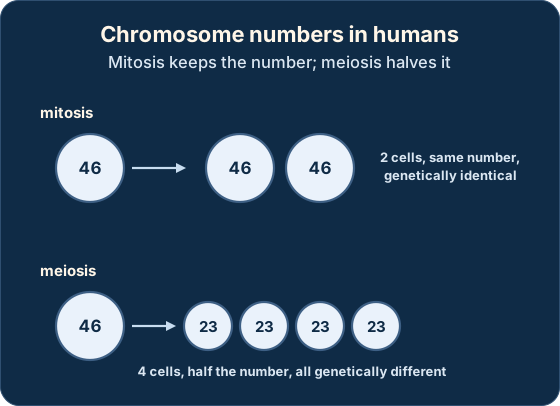
Two kinds of nuclear division: Mitosis keeps the chromosome number and the genome the same. Meiosis halves the chromosome number and makes every cell genetically different.
| Mitosis | Meiosis | |
|---|---|---|
| Chromosome number | Kept the same | Halved |
| Genome of daughter cells | Identical to the parent | Different: genetic diversity |
| Daughter cells | Two | Four |
| Roles | Growth, repair, replacement, asexual reproduction | Making gametes for sexual reproduction |
Why halve the number?: At fertilisation two gametes fuse. If they were not haploid, the chromosome number would double in every generation.
How it is asked: A Paper 2 'distinguish between mitosis and meiosis', a 1B 'distinguish between the cells produced', or a 1A item on what each division does to the chromosome number.
IB-style questionDistinguish[4 marks]
Distinguish between cell division by mitosis and by meiosis in eukaryotes.
Model answer plan
See the answer broken into clear points, with guidance on how each point earns marks.