The big idea: A cell does not divide the instant it is made. It first grows and copies its DNA, and only then divides into two. This repeating sequence of events is called the cell cycle.
Interphase
- A long preparation phase
- The cell grows and copies its DNA
Mitotic phase (M phase)
- A short dividing phase
- The cell divides into two
- Cell cycle
- The repeating sequence of events a cell goes through from when it is formed to when it divides into two new cells.
- Interphase
- The part of the cell cycle when the cell is NOT dividing — it grows and copies its DNA. It is made up of three stages: G1, S and G2.
- G1 phase (first gap)
- The first stage of interphase, when the cell grows larger and makes new proteins and organelles.
- S phase (synthesis)
- The stage of interphase when the DNA is replicated (copied), so the amount of DNA in the cell doubles.
- G2 phase (second gap)
- The last stage of interphase, when the cell keeps growing and prepares everything it needs to divide.
- Mitotic phase (M phase)
- The short part of the cell cycle when the nucleus divides (mitosis) and the cell splits into two (cytokinesis).
Interphase is NOT a 'resting' phase: It is easy to think interphase is the cell 'doing nothing' between divisions.
In fact interphase is the busiest, longest part of the cycle — the cell is growing the whole time and copying its entire set of DNA in the middle of it.
Division (M phase) is actually the quick part at the end.
Free preview
This is the free notes preview
You're reading the free notes. Aimnova Pro unlocks the full study experience — and you can try it with your first topic free to keep:
- FlashcardsLock in vocabulary and key terms with spaced repetition.
- Practice questionsAnswer exam-style questions and get instant AI marking.
- Mock exams & past-paper vaultSit full mocks and see exactly how examiners award marks.
- Personalised study planA daily plan built around your exam date and weak areas.
Interphase is not one single step — it is split into three stages that always happen in the same order: G1, then S, then G2.
Why the order matters: The cell grows first (G1), then copies its DNA (S), then does final growth and checks before dividing (G2).
What happens in each stage of interphase
- G1 (first gap): the cell grows larger and makes new proteins and organelles.
- S (synthesis): the cell replicates its DNA — every chromosome is copied, so the amount of DNA doubles.
- G2 (second gap): the cell keeps growing and prepares to divide, checking that the copied DNA is ready.
- After G2 the cell leaves interphase and enters the M phase to divide.
| Stage | Part of the cycle | What the cell is doing |
|---|---|---|
| G1 (first gap) | Interphase | The cell grows larger and makes new proteins and organelles |
| S (synthesis) | Interphase | DNA is replicated — every chromosome is copied, so the amount of DNA doubles |
| G2 (second gap) | Interphase | The cell keeps growing and prepares for division (more proteins, organelles checked) |
| M (mitosis + cytokinesis) | Mitotic phase | The nucleus divides (mitosis) and the cell splits in two (cytokinesis) |
The key change: DNA doubles in S phase: The single most important event of interphase is DNA replication in S phase. This is why a cell at G2 has double the DNA of a cell at G1 — a favourite exam 'distinguish' point.
Before S phase (at G1)
- The cell has its normal amount of DNA
After S phase (at G2)
- Every chromosome has been copied
- The cell has twice as much DNA
You can track this doubling as a set of numbers. If the amount of DNA at G1 is called 2 units, then it rises to 4 units during S phase and stays at 4 units through G2 — until mitosis shares it back out:
| Stage of the cycle | Amount of DNA in the cell (arbitrary units) | Why |
|---|---|---|
| G1 (before replication) | 2 | Each chromosome is a single copy |
| S (DNA being replicated) | rising 2 → 4 | Chromosomes are being copied |
| G2 (after replication) | 4 | Every chromosome has been copied — DNA has doubled |
| End of mitosis / cytokinesis | 2 (in each daughter cell) | The copies are shared out equally between two cells |
Interphase (G1, S, G2)
- The cell grows and copies its DNA
- DNA doubles during S phase
- The longest part of the cycle
- The cell is not dividing yet
Mitotic phase (M)
- The nucleus divides (mitosis)
- The cell splits in two (cytokinesis)
- A short part of the cycle
- DNA is shared equally to two daughter cells
An easy way to remember the order: G1 → S → G2 → M. The two Gaps sit either side of Synthesis (the DNA copy), and M (division) comes last.
Think: Grow → Synthesise (copy DNA) → Grow again → Mitosis.
| Feature | Interphase (G1, S, G2) | Mitotic phase (M) |
|---|---|---|
| What happens | Growth and DNA replication | Nucleus and cell divide |
| How long it lasts | Most of the cell cycle (the longest part) | A short part of the cycle |
| DNA content | Doubles during S phase | Halved back to normal as the cell divides |
| Is the cell dividing? | No — it is preparing | Yes — division is happening |
Learn what examiners really want
See exactly what to write to score full marks. Our AI shows you model answers and the key phrases examiners look for.
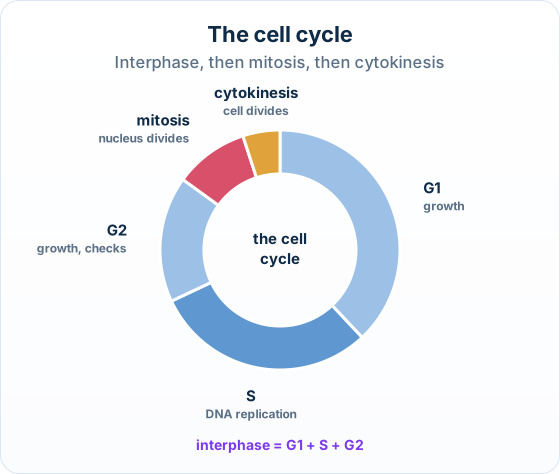
The big idea: Cells proliferate by going round the cell cycle: interphase (G1, S, G2), then mitosis, then cytokinesis.
The points to remember
- The cell cycle is how cell proliferation is achieved.
- Interphase = G1, then S, then G2.
- After interphase comes mitosis (the nucleus divides), then cytokinesis (the cell divides).
- Each daughter cell can then begin the cycle again at G1.
- Interphase takes up most of the cycle; mitosis and cytokinesis are short.
Remember it as: G1, S, G2, M, C, and round again.
Real example: one turn of the cycle. Many human cells grown in the lab go round the cycle in about a day, with mitosis taking only about an hour of it.
How it is asked: 1A items on the order of the stages or which stage replicates DNA; graphs of DNA per cell; a short outline of the whole cycle, often as the start of a longer answer on cell division.
Outline the sequence of events in the cell cycle.
Model answer plan
See the answer broken into clear points, with guidance on how each point earns marks.
Mitosis is not part of interphase: Interphase is G1, S and G2 only. Mitosis and cytokinesis come after it.