aımnova
DashboardMy LearningCrash CoursesStudy Plan

Aimnova site navigation

Stay in the loop

Get the latest study resources and updates

New features, study tips and exam insights — straight to your inbox.

IB Diploma

  • IB Past Papers
  • IB Study Notes
  • IB Question Bank
  • IB Mock Exams
  • IB Revision

IB Subjects

  • IB Math AA
  • IB Math AI
  • IB Economics
  • IB Business Management
  • IB Physics
  • IB Biology
  • View all IB subjects→

IB Past Papers

  • IB Math AA HL Past Papers
  • IB Math AA SL Past Papers
  • IB Math AI HL Past Papers
  • IB Math AI SL Past Papers
  • IB Economics HL Past Papers
  • IB Economics SL Past Papers
  • IB ESS Past Papers
  • View all past papers→

Study Resources

  • Study Notes
  • Question Bank
  • Mock Exams
  • Crash Courses
  • Flashcards
  • Revision Guide
  • Exam Skills
  • Command Terms
  • Grade Calculator
  • Exam Timetable 2026

Aimnova

  • Features
  • Pricing
  • For Teachers
  • For Schools
  • For Parents
  • About Us
  • Blog
  • Contact
aımnova

IB study, practice and feedback built around the real exam.

TermsPrivacyCookies·© 2026 Aimnova. All rights reserved.06bfe1b

Aimnova is not affiliated with or endorsed by the International Baccalaureate Organization (IB).

NotesBiology HLTopic 4.4Cell proliferation for growth, cell replacement and tissue repair
Back to Biology HL Topics
4.4.123 min read

Cell proliferation for growth, cell replacement and tissue repair (Biology HL)

IB Biology · Unit 4

AI-powered feedback

Stop guessing — know where you lost marks

Get instant, examiner-style feedback on every answer. See exactly how to improve and what the markscheme expects.

Try It Free

Contents

  1. 1Why cells proliferate
  2. 2Three jobs, one process
  3. 3Exam-style question (step by step)
The big idea: Cell proliferation is a rapid increase in cell number by repeated cell division. Organisms use it to grow, to replace cells and to repair damage.
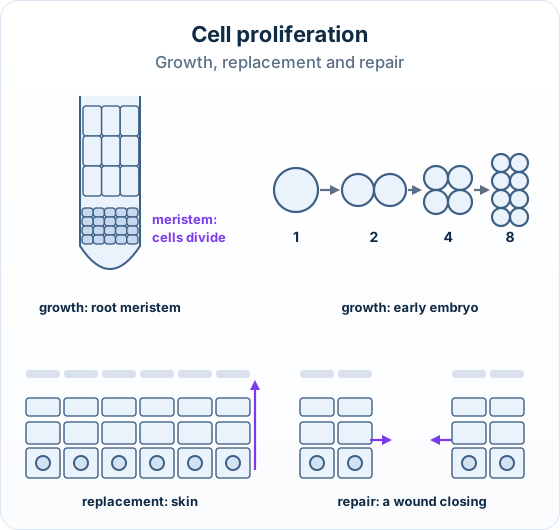
Four panels: a root tip with a meristem of small dividing cells, an embryo dividing from 1 to 8 cells, skin cells dividing at the base, and cells closing a cut
Proliferation: growth, replacement and repair.

The points to remember

  • Plant growth: cells in meristems (at root and shoot tips) keep dividing.
  • Animal growth: an early embryo divides again and again, with little growth between divisions.
  • Replacement: cells at the base of the skin divide all the time to replace cells lost at the surface.
  • Repair: after a wound, cells at its edges divide faster until the gap is closed.
Remember it as: Grow, replace, repair: all by dividing.

Real example: new skin. The outer layer of human skin is replaced roughly every four to six weeks, by cells dividing at its base and moving up to the surface.

Free preview

This is the free notes preview

You're reading the free notes. Aimnova Pro unlocks the full study experience — and you can try it with your first topic free to keep:

  • FlashcardsLock in vocabulary and key terms with spaced repetition.
  • Practice questionsAnswer exam-style questions and get instant AI marking.
  • Mock exams & past-paper vaultSit full mocks and see exactly how examiners award marks.
  • Personalised study planA daily plan built around your exam date and weak areas.
Start Studying Free Full access to Aimnova Pro · cancel anytime
Three jobs, one process: The same process, mitosis followed by cytokinesis, does all three jobs; what differs is where and why it happens.
JobWhereWhat happens
Growth (plants)Meristems at root and shoot tipsCells divide, then grow and specialise
Growth (animals)Early embryoThe zygote divides into a ball of cells
ReplacementBase of the skinNew cells replace those lost at the surface
RepairEdges of a woundCells divide faster until the gap closes
Controlled, not random: Proliferation speeds up when it is needed and stops when it is not, for example once a wound has closed. The cell cycle and its controls (4.4.13 and 4.4.15) make this possible.

Know your predicted grade

Take timed mock exams and get detailed feedback on every answer. See exactly where you're losing marks.

Try Mock Exams FreeYour first topic is free to keep • No credit card required
How it is asked: A short answer on why cells divide in a named tissue, or a 1A item matching an example (meristem, embryo, skin, wound) to growth, replacement or repair.
IB-style questionOutline[3 marks]

Outline three different roles of cell proliferation in multicellular organisms, with an example of each.

Model answer plan

See the answer broken into clear points, with guidance on how each point earns marks.

Claim your free topic

Try an IB Exam Question — Free AI Feedback

Test yourself on Cell proliferation for growth, cell replacement and tissue repair. Write your answer and get instant AI feedback — just like a real IB examiner.

the term for a rapid increase in the number of cells by repeated cell division. [1 mark]

Related Biology HL Topics

Continue learning with these related topics from the same unit:

4.1.1DNA replication as production of exact copies of DNA with identical base sequences4.1.2Semi-conservative nature of DNA replication and role of complementary base pairing4.1.3Role of helicase and DNA polymerase in DNA replication4.1.4Polymerase chain reaction and gel electrophoresis as tools for amplifying and separating DNA
View all Biology HL topics
Improve your exam techniqueCommand terms, paper structure, and mark-scheme tips for Biology HL
Previous4.4.11Meiosis as a source of variationNextPhases of the cell cycle4.4.13

5 questions to test your understanding

Reading is just the start. Students who tested themselves scored 82% on average — try IB-style questions with AI feedback.

Start FreeView All Biology HL Topics