Elongation at Higher Level: The same statement as SL. At HL the same cycle is described with the ribosome's A, P and E sites, on the initiation page.
Practise this as you read
- Outline how amino acids are added to a polypeptide.
- Explain why chains on one mRNA differ in length.
Free preview
This is the free notes preview
You're reading the free notes. Aimnova Pro unlocks the full study experience — and you can try it with your first topic free to keep:
- FlashcardsLock in vocabulary and key terms with spaced repetition.
- Practice questionsAnswer exam-style questions and get instant AI marking.
- Mock exams & past-paper vaultSit full mocks and see exactly how examiners award marks.
- Personalised study planA daily plan built around your exam date and weak areas.
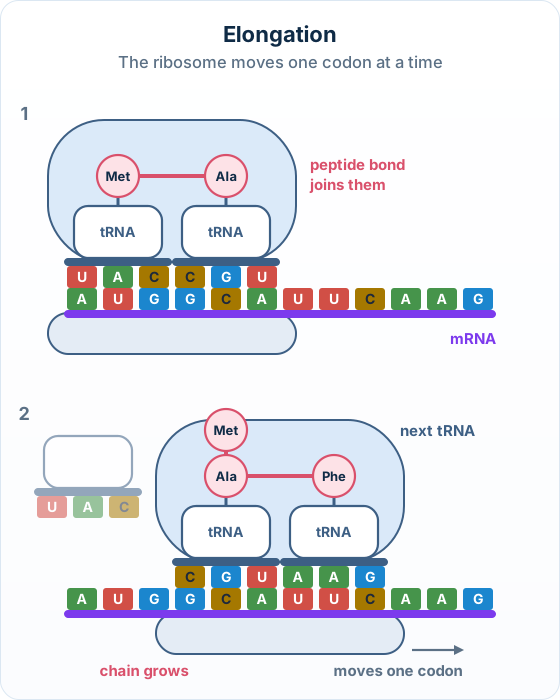
The big idea: During elongation the ribosome joins amino acids with peptide bonds, then moves one codon along the mRNA, again and again.
The points to remember
- Two tRNAs sit in the ribosome at once, each on its codon.
- The ribosome joins their amino acids with a peptide bond.
- The ribosome then moves one codon (three bases) along the mRNA.
- The first tRNA, now without its amino acid, leaves.
- The next tRNA arrives, and the polypeptide grows by one amino acid each time.
Remember it as: Bond, shift, release, repeat: one codon, one amino acid.
Real example: puromycin. The antibiotic puromycin looks like the end of a tRNA carrying an amino acid. The ribosome joins it to the chain, but nothing can be added after it, so elongation stops early.
Learn what examiners really want
See exactly what to write to score full marks. Our AI shows you model answers and the key phrases examiners look for.
Many ribosomes, one mRNA: Several ribosomes can move along the same mRNA at once, one behind another.
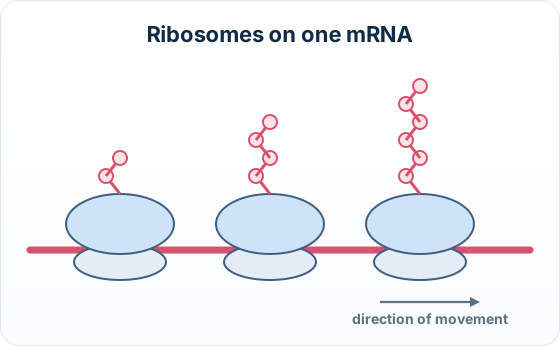
A ribosome that started earlier has moved further along the mRNA, so it has added more amino acids. That is why the chains are different lengths: the longest chain is on the ribosome that has travelled furthest.
Not different proteins: The chains are the same polypeptide at different stages. When each ribosome reaches the end, all the chains are the same length.
How it is asked: A diagram of ribosomes on an mRNA, with a few marks on why the chains differ, or the steps of elongation.
An electron micrograph shows several ribosomes on one mRNA molecule, each with a polypeptide chain of a different length. Explain why the chains are different lengths.
Model answer plan
See the answer broken into clear points, with guidance on how each point earns marks.