Polar habitat change at Higher Level: The same statement as SL. An HL Paper 2 question has asked for melting ice and changing ocean currents together in one 4-mark answer.
Practise this as you read
- Describe how melting ice affects one named polar species.
- Link this page to the next one, on ocean currents and nutrient upwelling.
Free preview
This is the free notes preview
You're reading the free notes. Aimnova Pro unlocks the full study experience — and you can try it with your first topic free to keep:
- FlashcardsLock in vocabulary and key terms with spaced repetition.
- Practice questionsAnswer exam-style questions and get instant AI marking.
- Mock exams & past-paper vaultSit full mocks and see exactly how examiners award marks.
- Personalised study planA daily plan built around your exam date and weak areas.
Start Studying Free Full access to Aimnova Pro · cancel anytime
The big idea: Polar animals depend on ice as a habitat. Warming melts it. Emperor penguins in the Antarctic can lose their breeding grounds when landfast ice breaks out early. Walruses in the Arctic lose their sea ice habitat.
See it drawn, step by step
In My Learning, handwritten diagrams build one step at a time. Play, pause and replay each explanation until it clicks. Create your free account to try it.
- Sea ice
- Frozen sea water that floats on the surface of the ocean.
- Landfast ice
- Sea ice that is attached to the coast or to an ice shelf, so it does not drift.
- Breakout
- The breaking up of landfast ice, which then drifts away from the coast.
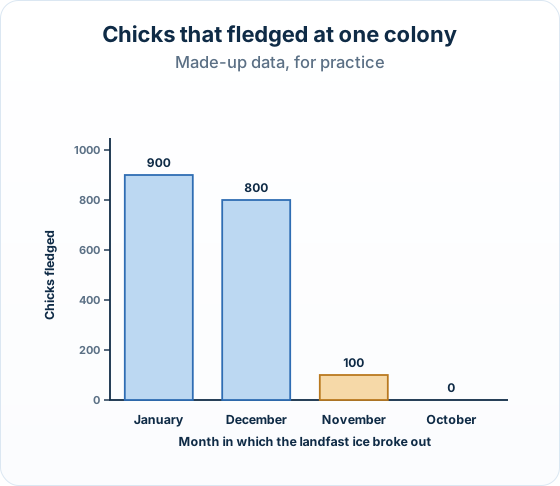
A real case: In 2022 the sea ice of the Bellingshausen Sea, Antarctica, broke up early. Satellite images suggest that no chicks survived at four of the five emperor penguin colonies there (Fretwell and others, 2023).
The points to remember
- Landfast ice is attached to the land. Other sea ice drifts.
- Penguins: loss of breeding grounds. Walruses: loss of sea ice habitat.
- In the Arctic, walruses now gather on beaches in tens of thousands, for example near Point Lay, Alaska (US Geological Survey).
Remember it as: Penguins in the south, walruses in the north.
Never wonder what to study next
Get a personalized daily plan based on your exam date, progress, and weak areas. We'll tell you exactly what to review each day.
Try Free Study PlanYour first topic is free to keep • No credit card required
| Emperor penguin | Walrus | |
|---|---|---|
| Where | Antarctic | Arctic |
| Ice used | Landfast ice | Sea ice over shallow sea |
| Used for | Breeding: eggs and chicks stay on the ice for months | Resting between feeding dives, and raising young |
| Change | Early breakout of the ice | Ice melts back over deep water |
| Effect | Loss of breeding grounds; chicks die | Loss of habitat; crowding on land |
The points to remember
- Emperor penguin chicks need the ice until summer, when they have waterproof feathers.
- In an exam you may write the common name or the scientific name (Aptenodytes forsteri).
- Other Arctic animals of the sea ice, such as polar bears, lose habitat in the same way.
Remember it as: No ice, no place to breed or rest.
How it is asked: Short Paper 2 answers that describe or outline how melting ice changes polar habitats, with a named animal, and Paper 1A items that match the animal, the kind of ice and the effect.
IB-style questionOutline[3 marks]
Summer sea ice in the Arctic is melting back further each decade. Outline how this affects walruses.
Model answer plan
See the answer broken into clear points, with guidance on how each point earns marks.