The boreal forest tipping point at Higher Level: The same statement as SL. HL answers can link it to positive feedback and to the carbon cycle.
Practise this as you read
- Explain the chain from warming to legacy carbon combustion.
- Outline why this change is a tipping point.
Free preview
This is the free notes preview
You're reading the free notes. Aimnova Pro unlocks the full study experience — and you can try it with your first topic free to keep:
- FlashcardsLock in vocabulary and key terms with spaced repetition.
- Practice questionsAnswer exam-style questions and get instant AI marking.
- Mock exams & past-paper vaultSit full mocks and see exactly how examiners award marks.
- Personalised study planA daily plan built around your exam date and weak areas.
The big idea: Boreal forest (taiga) has taken up more carbon than it lost for thousands of years. Warming can change it from net carbon accumulation to net carbon loss. This is an example of a tipping point.
See it drawn, step by step
In My Learning, handwritten diagrams build one step at a time. Play, pause and replay each explanation until it clicks. Create your free account to try it.
- Tipping point
- A threshold beyond which a change becomes self-sustaining and very hard or impossible to reverse: the system moves to a new state.
- Boreal forest (taiga)
- The cold forest of conifers that crosses northern North America, Europe and Asia.
- Legacy carbon
- Carbon that has built up in the soil over a long time and was not burned by earlier fires.
- Forest browning
- Needles and leaves turn brown and trees die back, because of drought and heat.
The points to remember
- Less winter snow means less meltwater in spring, so soils are drier in summer.
- Drought lowers primary production: the trees fix less carbon.
- Hotter, more intense fires burn into the soil and release the legacy carbon.
Remember it as: Warmer, drier, browner, burning.
Memorize terms 3x faster
Smart flashcards show you cards right before you forget them. Perfect for definitions and key concepts.
Before the tipping point
- Cold, with deep winter snow
- High primary production in summer
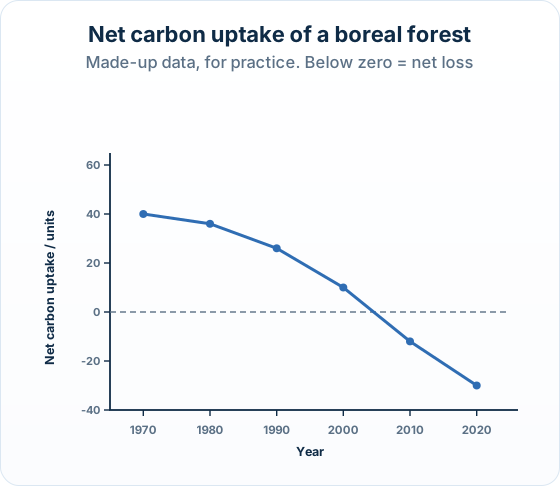
- Net accumulation of carbon: a carbon sink
After the tipping point
- Warmer and drier, more drought
- Browning, more frequent and intense fires
- Net loss of carbon: a carbon source
The points to remember
- A tipping point is a threshold. Past it, the change keeps going by itself and is very hard to reverse.
- The carbon dioxide from the fires causes more warming, which causes more drought and fire.
- The Amazon rainforest is another example of a possible tipping point.
Remember it as: A sink becomes a source, and stays one.
How it is asked: Expect a Paper 1A item on the order of events or on a graph of carbon uptake, and short Paper 2 answers that outline or explain the chain from warming to legacy carbon combustion.
Boreal forests have stored carbon for thousands of years. Outline why their change to a net loss of carbon is described as a tipping point.
Model answer plan
See the answer broken into clear points, with guidance on how each point earns marks.