The big idea: A strand of DNA has two different ends. DNA polymerase can only add nucleotides to one of them: the 3' end.
The points to remember
- The 5' end of a strand finishes with a phosphate (on carbon 5 of the deoxyribose).
- The 3' end finishes with the sugar: its carbon 3 carries a free -OH group.
- DNA polymerase joins the 5' phosphate of a new nucleotide to the 3' carbon of the strand.
- So a new strand always grows in the 5' to 3' direction.
- The two strands of a helix are antiparallel: they run in opposite directions.
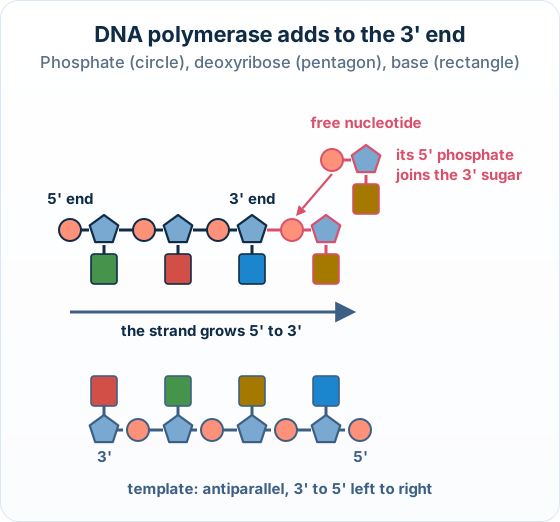
Remember it as: Five to three, never the other way.
Real example: E. coli. Every DNA polymerase known, in bacteria, plants and humans, works only 5' to 3'. That one rule shapes how every cell copies its DNA.
Get the ends right: The 5' end has the phosphate; the 3' end has the sugar. Polymerase adds to the 3' end, never the 5' end.
Free preview
This is the free notes preview
You're reading the free notes. Aimnova Pro unlocks the full study experience — and you can try it with your first topic free to keep:
- FlashcardsLock in vocabulary and key terms with spaced repetition.
- Practice questionsAnswer exam-style questions and get instant AI marking.
- Mock exams & past-paper vaultSit full mocks and see exactly how examiners award marks.
- Personalised study planA daily plan built around your exam date and weak areas.
Start Studying Free Full access to Aimnova Pro · cancel anytime
One rule, two templates: The templates are antiparallel, but each new strand must grow 5' to 3'. So the two new strands cannot be made the same way.
Helicase
- Opens the helix at the fork.
- Gives two templates running in opposite directions.
One template
- Its new strand grows 5' to 3' towards the fork.
- It can be made in one piece.
The other template
- Its new strand grows 5' to 3' away from the fork.
- It has to be made in short pieces.
Why this matters
- Antiparallel templates + a 5' to 3' only polymerase = two different ways of copying.
- This is why there is a leading strand and a lagging strand.
Feeling unprepared for exams?
Get a clear study plan, practice with real questions, and know exactly where you stand before exam day. No more guessing.
Get Exam Ready FreeYour first topic is free to keep • No credit card required
How it is asked: A long Describe on the directionality of DNA and what it means for replication, or a 1A item on which end a nucleotide is added to.
IB-style questionDescribe[5 marks]
Describe the implications of the directionality of DNA for its replication.
Model answer plan
See the answer broken into clear points, with guidance on how each point earns marks.