Depolarization at Higher Level: An AHL statement: what the voltage-gated channels do during an action potential.
Practise this as you read
- Explain the role of the voltage-gated channels.
- Identify channel states on a trace.
Free preview
This is the free notes preview
You're reading the free notes. Aimnova Pro unlocks the full study experience — and you can try it with your first topic free to keep:
- FlashcardsLock in vocabulary and key terms with spaced repetition.
- Practice questionsAnswer exam-style questions and get instant AI marking.
- Mock exams & past-paper vaultSit full mocks and see exactly how examiners award marks.
- Personalised study planA daily plan built around your exam date and weak areas.
An action potential is not one event but a quick sequence of phases, each driven by ion channels opening and closing in turn.
Follow the cause and effect
Threshold
A stimulus pushes the membrane up to threshold.
Na⁺ channels open
Reaching threshold opens Na⁺ channels.
Depolarisation
Na⁺ rushing in depolarises the membrane.
K⁺ channels open
Then K⁺ channels open.
Repolarisation
K⁺ leaving repolarises the membrane back to rest.
Threshold → Na⁺ in → K⁺ out → rest
| Phase | What the ion gates do | Effect on membrane potential |
|---|---|---|
| Resting | Na⁺ and K⁺ gates mostly closed; the membrane is held at about −70 mV | Stays at the resting potential (inside negative) |
| Depolarisation | Voltage-gated Na⁺ channels open; Na⁺ ions rush IN | Rises sharply from −70 mV up to about +40 mV (inside becomes positive) |
| Repolarisation | Na⁺ channels close and voltage-gated K⁺ channels open; K⁺ ions move OUT | Falls back down towards −70 mV (inside negative again) |
| Back to resting | The Na⁺/K⁺ pump restores the original ion balance | Returns to the resting potential, ready for the next impulse |
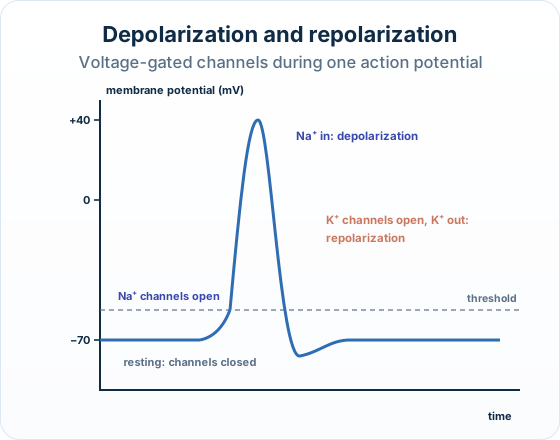
Depolarisation — Na⁺ rushes IN: Once the stimulus reaches threshold, voltage-gated sodium channels open and Na⁺ ions flood into the axon.
Sodium is positive, so the inside of the axon quickly becomes less negative and then positive — the membrane potential rises from −70 mV to about +40 mV.
This is the steep upstroke you see on the trace.
Repolarisation — K⁺ moves OUT: At the peak the Na⁺ channels close and voltage-gated potassium channels open, so K⁺ ions move out of the axon.
Losing positive ions makes the inside negative again, so the membrane potential falls back towards −70 mV — the downstroke on the trace.
The undershoot: There is often a brief undershoot below −70 mV before the Na⁺/K⁺ pump restores the resting state, ready for the next impulse.
Reading the trace: the rising part is depolarisation (Na⁺ in), the peak is +40 mV, and the falling part is repolarisation (K⁺ out) returning the membrane to its resting potential.
Interactive diagram
Explore the labelled diagram, charts and maps for this topic in full study mode.
Depolarisation
- Na⁺ ions rush IN
- Voltage-gated Na⁺ channels open
- Inside becomes positive (up to about +40 mV)
- The rising part of the trace
Repolarisation
- K⁺ ions move OUT
- Voltage-gated K⁺ channels open
- Inside becomes negative again (back to −70 mV)
- The falling part of the trace
All-or-none — every spike is the same size: An action potential either fires fully or not at all — this is the all-or-none principle.
Below threshold
- A weak stimulus that does not reach threshold triggers nothing
At or above threshold
- Any stimulus at or above threshold triggers a full action potential
- Always the same size (up to about +40 mV)
A stronger stimulus: So a stronger stimulus does not make a bigger spike — it makes the neuron fire action potentials more frequently instead.
On a graph of responses to increasing stimulus strength, the height of each spike stays constant.
Travelling along the axon (propagation): An action potential in one region depolarises the next region of membrane, which then fires its own action potential, and so on — the impulse is regenerated all the way along the axon without getting smaller.
Why it travels one way: It travels one way only, because the region just behind is briefly recovering (refractory) and cannot fire again straight away. This keeps the nerve impulse moving away from the cell body towards the axon terminals.
Feeling unprepared for exams?
Get a clear study plan, practice with real questions, and know exactly where you stand before exam day. No more guessing.
The big idea: Voltage-gated channels open and close when the membrane potential changes. When a stimulus brings the membrane to the threshold, sodium channels open: Na⁺ diffuses in (depolarization). Then potassium channels open: K⁺ diffuses out (repolarization).
The points to remember
- At rest both voltage-gated channels are closed.
- At the threshold (about −55 mV) Na⁺ channels open.
- Na⁺ diffuses in: depolarization to about +40 mV; Na⁺ channels close.
- K⁺ channels open: K⁺ diffuses out: repolarization.
- Below the threshold, the sodium channels stay closed: no action potential.
Remember it as: Threshold, sodium in, potassium out.
Real example: local anaesthetics. Lidocaine, used by dentists, blocks voltage-gated sodium channels, so impulses from pain receptors in the gum cannot depolarize the axon and never reach the brain.
Trap: Ions move through the channels by diffusion (facilitated diffusion), down their gradients; the pump is not what makes the action potential.
How it is asked: Expect MCQs on a trace (where sodium channels open, which channels are open as the potential falls), Explain questions on the potassium channels or on the membrane's role, and an Outline of the membrane proteins in an impulse.
Explain why a stimulus that does not reach the threshold produces no action potential.
Model answer plan
See the answer broken into clear points, with guidance on how each point earns marks.