Photosystems at Higher Level: An AHL statement: it opens the light-dependent reactions (3.3.9-3.3.14), which turn light into ATP and reduced NADP.
Practise this as you read
- Outline the structure and function of a photosystem.
- State where photosystems are.
Free preview
This is the free notes preview
You're reading the free notes. Aimnova Pro unlocks the full study experience — and you can try it with your first topic free to keep:
- FlashcardsLock in vocabulary and key terms with spaced repetition.
- Practice questionsAnswer exam-style questions and get instant AI marking.
- Mock exams & past-paper vaultSit full mocks and see exactly how examiners award marks.
- Personalised study planA daily plan built around your exam date and weak areas.
Start Studying Free Full access to Aimnova Pro · cancel anytime
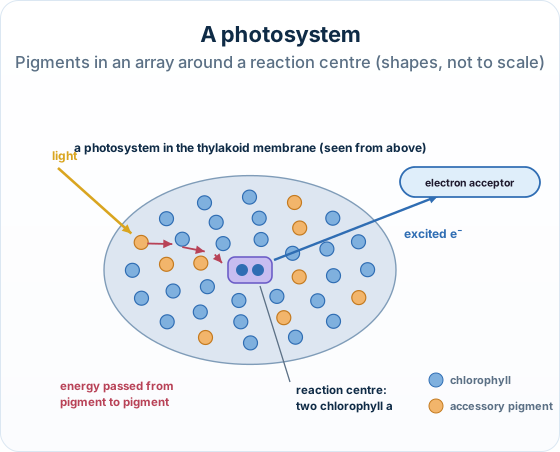
The big idea: A photosystem is an array of many pigment molecules, chlorophylls and accessory pigments, held by proteins in a membrane. Light energy absorbed anywhere in the array is passed to a reaction centre, which emits an excited electron.
The points to remember
- Photosystems are always in membranes: thylakoid membranes in chloroplasts, the cell membranes of cyanobacteria.
- Each is an array of chlorophyll and accessory pigments held by proteins.
- Absorbed light excites electrons; the energy is passed between pigments.
- The reaction centre (a pair of chlorophyll a) emits an excited electron.
- There are two kinds: photosystem II and photosystem I, each with its own reaction centre.
Remember it as: Many pigments catch, one centre throws.
Real example: cyanobacteria. Cyanobacteria have no chloroplasts, yet they photosynthesise: their photosystems sit in folded internal membranes called thylakoids, inside the cell.
Trap: It is the reaction centre that emits the excited electron, not every pigment in the array: the others pass on energy.
Know your predicted grade
Take timed mock exams and get detailed feedback on every answer. See exactly where you're losing marks.
Try Mock Exams FreeYour first topic is free to keep • No credit card required
How it is asked: Expect an Outline question on the structure, location and function of photosystems, or a multiple-choice statement about them.
IB-style questionOutline[3 marks]
Outline the relationship between the structure and the function of a photosystem.
Model answer plan
See the answer broken into clear points, with guidance on how each point earns marks.