Building carbon compounds at Higher Level: An AHL statement that closes the Calvin cycle: what its product becomes, and why plants need mineral nutrients.
Practise this as you read
- Outline how triose phosphate is used.
- Explain why plants need nitrogen and phosphorus.
Free preview
This is the free notes preview
You're reading the free notes. Aimnova Pro unlocks the full study experience — and you can try it with your first topic free to keep:
- FlashcardsLock in vocabulary and key terms with spaced repetition.
- Practice questionsAnswer exam-style questions and get instant AI marking.
- Mock exams & past-paper vaultSit full mocks and see exactly how examiners award marks.
- Personalised study planA daily plan built around your exam date and weak areas.
The big idea: Every carbon atom in a plant — in its sugars, its starch, its cell walls and its oils — started out as carbon dioxide (CO₂) in the air.
From air to molecule
Fix the carbon
In photosynthesis, a plant takes that CO₂ and locks its carbon into a biological molecule. This is called carbon fixation.
Make glucose first
The first carbohydrate made is triose phosphate; plants join it to make glucose.
Build everything else
From glucose, the plant can build everything else it needs — including energy-rich oils.
CO₂ → carbon fixation → glucose → everything else
Photosynthesis fixes carbon dioxide from the air; the Calvin cycle makes triose phosphate, from which glucose and the plant's other carbon compounds are built.
Interactive diagram
Explore the labelled diagram, charts and maps for this topic in full study mode.
- Carbon fixation
- The process of taking carbon dioxide (CO₂) from the air and building its carbon into an organic (biological) molecule. In plants this happens during photosynthesis.
- Glucose
- The first carbohydrate a plant makes from fixed carbon. It is the starting molecule from which other biological molecules are built.
- Organic molecule
- A molecule built around a skeleton of carbon atoms — for example a carbohydrate, a lipid or a protein.
- Lipid (oil / fat)
- An energy-storage molecule made from glycerol and fatty acids. Plant oils are lipids, often stored in seeds.
Why this matters: Carbon fixation is how carbon enters the living world.
Without it, the carbon in the air would never become part of a plant, an animal or you.
So the same CO₂ that a plant absorbs can end up as the oil in a sunflower seed — built, step by step, from atmospheric carbon.
Study smarter, not longer
Most students waste 40% of study time on topics they already know. Our AI tracks your progress and optimizes every minute.
A plant does not make glucose just to store it as glucose. Glucose is a hub molecule: once it has been made, the plant converts it into whatever else it needs.
Think of a workbench: Think of glucose as the raw material on a workbench. The same starting material can be turned into several very different finished products.
Glucose is the starting point: The carbon fixed from CO₂ is first built into triose phosphate, and from it glucose.
These are then used to build all the other biological molecules of the plant:
starch (storage), cellulose (cell walls), amino acids and proteins (with added nitrogen), and lipids / oils (energy-dense storage).
Every one of these is made from carbon that began as atmospheric CO₂.
Glucose is the starting point: once made, the plant converts it into starch, cellulose, amino acids and lipids (oils). Every one of these molecules is built from carbon that began as CO₂.
Interactive diagram
Explore the labelled diagram, charts and maps for this topic in full study mode.
The fates of the fixed carbon: The glucose a plant makes can take several different fates. It can be:
respired (broken down to release energy), stored as starch, built into cellulose for cell walls, combined with nitrogen to make amino acids and proteins, or converted into lipids (oils) for energy-dense storage.
| What the glucose is used for | Molecule made | Why the plant makes it |
|---|---|---|
| Broken down for energy | (used in respiration) | Releases energy to power the plant's cells |
| Joined into a storage carbohydrate | Starch | Stores energy compactly and insolubly inside the plant |
| Joined into a structural carbohydrate | Cellulose | Builds strong cell walls |
| Combined with nitrogen | Amino acids → proteins | Needs nitrogen (N) taken up from the soil as well as carbon |
| Converted to glycerol and fatty acids, then joined | Lipids (oils / fats) | Stores the most energy per gram — packed into seeds |
Building oils — the pathway: To make an oil, the plant uses glucose in a short chain of steps:
glucose → glycerol and fatty acids → these join together (by condensation) → a lipid (oil).
The oil is then stored, very often in seeds, where its packed energy fuels the growth of the next plant.
| Step | What happens | Where the carbon comes from |
|---|---|---|
| 1 | Carbon dioxide is absorbed from the air and fixed in photosynthesis | Atmospheric CO₂ |
| 2 | The fixed carbon is used to make glucose | The CO₂ just fixed |
| 3 | Glucose is converted into glycerol and fatty acids | The glucose made in step 2 |
| 4 | Glycerol and fatty acids join (by condensation) to form lipids | Glycerol + fatty acids from step 3 |
| 5 | The lipids (oils) are stored, often in seeds | The lipids made in step 4 |
Stored as starch (carbohydrate)
- Made by joining glucose molecules together
- A carbohydrate — contains C, H and O
- A short-term, compact energy store
- Common in stems, roots and tubers (e.g. potato)
Stored as oil (lipid)
- Made from glycerol and fatty acids
- A lipid — also built from C, H and O
- Stores the most energy per gram of any food molecule
- Common in seeds (e.g. sunflower, olive)
Remember it as: Air → triose phosphate → glucose → everything. Carbon enters as CO₂, becomes triose phosphate and then glucose, and glucose is the hub from which starch, cellulose, protein and oils are all built.
Oils need an extra conversion: glucose → glycerol + fatty acids → lipid.
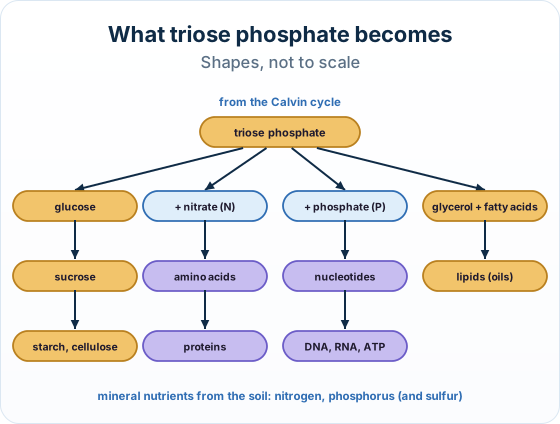
The big idea: The Calvin cycle's product is triose phosphate. With only C, H and O it can become carbohydrates and lipids; with mineral nutrients from the soil, nitrogen and phosphorus (and sulfur), it becomes amino acids and nucleotides too.
The points to remember
- Triose phosphate → glucose → sucrose (transport), starch (store), cellulose (walls).
- + nitrate (N) → amino acids → proteins; some amino acids also need sulfur.
- + phosphate (P) → nucleotides → DNA, RNA and ATP.
- Triose phosphate → glycerol + fatty acids → lipids.
- Minerals are absorbed by the roots from the soil.
Remember it as: Sugar is the skeleton; minerals add the N and P.
Real example: nitrogen deficiency. Crops short of nitrate cannot make enough amino acids for proteins such as Rubisco: their older leaves turn yellow and growth slows, which is why farmers add nitrate fertiliser.
Trap: Photosynthesis alone gives only C, H and O: amino acids and nucleotides also need minerals from the soil.
Practice with exam-style questions
Answer exam-style questions and get AI feedback that shows you exactly what examiners want to see in a full-marks response.
How this is tested: A common question here is a 4-mark Outline: explain how a plant builds oils using carbon taken from the atmosphere.
The chain examiners want
Start in the air
The carbon begins as CO₂ in the atmosphere.
Fix the carbon
The carbon is fixed in photosynthesis.
Make glucose
The fixed carbon is built into glucose.
Convert it
Glucose is converted to glycerol and fatty acids.
Join them
Glycerol and fatty acids are joined into a lipid.
Examiners want a clear chain of steps — each step is a separate scoring point.
Trap: Do not jump straight from 'CO₂' to 'oil': name every intermediate.
Exam-style question — outline how plants build oils from atmospheric carbon
Outline how a plant uses carbon taken from the atmosphere to build oils. [4]
Step by step
- Fix the carbon. Carbon dioxide (CO₂) is absorbed from the air and fixed during photosynthesis.
- Make sugar. The fixed carbon is first made into triose phosphate, then glucose.
- Convert the glucose. Glucose is converted into glycerol and fatty acids — the building blocks of a lipid.
- Join into a lipid. The glycerol and fatty acids are joined together (by condensation) to form a lipid (oil), which is then stored, often in seeds.
Final answer
CO₂ from the air is fixed in photosynthesis; the fixed carbon makes glucose; glucose is converted to glycerol and fatty acids; these join to form a lipid (oil), stored in seeds.
Why this works: Each sentence is a separate step in the pathway: fix carbon, make sugar, make glycerol and fatty acids, join them into a lipid.
An 'Outline' of four steps needs four linked steps, not 'CO₂ becomes oil' written four ways.
| Step | What happens | Where the carbon comes from |
|---|---|---|
| 1 | Carbon dioxide is absorbed from the air and fixed in photosynthesis | Atmospheric CO₂ |
| 2 | The fixed carbon is used to make glucose | The CO₂ just fixed |
| 3 | Glucose is converted into glycerol and fatty acids | The glucose made in step 2 |
| 4 | Glycerol and fatty acids join (by condensation) to form lipids | Glycerol + fatty acids from step 3 |
| 5 | The lipids (oils) are stored, often in seeds | The lipids made in step 4 |
Another question in the papers' style:
Outline how a plant uses the products of the Calvin cycle and mineral nutrients to make proteins and nucleic acids.
Model answer plan
See the answer broken into clear points, with guidance on how each point earns marks.