aımnova
DashboardMy LearningCrash CoursesStudy Plan

Aimnova site navigation

Stay in the loop

Get the latest study resources and updates

New features, study tips and exam insights — straight to your inbox.

IB Diploma

  • IB Past Papers
  • IB Study Notes
  • IB Question Bank
  • IB Mock Exams
  • IB Revision

IB Subjects

  • IB Math AA
  • IB Math AI
  • IB Economics
  • IB Business Management
  • IB Physics
  • IB Biology
  • View all IB subjects→

IB Past Papers

  • IB Math AA HL Past Papers
  • IB Math AA SL Past Papers
  • IB Math AI HL Past Papers
  • IB Math AI SL Past Papers
  • IB Economics HL Past Papers
  • IB Economics SL Past Papers
  • IB ESS Past Papers
  • View all past papers→

Study Resources

  • Study Notes
  • Question Bank
  • Mock Exams
  • Crash Courses
  • Flashcards
  • Revision Guide
  • Exam Skills
  • Command Terms
  • Grade Calculator
  • Exam Timetable 2026

Aimnova

  • Features
  • Pricing
  • For Teachers
  • For Schools
  • For Parents
  • About Us
  • Blog
  • Contact
aımnova

IB study, practice and feedback built around the real exam.

TermsPrivacyCookies·© 2026 Aimnova. All rights reserved.06bfe1b

Aimnova is not affiliated with or endorsed by the International Baccalaureate Organization (IB).

NotesBiology HLTopic 3.3Regeneration of RuBP in the Calvin cycle using ATP
Back to Biology HL Topics
3.3.173 min read

Regeneration of RuBP in the Calvin cycle using ATP (Biology HL)

IB Biology · Unit 3

Exam preparation

Practice the questions examiners actually ask

Our question bank mirrors real IB exam papers. Practice under timed conditions and track your progress across topics.

Start Practicing

Contents

  1. 1RuBP regeneration at Higher Level
  2. 2Regenerating RuBP
  3. 3Exam-style question (step by step)
RuBP regeneration at Higher Level: An AHL statement that closes the Calvin cycle (3.3.15-3.3.17).

Practise this as you read

  • Calculate the numbers of molecules in the cycle.
  • Explain why RuBP must be regenerated.

Free preview

This is the free notes preview

You're reading the free notes. Aimnova Pro unlocks the full study experience — and you can try it with your first topic free to keep:

  • FlashcardsLock in vocabulary and key terms with spaced repetition.
  • Practice questionsAnswer exam-style questions and get instant AI marking.
  • Mock exams & past-paper vaultSit full mocks and see exactly how examiners award marks.
  • Personalised study planA daily plan built around your exam date and weak areas.
Start Studying Free Full access to Aimnova Pro · cancel anytime
The big idea: Most of the triose phosphate made in the Calvin cycle is used to regenerate RuBP, so carbon fixation can go on. This needs ATP. Five triose phosphates (15 carbons) make three RuBP (15 carbons); only one TP in six leaves the cycle.
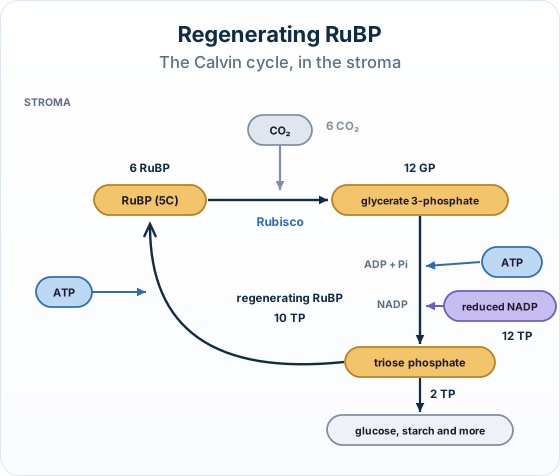
The Calvin cycle drawn step by step: fixation and reduction making triose phosphate; most triose phosphate regenerating RuBP using ATP; some triose phosphate leaving to make glucose and more; the numbers for six turns
Regenerating RuBP, step by step.

The points to remember

  • 5 TP (3C) → 3 RuBP (5C): 15 carbons each side.
  • Regeneration uses ATP (but no reduced NADP).
  • For one glucose: 6 turns, 6 CO₂, 12 GP, 12 TP.
  • 10 TP regenerate the 6 RuBP; 2 TP leave to make one glucose.
  • Without regeneration, RuBP would run out and fixation would stop.
Remember it as: Five threes make three fives.

Real example: why the dark stops the cycle. In the dark, ATP runs out, so RuBP cannot be regenerated: RuBP levels fall and glycerate 3-phosphate builds up, which is how the Calvin cycle was first traced with radioactive carbon.

Trap: ATP is used twice in the cycle: to reduce GP and to regenerate RuBP. Reduced NADP is used once.

Counting the carbons for one glucose:

For one glucose (six turns)NumberCarbons
Carbon dioxide fixed66
RuBP used630
Glycerate 3-phosphate made1236
Triose phosphate made1236
TP back to make RuBP1030
TP leaving (one glucose)26

See how examiners mark answers

Answer exam-style questions with model answers. Learn exactly what earns marks and what doesn't.

Try Exam Vault FreeYour first topic is free to keep • No credit card required
How it is asked: Expect a calculation of the numbers of RuBP, GP or TP for one glucose, or why RuBP must be regenerated.
IB-style questionCalculate[2 marks]

Calculate how many molecules of triose phosphate are used to regenerate RuBP when 12 molecules of triose phosphate are made.

Model answer plan

See the answer broken into clear points, with guidance on how each point earns marks.

Claim your free topic

Try an IB Exam Question — Free AI Feedback

Test yourself on Regeneration of RuBP in the Calvin cycle using ATP. Write your answer and get instant AI feedback — just like a real IB examiner.

why most of the triose phosphate made in the Calvin cycle is used to regenerate RuBP. [2 marks]

Related Biology HL Topics

Continue learning with these related topics from the same unit:

3.1.1Enzymes as catalysts3.1.2Role of enzymes in metabolism3.1.3Anabolic and catabolic reactions3.1.4Enzymes as globular proteins with an active site for catalysis
View all Biology HL topics
Improve your exam techniqueCommand terms, paper structure, and mark-scheme tips for Biology HL
Previous3.3.16Synthesis of triose phosphate using reduced NADP and ATPNextSynthesis of carbohydrates, amino acids and other carbon compounds using the products of the Calvin cycle and mineral nutrients3.3.18

9 questions to test your understanding

Reading is just the start. Students who tested themselves scored 82% on average — try IB-style questions with AI feedback.

Start FreeView All Biology HL Topics