aımnova
DashboardMy LearningCrash CoursesStudy Plan

Aimnova site navigation

Stay in the loop

Get the latest study resources and updates

New features, study tips and exam insights — straight to your inbox.

IB Diploma

  • IB Past Papers
  • IB Study Notes
  • IB Question Bank
  • IB Mock Exams
  • IB Revision

IB Subjects

  • IB Math AA
  • IB Math AI
  • IB Economics
  • IB Business Management
  • IB Physics
  • IB Biology
  • View all IB subjects→

IB Past Papers

  • IB Math AA HL Past Papers
  • IB Math AA SL Past Papers
  • IB Math AI HL Past Papers
  • IB Math AI SL Past Papers
  • IB Economics HL Past Papers
  • IB Economics SL Past Papers
  • IB ESS Past Papers
  • View all past papers→

Study Resources

  • Study Notes
  • Question Bank
  • Mock Exams
  • Crash Courses
  • Flashcards
  • Revision Guide
  • Exam Skills
  • Command Terms
  • Grade Calculator
  • Exam Timetable 2026

Aimnova

  • Features
  • Pricing
  • For Teachers
  • For Schools
  • For Parents
  • About Us
  • Blog
  • Contact
aımnova

IB study, practice and feedback built around the real exam.

TermsPrivacyCookies·© 2026 Aimnova. All rights reserved.06bfe1b

Aimnova is not affiliated with or endorsed by the International Baccalaureate Organization (IB).

NotesBiology HLTopic 3.2Differences between lipids and carbohydrates as respiratory substrates
Back to Biology HL Topics
3.2.173 min read

Differences between lipids and carbohydrates as respiratory substrates (Biology HL)

IB Biology · Unit 3

AI-powered feedback

Stop guessing — know where you lost marks

Get instant, examiner-style feedback on every answer. See exactly how to improve and what the markscheme expects.

Try It Free

Contents

  1. 1Lipids and carbohydrates: Higher Level only
  2. 2Lipids and carbohydrates as fuel
  3. 3Exam-style question (step by step)
Lipids and carbohydrates: Higher Level only: This statement is Higher Level only. It compares the two main fuels of respiration (SL 3.2.4 names them).

Practise this as you read

  • Distinguish between lipids and carbohydrates as substrates.
  • Explain why lipids yield more energy per gram.

Free preview

This is the free notes preview

You're reading the free notes. Aimnova Pro unlocks the full study experience — and you can try it with your first topic free to keep:

  • FlashcardsLock in vocabulary and key terms with spaced repetition.
  • Practice questionsAnswer exam-style questions and get instant AI marking.
  • Mock exams & past-paper vaultSit full mocks and see exactly how examiners award marks.
  • Personalised study planA daily plan built around your exam date and weak areas.
Start Studying Free Full access to Aimnova Pro · cancel anytime
The big idea: Both lipids and carbohydrates can be respired, but differently. Glucose goes through glycolysis, so it can be respired with or without oxygen. Fatty acids are cut into two-carbon acetyl groups that enter the Krebs cycle, so they need oxygen. Per gram, lipids release about twice the energy.
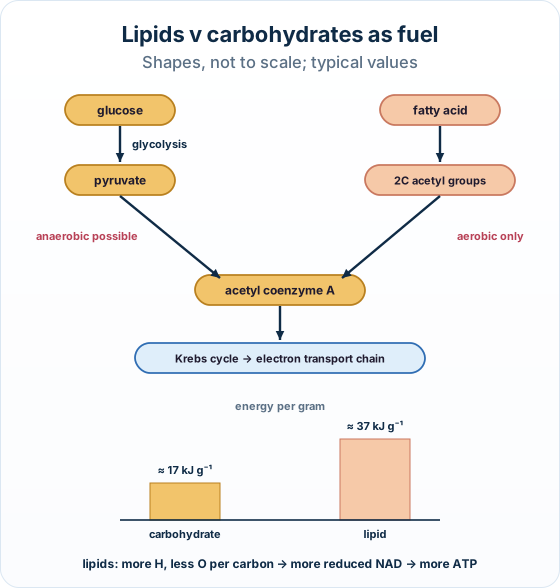
Glucose passing through glycolysis to pyruvate and acetyl coenzyme A, with anaerobic respiration possible; fatty acids cut into two-carbon acetyl groups joining acetyl coenzyme A, aerobic only; bars of energy per gram, about 17 for carbohydrate and about 37 kilojoules for lipid; lipids have more hydrogen per carbon
Lipids and carbohydrates, step by step.

The points to remember

  • Carbohydrate (glucose): glycolysis → pyruvate; can be respired anaerobically.
  • Lipid: fatty acids → two-carbon acetyl groups → acetyl coenzyme A → Krebs cycle.
  • Fatty acids miss glycolysis, so they can be respired only aerobically.
  • Energy per gram: lipid ≈ 37 kJ, carbohydrate ≈ 17 kJ.
  • Lipids have more hydrogen, less oxygen per carbon: more reduced NAD, more ATP.
Remember it as: Fat: twice the energy, but only with oxygen.

Real example: marathon runners and sprinters. In a marathon, muscles burn a high proportion of fat aerobically; in a sprint, they depend on glucose, which glycolysis can use quickly even without enough oxygen.

Trap: Lipids give more energy per gram, but carbohydrates are quicker to use and can give ATP without oxygen.

Never wonder what to study next

Get a personalized daily plan based on your exam date, progress, and weak areas. We'll tell you exactly what to review each day.

Try Free Study PlanYour first topic is free to keep • No credit card required
How it is asked: Expect a Distinguish or Compare question on lipids and carbohydrates as respiratory substrates.
IB-style questionDistinguish[3 marks]

Distinguish between lipids and carbohydrates as respiratory substrates.

Model answer plan

See the answer broken into clear points, with guidance on how each point earns marks.

Claim your free topic

Try an IB Exam Question — Free AI Feedback

Test yourself on Differences between lipids and carbohydrates as respiratory substrates. Write your answer and get instant AI feedback — just like a real IB examiner.

why lipids release more energy per gram than carbohydrates when respired. [2 marks]

Related Biology HL Topics

Continue learning with these related topics from the same unit:

3.1.1Enzymes as catalysts3.1.2Role of enzymes in metabolism3.1.3Anabolic and catabolic reactions3.1.4Enzymes as globular proteins with an active site for catalysis
View all Biology HL topics
Improve your exam techniqueCommand terms, paper structure, and mark-scheme tips for Biology HL
Previous3.2.16Role of oxygen as terminal electron acceptor in aerobic cell respirationNextTransformation of light energy to chemical energy when carbon compounds are produced in photosynthesis3.3.1

6 exam-style questions ready for you

Students who practice on Aimnova improve their scores by 15% on average. Get instant feedback that shows exactly how to improve your answers.

Practice Now — FreeView All Biology HL Topics