Oxygen's role: Higher Level only: This statement is Higher Level only. It explains why aerobic respiration needs oxygen at all.
Practise this as you read
- Explain the role of oxygen.
- Predict what happens without oxygen.
Free preview
This is the free notes preview
You're reading the free notes. Aimnova Pro unlocks the full study experience — and you can try it with your first topic free to keep:
- FlashcardsLock in vocabulary and key terms with spaced repetition.
- Practice questionsAnswer exam-style questions and get instant AI marking.
- Mock exams & past-paper vaultSit full mocks and see exactly how examiners award marks.
- Personalised study planA daily plan built around your exam date and weak areas.
Start Studying Free Full access to Aimnova Pro · cancel anytime
The big idea: Electrons that reach the end of the chain must go somewhere. Oxygen accepts them and combines with protons to form water. By removing electrons, oxygen keeps them flowing, so protons go on being pumped and ATP goes on being made.
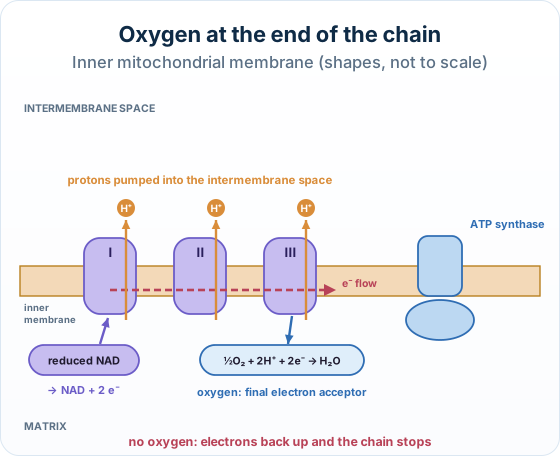
The points to remember
- Oxygen is the terminal (final) electron acceptor.
- ½O₂ + 2H⁺ + 2e⁻ → H₂O (on the matrix side of the inner membrane).
- This removes electrons, so they keep flowing along the chain.
- Using protons from the matrix also helps keep the gradient.
- No oxygen: the chain stops, reduced NAD builds up, and only anaerobic respiration is possible.
Remember it as: No oxygen at the end, no flow along the chain.
Real example: cyanide. Cyanide stops the last carrier passing electrons to oxygen. Even with plenty of oxygen in the blood, cells cannot use it, and ATP production collapses within minutes.
Trap: Oxygen is used only at the very end of aerobic respiration. Without it, the link reaction and Krebs cycle stop too, because NAD is no longer regenerated.
See how examiners mark answers
Answer exam-style questions with model answers. Learn exactly what earns marks and what doesn't.
Try Exam Vault FreeYour first topic is free to keep • No credit card required
How it is asked: Expect an Explain on why oxygen is needed, often as the last part of a longer question on ATP production.
IB-style questionExplain[3 marks]
Explain the role of oxygen in aerobic respiration.
Model answer plan
See the answer broken into clear points, with guidance on how each point earns marks.