Induced fit at Higher Level: The same statement as SL. HL questions ask how substrate and enzyme interact; at HL the idea of a shape change also explains allosteric inhibition, later in this topic.
Practise this as you read
- Identify induced-fit binding from a diagram.
- Outline how substrate and active site interact.
Free preview
This is the free notes preview
You're reading the free notes. Aimnova Pro unlocks the full study experience — and you can try it with your first topic free to keep:
- FlashcardsLock in vocabulary and key terms with spaced repetition.
- Practice questionsAnswer exam-style questions and get instant AI marking.
- Mock exams & past-paper vaultSit full mocks and see exactly how examiners award marks.
- Personalised study planA daily plan built around your exam date and weak areas.
Each enzyme works on only one substrate (or one type of reaction). This is called specificity.
Where specificity comes from: Specificity comes from shape: the active site is complementary to the substrate, so only that substrate fits, like one particular key fitting one particular lock.
Why enzymes are specific: The active site has a particular 3-D shape.
Only a substrate whose shape is complementary to the active site can bind to it.
A substrate of the wrong shape simply does not fit, so the enzyme cannot act on it. That is why each enzyme catalyses only one reaction — its specificity.
The active site is complementary in shape to one substrate, so only that substrate fits — this is the source of an enzyme's specificity.
Interactive diagram
Explore the labelled diagram, charts and maps for this topic in full study mode.
Induced fit — the modern model: The active site is not a rigid, perfectly pre-shaped hole. As the substrate binds, the active site changes shape slightly to mould more closely around it. This is called induced fit (the substrate 'induces' a better fit).
What induced fit explains
- The snug moulding puts a strain on the substrate's bonds, which helps the reaction happen more easily.
- So induced fit explains both specificity and how enzymes speed reactions up.
Lock-and-key (older idea)
- Active site is a rigid, exact match
- Substrate slots in unchanged
- A simple picture of specificity
- Now superseded by induced fit
Induced fit (modern model)
- Active site is slightly flexible
- Active site moulds around the substrate
- Strains the substrate's bonds → reaction easier
- The accepted model — name this one
| Feature | Lock-and-key (older model) | Induced fit (modern model) |
|---|---|---|
| Shape of the active site before binding | Already a perfect, rigid match for the substrate | A close but not exact match — slightly flexible |
| What happens as the substrate binds | The substrate simply slots in; nothing moves | The active site changes shape slightly to mould around the substrate |
| Why specificity still holds | Only a substrate of the right shape fits the rigid site | Only a substrate of a roughly complementary shape can induce the right fit |
| Which model to use | A useful simple picture, but now superseded | The accepted model — name THIS one if asked |
An easy way to remember: Lock-and-key = a stiff lock that never moves. Induced fit = a glove that adjusts around the hand once it goes in.
If an exam asks which model the diagram shows and the active site changes shape on binding, the answer is induced fit.
What every enzyme has in common: However different they look, all enzymes share the same core features: they are globular proteins, they are biological catalysts, each has an active site, each is specific, and each is left unchanged so it can be reused.
A 'feature shared by all enzymes' question is asking for one of these.
| Feature shared by every enzyme | What it means |
|---|---|
| They are globular proteins | Folded into a rounded 3-D shape, with a specific surface pocket |
| They are biological catalysts | They speed up a reaction without being used up |
| They have an active site | A specific region whose shape is complementary to one substrate |
| They are specific | Each enzyme catalyses only one reaction / one substrate |
| They are unchanged and reusable | The enzyme is released intact and can catalyse the same reaction again |
See how examiners mark answers
Answer exam-style questions with model answers. Learn exactly what earns marks and what doesn't.
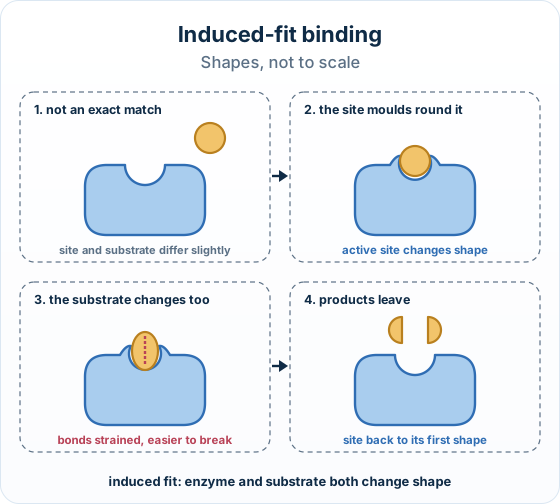
The big idea: In induced fit, binding changes both partners: the active site changes shape to mould round the substrate, and the substrate changes shape too.
The points to remember
- Before binding, the active site is close to, but not an exact match for, the substrate.
- As the substrate binds, the active site changes shape and closes round it.
- The substrate changes shape too: its bonds are strained, so they break more easily.
- After the products leave, the active site goes back to its original shape.
Remember it as: Induced fit: both partners change shape.
Real example: carboxypeptidase A. When a substrate binds to carboxypeptidase A, a protein-digesting enzyme, one amino acid of the active site swings across by about a nanometre to close over it. The bound substrate is pulled slightly out of shape too.
Trap: Induced fit is not permanent. The substrate does not permanently alter the active site; the enzyme is unchanged once the products leave.
How this is tested: Questions test the model of binding, the features all enzymes share, and why enzymes are specific.
| Type | Format | What to do |
|---|---|---|
| Multiple choice | A diagram of an enzyme and substrate: identify the model of binding. | If the active site changes shape as the substrate binds, the answer is induced fit, not lock-and-key. |
| Multiple choice | Pick a feature shared by all enzymes. | Choose a true general statement (globular protein, has an active site, specific, a catalyst, unchanged/reusable). |
| Written | An Explain question asks why enzymes are specific. | Link the complementary shape of the active site and substrate to induced fit. |
Exam-style question — explain why enzymes are specific
Enzymes are described as specific. Explain how the structure of an enzyme makes it specific to its substrate. [4]
Step by step
- Name the active site. Each enzyme has a region called the active site, where the substrate binds.
- Link shape to binding. The active site has a specific 3-D shape that is complementary to the shape of one particular substrate.
- Explain the consequence. Only a substrate of the correct, complementary shape can fit and bind, forming an enzyme-substrate complex; a substrate of the wrong shape cannot bind.
- Add induced fit. As the substrate binds, the active site changes shape slightly to mould around it (induced fit), so only the right substrate produces the proper fit.
Final answer
Each enzyme has an active site of a specific shape that is complementary to one substrate; only that substrate fits and binds (forming an enzyme-substrate complex), and induced fit moulds the site around it — so the enzyme acts on only one substrate.
Why this works: Each sentence adds one idea — active site, complementary shape, only the right substrate fits, induced fit.
An 'Explain [4]' needs the cause-and-effect chain spelled out, not just the word 'specific' repeated.
An enzyme at work: the substrate binds the active site, forming an enzyme-substrate complex (induced fit); the reaction occurs and the products are released, leaving the enzyme unchanged and able to be reused.
Interactive diagram
Explore the labelled diagram, charts and maps for this topic in full study mode.
Reading a data question: Enzyme topics are a data-question favourite. A table might show one enzyme tested against several different substrates, with a product formed for only one of them.
The reasoning to write is always the same: the enzyme catalyses only the substrate whose shape is complementary to its active site, so the others give no product.
Another question in the papers' style:
Outline how the substrate and the active site interact in induced-fit binding.
Model answer plan
See the answer broken into clear points, with guidance on how each point earns marks.