Competitive inhibition: Higher Level only: This statement is Higher Level only. Learn statins as the example, and how substrate concentration affects competitive but not non-competitive inhibition.
Practise this as you read
- Explain competitive inhibition, with statins.
- Compare competitive and non-competitive inhibition.
Free preview
This is the free notes preview
You're reading the free notes. Aimnova Pro unlocks the full study experience — and you can try it with your first topic free to keep:
- FlashcardsLock in vocabulary and key terms with spaced repetition.
- Practice questionsAnswer exam-style questions and get instant AI marking.
- Mock exams & past-paper vaultSit full mocks and see exactly how examiners award marks.
- Personalised study planA daily plan built around your exam date and weak areas.
Start Studying Free Full access to Aimnova Pro · cancel anytime
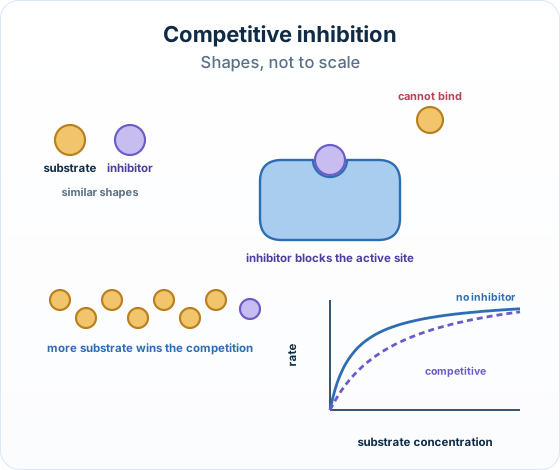
The big idea: A competitive inhibitor looks like the substrate and binds reversibly to the active site, blocking it. Substrate and inhibitor compete, so more substrate reduces the inhibition.
The points to remember
- The inhibitor has a shape and chemistry similar to the substrate, so it fits the active site.
- While it is bound, the substrate cannot bind, so fewer enzyme-substrate complexes form.
- Binding is reversible: the inhibitor leaves again, and substrate can take the site.
- Raising the substrate concentration reduces the inhibition; the maximum rate can still be reached.
Competitive
- Binds the active site
- Similar shape to the substrate
- Blocks the substrate
- More substrate reduces the effect
Non-competitive
- Binds an allosteric site
- Not shaped like the substrate
- Changes the active site's shape
- More substrate has no effect
Remember it as: Same shape, same site: more substrate wins.
Real example: statins. Statins are drugs that lower blood cholesterol. They are competitive inhibitors of HMG-CoA reductase, an enzyme the liver needs to make cholesterol.
Trap: Competitive inhibition does not change the enzyme's shape. The inhibitor simply occupies the active site.
Practice with exam-style questions
Answer exam-style questions and get AI feedback that shows you exactly what examiners want to see in a full-marks response.
Try Practice FreeYour first topic is free to keep • No credit card required
How it is asked: Expect statins as the example, a graph to identify, a data comparison of two inhibitors, or a long answer comparing competitive and non-competitive inhibition.
IB-style questionDistinguish[2 marks]
Distinguish between the effect of increasing substrate concentration on competitive and on non-competitive inhibition.
Model answer plan
See the answer broken into clear points, with guidance on how each point earns marks.