Intracellular and extracellular enzymes: Higher Level only: This statement is Higher Level only. Learn the guide's examples: glycolysis and the Krebs cycle inside cells, and chemical digestion in the gut outside them.
Practise this as you read
- Identify an intracellular or extracellular reaction.
- Distinguish between the two, with examples.
Free preview
This is the free notes preview
You're reading the free notes. Aimnova Pro unlocks the full study experience — and you can try it with your first topic free to keep:
- FlashcardsLock in vocabulary and key terms with spaced repetition.
- Practice questionsAnswer exam-style questions and get instant AI marking.
- Mock exams & past-paper vaultSit full mocks and see exactly how examiners award marks.
- Personalised study planA daily plan built around your exam date and weak areas.
The big idea: A cell makes enzymes to speed up its chemical reactions. But not every enzyme works in the same place.
Intracellular enzymes
- Work inside the cell that made them
- Run the cell's own reactions, such as respiration
Extracellular enzymes
- Are secreted (released) and work outside the cell
- For example the digestive enzymes that break food down in the gut
Same enzymes, different place: Both are still ordinary enzymes. The only difference is where they do their job.
- Enzyme
- A biological catalyst (a globular protein) that speeds up a chemical reaction by lowering its activation energy, without being used up itself.
- Intracellular enzyme
- An enzyme that catalyses a reaction inside the cell that produced it (for example a respiration enzyme).
- Extracellular enzyme
- An enzyme that is secreted by the cell and catalyses a reaction outside the cell (for example a digestive enzyme).
- Secrete
- To release a substance (such as an enzyme) out of a cell, through the cell membrane, into the surroundings.
- Metabolic pathway
- A linked series of enzyme-controlled reactions, where the product of one reaction becomes the substrate of the next.
The word tells you the place: Intra = 'inside' → an intracellular enzyme acts inside the cell.
Extra = 'outside' → an extracellular enzyme acts outside the cell.
Same Latin trick as 'international' (between nations): let the prefix point you to the location.
Study smarter, not longer
Most students waste 40% of study time on topics they already know. Our AI tracks your progress and optimizes every minute.
Most of a cell's enzymes stay inside it. So why would a cell ever secrete an enzyme to work outside? Because some jobs simply cannot be done indoors.
Kept in-house
- Respiration is a metabolic pathway run by intracellular enzymes in the cytoplasm and mitochondria.
- The cell keeps those reactions in-house because that is where it needs the energy.
Intracellular enzymes — the cell's in-house chemistry: Intracellular enzymes stay inside and run the cell's own metabolic pathways.
Examples: the enzymes of respiration (releasing energy from glucose); catalase, which breaks down toxic hydrogen peroxide inside the cell; the enzymes that build and recycle the cell's molecules.
These reactions belong to the cell, so the enzymes never leave it.
Extracellular enzymes — sent out to do a job: Extracellular enzymes are secreted and act outside the cell. The classic reason is digestion.
Why digestion happens outside the cell
Too big
A food molecule such as starch or protein is far too large to cross the cell membrane, so the cell cannot absorb it whole.
Enzyme released
The cell releases an enzyme onto the food.
Hydrolysis
The enzyme hydrolyses the big molecule into small, soluble subunits (starch → maltose/glucose; protein → amino acids).
Absorbed
Those subunits are now small enough to be absorbed into the cell.
Examples
- Amylase, protease and lipase in the gut
- The enzymes a decomposer (saprotroph) secretes onto dead matter to digest it externally before absorbing the nutrients
| Step | What happens | Why it matters |
|---|---|---|
| 1. The problem | A food molecule (e.g. starch, protein) is too LARGE to cross the cell membrane | The cell cannot absorb it as it is |
| 2. The solution | The cell SECRETES an extracellular enzyme onto the food | Digestion happens outside the cell |
| 3. The reaction | The enzyme hydrolyses the large molecule into small soluble subunits | Starch → maltose/glucose; protein → amino acids |
| 4. The payoff | The small soluble subunits are now small enough to be ABSORBED into the cell | The cell finally gets its nutrients |
Intracellular
- Acts inside the cell that made it
- Runs the cell's own metabolic pathways
- e.g. respiration enzymes, catalase
- Stays put — never leaves the cell
Extracellular
- Secreted to act outside the cell
- Digests large molecules in the surroundings
- e.g. amylase, protease, lipase; decomposers' enzymes
- Breaks big food into small, absorbable subunits
Location changes — the enzyme does not: Whichever type it is, it is still a true enzyme: a globular protein that lowers activation energy, is specific to its substrate, and is reusable.
Being secreted does not change how an enzyme works — the substrate still binds the active site by induced fit. Only the address is different.
Whether it works inside the cell (intracellular) or is secreted to act outside (extracellular), an enzyme works the same way: the substrate binds the active site, the reaction happens, and the products are released — the enzyme is unchanged and reused.
Interactive diagram
Explore the labelled diagram, charts and maps for this topic in full study mode.
An easy way to remember: Intracellular = the enzyme stays in.
Extracellular = the enzyme exits (is secreted) to digest food that is too big to come in.
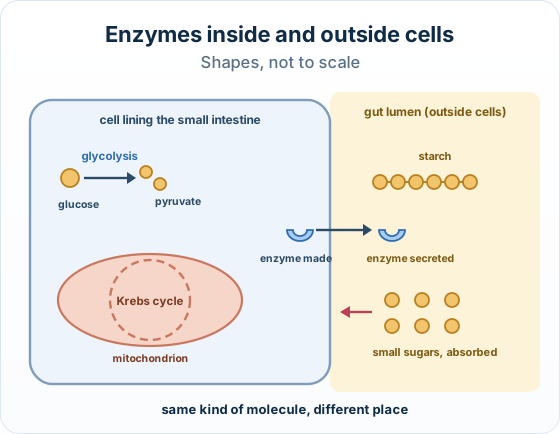
The big idea: Glycolysis and the Krebs cycle are catalysed by intracellular enzymes. Chemical digestion in the gut is catalysed by extracellular enzymes, secreted by cells.
The points to remember
- Glycolysis: enzymes in the cytoplasm break glucose into pyruvate (intracellular).
- Krebs cycle: enzymes in the mitochondrial matrix continue the breakdown (intracellular).
- Digestion: amylase, proteases and lipase are secreted into the gut and hydrolyse food there (extracellular).
- The products of digestion are small enough to be absorbed into cells.
Remember it as: Respiration stays in; digestion goes out.
Real example: pancreas cells. Cells of the pancreas make amylase, proteases and lipase and secrete them into the small intestine. Their own glycolysis enzymes stay in their cytoplasm.
Trap: An enzyme being made inside a cell does not make it intracellular. What counts is where it works.
Practice with exam-style questions
Answer exam-style questions and get AI feedback that shows you exactly what examiners want to see in a full-marks response.
How this is tested: Enzymes are one of the most heavily examined topics in Theme C, and the location split is an easy source of marks.
| Question | What it asks | How to answer |
|---|---|---|
| Distinguish | Contrast intracellular and extracellular enzymes. | Give the contrast explicitly (inside vs secreted/outside) with an example of each. |
| Outline | Why a cell secretes a digestive enzyme. | Large food molecules are too big to enter the cell, so they are broken into small soluble subunits that can be absorbed. |
| Data question | A short data set shows where an enzyme's activity appears (inside the cells, or out in the surrounding medium). | Deduce which type it is. |
Exam-style question — distinguish the two types of enzyme
Distinguish between intracellular and extracellular enzymes, giving one example of each. [4]
Step by step
- Contrast the location. An intracellular enzyme acts inside the cell that made it, whereas an extracellular enzyme is secreted and acts outside the cell.
- Give an intracellular example. A respiration enzyme (working inside the cytoplasm/mitochondria) is intracellular.
- Give an extracellular example. A digestive enzyme such as amylase, protease or lipase is extracellular.
- Add the linking point. Both are still true enzymes (globular proteins that lower activation energy and are reusable); only their location differs.
Final answer
Intracellular enzymes act inside the cell that made them (e.g. respiration enzymes); extracellular enzymes are secreted and act outside the cell (e.g. digestive amylase/protease/lipase). Both are ordinary enzymes — only the location differs.
Why this works: A Distinguish answer must make the contrast explicit for each pair — 'intracellular does X whereas extracellular does Y' — and it backs each side with a named example.
Describe both types, not just one.
| Feature | Intracellular enzyme | Extracellular enzyme |
|---|---|---|
| Where it acts | Inside the cell that made it | Outside the cell — it is secreted (released) |
| Made by the cell? | Yes | Yes (then exported through the membrane) |
| Typical job | Runs the cell's own metabolic pathways | Breaks down large molecules in the surroundings |
| Examples | Respiration enzymes; enzymes of a metabolic pathway (e.g. catalase breaking down hydrogen peroxide) | Digestive enzymes (amylase, protease, lipase); the enzymes a decomposer secretes onto dead matter |
| Still a true enzyme? | Yes — globular protein, lowers activation energy, specific, reusable | Yes — identical properties; only the LOCATION differs |
Another question in the papers' style:
Explain why digestion of starch in the gut is extracellular, whereas glycolysis is intracellular.
Model answer plan
See the answer broken into clear points, with guidance on how each point earns marks.