Abiotic variables at Higher Level: The same statement as SL. HL questions ask for factors that act on both plants and animals, and link each to the organism's biology.
Practise this as you read
- State an abiotic factor affecting both plants and animals.
- Suggest abiotic variables that explain a distribution in data.
Free preview
This is the free notes preview
You're reading the free notes. Aimnova Pro unlocks the full study experience — and you can try it with your first topic free to keep:
- FlashcardsLock in vocabulary and key terms with spaced repetition.
- Practice questionsAnswer exam-style questions and get instant AI marking.
- Mock exams & past-paper vaultSit full mocks and see exactly how examiners award marks.
- Personalised study planA daily plan built around your exam date and weak areas.
The big idea: A species is not found everywhere — it lives only where the conditions suit it.
Abiotic factors
- The non-living, physical and chemical conditions of a habitat are called abiotic factors
- Examples: temperature, water, light, pH and salinity
- Each abiotic factor has a range of values that a species can tolerate
- Where those conditions are met, the species can live; where they are not, it is absent
Why it matters: This is why abiotic factors determine the distribution of a species.
- Abiotic factor
- A non-living, physical or chemical feature of a habitat — for example temperature, water availability, light intensity, pH or salinity.
- Biotic factor
- A living feature of a habitat that comes from other organisms — for example predators, competitors, food or disease. (Contrast with abiotic.)
- Distribution
- Where a species is found across an area — the places it does and does not live.
- Range of tolerance
- The span of values of an abiotic factor over which a species can survive; outside this range the species cannot live.
- Limiting factor
- The one factor in short (or excess) supply that holds back a species and stops it living in a particular place.
Abiotic vs biotic: Abiotic = Absence of life — the physical/chemical conditions (temperature, water, light, pH, salt, oxygen, wind, soil minerals).
Biotic = the living influences (predators, competitors, food, disease).
This micro is about the abiotic ones, but real distributions are usually shaped by both together.
Never wonder what to study next
Get a personalized daily plan based on your exam date, progress, and weak areas. We'll tell you exactly what to review each day.
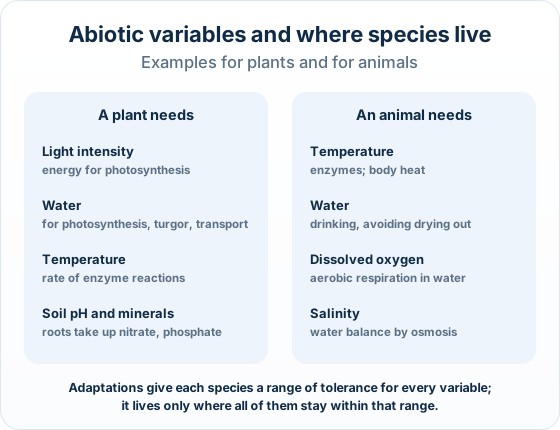
The big idea: Plants and animals are limited by different sets of abiotic variables, but the rule is the same: a species lives only where every variable is within its range of tolerance.
The points to remember
- Plants: light intensity, water, temperature, soil pH and mineral ions (nitrate, phosphate).
- Animals: temperature, water, dissolved oxygen (in water) and salinity.
- Some act on both: temperature, water, pH, salinity and oxygen.
- A species' adaptations decide how wide its range of tolerance is for each variable.
Remember it as: Name the variable, then how it acts on the organism.
Real example: brown trout. Brown trout need cool water rich in dissolved oxygen, so they live in fast, shaded upland streams and disappear from rivers that become warm and low in oxygen.
Trap: Asked for a factor that affects both plants and animals, do not give light: animals do not need it to survive. Temperature, water, oxygen or salinity all work.
How this is tested: These questions almost always sit on a data figure — a distribution graph, a transect or a table. The marks come in pairs: a factor, then its reason.
The two question types
- A 2-mark Describe question gives you one factor (say water depth) and asks for two more abiotic factors that could affect the distribution — each with a reason.
- A Suggest question asks you to propose an abiotic factor that could explain a measured difference (for example why soil moisture is higher in winter than summer).
Factor, then reason: Name the factor, then give the reason for its effect. A bare list of factors with no reasons scores half marks.
Exam-style question — two abiotic factors, with reasons
A study of seaweed on a rocky shore shows that one species lives only in the shallowest water. Besides water depth, describe two abiotic factors that could affect where this seaweed is found. Give a reason for each. [4]
How to score all four marks
- Factor 1 — light intensity. Light intensity is lower in deeper water. Seaweed needs light for photosynthesis, so it can only live where enough light reaches it — keeping it in the shallows.
- Factor 2 — exposure / drying out (or temperature). Higher up the shore the seaweed is exposed to air for longer at low tide and can dry out (dehydrate), so it cannot survive too high up.
- Pair each factor with its reason. Notice every factor is followed by a 'because…': light → needed for photosynthesis; exposure → causes drying out.
Final answer
Light intensity (lower in deep water; needed for photosynthesis, so it stays shallow) and exposure to air / drying out (higher up the shore it is exposed at low tide and dehydrates).
Why this scores full marks: Each of the two factors is named and linked to a clear biological reason — that is what makes four scoring points.
The most common way to lose marks here is to list factors without reasons (e.g. just 'light and temperature'), which scores only the naming marks.
| Part of the answer | What to write | Worked example |
|---|---|---|
| The factor | Name ONE specific abiotic factor | Light intensity |
| The link (reason) | Say HOW that factor affects the organism | Light is needed for photosynthesis, |
| The effect on distribution | Say WHERE it can or cannot live as a result | so the plant only grows where it is not heavily shaded |
Another question in the papers' style:
State one abiotic factor that affects the distribution of both plants and animals in a freshwater lake.
Model answer plan
See the answer broken into clear points, with guidance on how each point earns marks.